
Publications · 20 February 2014
What Can “Singles” Teach Us?
 This review was prepared as part of the joint “Book Review” project of the Political Sphere Institute and the Centre for European Studies in Minsk.
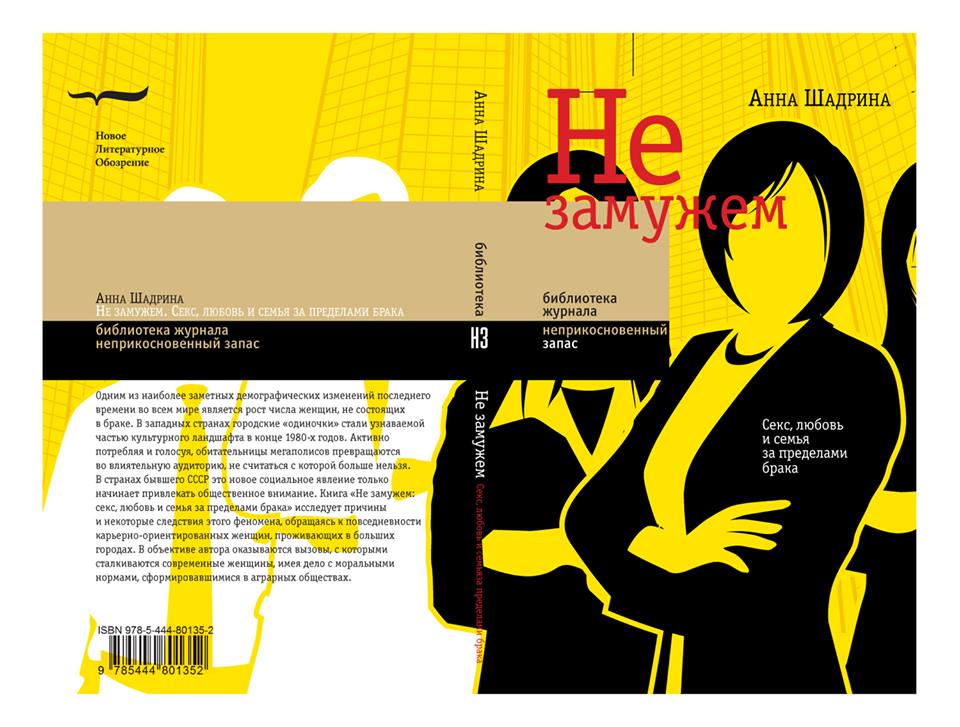
Shadrina, A. Not Married: Sex, Love, and Family beyond Marriage. – Moscow: New Literary Observer, 2014. – 240 pp.
Review prepared by Alena Talapila.
In 2014, Hanna Shadrina’s book Not Married: Sex, Love, and Family beyond Marriage was published.
The relevance of this topic is explained by the fact that “one of the most significant demographic changes of recent times around the world is the growing number of people who are not married” (p. 9). This new social phenomenon was noticed and began to be studied in America in the late 1980s. The author notes that, at the same time, in the countries of the former USSR the growing number of people living outside marriage has not only not been studied as a social phenomenon, but has not even been formulated as a research problem (p. 10). Nevertheless, according to the 2009 census, one third of Belarusian men and half of Belarusian women today live outside marriage (p. 10).
“Singles” as a new social phenomenon
In her book, Hanna Shadrina examines the causes and some consequences of this new reality (p. 10) and considers the challenges faced by our contemporaries. To do so, in 2005–2013 the author conducted interviews with women living in large post-Soviet cities who were not involved in romantic relationships. Hanna Shadrina repeatedly explains why the book was written: “I intended to draw attention to a new social reality in which … there will be more and more ‘singles’” (p. 15); “the aim of my inquiries was to find out what ‘singles’ think about their ‘singleness’, how they organize their lives beyond marriage” (p. 26); “I wrote this book in order to bring together scattered information about the challenges faced by my contemporaries living outside the traditional family. I hoped that I would be able to do this in such a way that readers could find points of application for my research in their everyday lives” (p. 209).
The author names Western studies of the transformation of intimacy as her theoretical framework, including the ideas of Anthony Giddens and others. Among the methods, she mentions autoethnography, effectively the description of her own experience, and interviews, the form of which is not specified.
The book consists of seven chapters, which the author divides in the preface into two parts. The first part discusses the global causes behind the emergence of diverse ways of organizing private life and compares the specific features of these processes in the Western world and in the post-Soviet space. The second considers the individual conditions that influence the choice of a life scenario.
The first chapter, titled “What Determines the Form of the ‘Primary Unit’?”, seeks answers to the question of what family is today. The second chapter (“Who Are Singles and ‘Singles’?”) examines how new unmarried women appeared in “mass consciousness”, what becomes the occasion for speaking about “female singleness”, how it is discussed in the West, and why this topic sounds different in Russian (p. 64). The third chapter (“Why Do People Have Sex?”) focuses on the history of sexuality and, among other things, tries to answer the question “whether sex is a special topic in the lives of ‘singles’” (p. 13). The fourth chapter (“Why Does Love Hurt?”) problematizes the phenomenon of romantic love and its main symbol, the monogamous ideal.
The fifth chapter (“What about the ‘Maternal Instinct’?”) seeks answers to the question: which version of reproductive behavior is today accepted as the norm, and why? The sixth chapter (“Where Can Loneliness Be Found?”) considers what loneliness is, why we fear it, and why it is necessary. The seventh chapter (“Can One Rewrite a Personal Story?”) is devoted to the way a personal story is created and to the narrative approach in therapy.
A book for representatives of the “conditional ‘middle class’” in Belarus and Russia?
Hanna Shadrina “wanted to interest a broad readership in the questions raised … since the latest social transformations in one way or another affect all social groups and spheres of life” (pp. 14–15). Who, in fact, might be interested in this book? Of course, academics and researchers interested in the topic of transformations in the post-Soviet space should be mentioned. But first of all, it seems to me, the book will interest those whose stories form the basis of the narrative: unmarried women of the conditional “middle class” (p. 23) and “middle age”, who will be able to recognize themselves in the heroines of the study. Nevertheless, women of other ages and social classes, and with other relationship statuses, may find parallels with the author’s inquiries, whose starting point was the question “what is wrong with me?” (p. 16), when individual strategies run counter to the expectations of society and one’s immediate circle. The author emphasizes: “The concept of a ‘single woman’ may include a young participant in the marriage market, an elderly widow, or a mature contemporary woman who is divorced or not interested in romantic relationships” (p. 22). It should be noted, however, that the search for new life strategies is not the prerogative of women; it is a topic relevant to many of our contemporaries.
Despite her aspiration to reach a broad audience, Hanna Shadrina realizes that “problematizing ‘singleness’ still requires a certain courage. Writing a book about unmarried women, largely based on autoethnographic material, just like attending thematic seminars, means making a kind of coming-out” (p. 170). She emphasizes that her aim is not to “promote loneliness” or to claim that one way of life is better than another (p. 169).
Not Married: Sex, Love, and Family beyond Marriage was published in Russia in the series “Library of the journal Neprikosnovennyi Zapas”, in which, according to the publishers, “the latest achievements in all fields of the social sciences are presented” http://www.nlobooks.ru/books/Bibliotyeka-zhoornala-Nyeprikosnovyenniy-zapas. The journal Neprikosnovennyi Zapas http://magazines.russ.ru/nz/ positions itself as “a journal of debates, information, and observations on politics, culture, economics, and society”. The journal’s task is “to make intellectual debates accessible to our reader, the educated non-specialist, without lowering the level of discussion”.
In terms of form, the author relies on real stories, cites journalistic articles, films, and discussions on social networks that relate to the topic of marital and reproductive choice; she connects and summarizes information from various sources, seeking to find interrelations between the general and the private (p. 12).
Hanna Shadrina conducted interviews with a number of women of the “conditional ‘middle class’” who were not involved in romantic relationships. The author admits: “My book turns to the experience of unmarried women because I myself belong to the group under study” (p. 16); “I was sincerely concerned about whether ‘singleness’ was my individual choice or part of certain broader processes” (p. 20). Turning to the experience of women of the conditional “middle class”, the author explains this choice by the sample available to her, since in 2005 Hanna Shadrina began interviewing friends and acquaintances using the “snowball” method (p. 23): “I intend to speak about urban women more or less of my generation, who grew up and live in the same economic and cultural conditions” (p. 24). The selection criteria were as follows: life in a metropolis, higher education, a successful professional history, and experience of organizing private life outside romantic partnership for at least several years (p. 23). These voices of contemporaries, as well as the author’s own voice, since she uses the method of autoethnography, were for me the most engaging part of the book. They are heard in every chapter of the work.
Which questions still await continuation?
Hanna Shadrina manages to maintain a tone in her book that allows us to follow the story of her intellectual search: the development of her interest in the topic of “singles”, and the way specific aspects moved to the foreground; we read about seminars that raised interesting questions, and about texts that prompted the author to think, for instance, about the topic of reproductive choice. Overall, the style of presentation is light and dynamic, in keeping with NZ’s promise to make intellectual debates accessible to the reader. Nevertheless, there were fragments where, in order to achieve this aim, the topic could have been developed further (for example, the gender contract of the working mother on p. 48 or Foucault’s dispositif of power on p. 102), or the necessity of dwelling on certain aspects could have been reconsidered altogether, or their relevance clarified by relating them to the “voices of contemporaries”, to the stories of particular women (for example, Lacan’s psychoanalysis on pp. 135–137).
It is also appealing that Hanna Shadrina is not afraid to reflect on her own stereotypes. She admits: “I began writing about ‘singles’ assuming that the women I interviewed were heterosexual ‘by default’. But in the course of the research it emerged that not all my informants defined themselves as such” (pp. 25–26).
It should be added that the bibliography alone is worth holding the book in one’s hands. Hanna Shadrina emphasizes that, in the post-Soviet space, the growing number of people living outside marriage has not been studied as a social phenomenon. It is therefore all the more important that the bibliography brings together books and articles that make it possible to set a context for such research. The list includes far more than Western academics alone. The author emphasizes: “The experience of career-successful American contemporaries and their peers from post-Soviet countries is similar in some respects, but is lived in fundamentally different conditions” (p. 21). For this reason, the bibliography includes a number of studies conducted in the post-Soviet space, including works by Belarusian authors.
The topic that especially attracted my attention in this book is “singles” in retirement (Chapter 6, “Where Can Loneliness Be Found?”). Fewer than ten pages are devoted to it, but I see considerable research potential here, especially given the aging of the population in Belarus. “Already today it is clear that answers must be sought to the question of how post-Soviet states intend to interact with the growing number of ‘singles’ among elderly people, so that, by studying the experience of aging outside the traditional family in different countries, they can create conditions that will help prevent social isolation and need”, Hanna Shadrina writes (p. 26). What seems especially important to me is that the author does not limit herself to the economic aspects of retirement life, but stresses the importance of autonomy and the realization of one’s values for people of any age.
I think Not Married would only have benefited if the author had clarified the form of her work in the introduction. Did Hanna Shadrina’s ambitions lie in the academic sphere? Is this a work of science journalism? Or even a self-help book intended to substantiate women’s right to alternative life strategies?
Another ambiguous point is the combination, in the study, of large cities in Belarus and Russia. The author justifies this by her geographic situation (she lives in Belarus and visits Moscow) and by her circle of contacts. In addition, Hanna Shadrina writes, “Russian media continue to occupy most of the information field in Belarus, which makes it possible to present the commonality of post-Soviet processes more broadly” (p. 24). Can we consider women residents of large cities in Belarus and Russia as one group? In Belarus, do large cities mean only Minsk? When citing statements by her informants, Hanna Shadrina does not indicate which city or country they come from. Does this mean that there is no difference between them related to geography and culture? Or is there a difference, but it is not significant for this book? Do the processes in Saint Petersburg and Homel coincide in principle? Perhaps these are questions for a separate study.
In this connection, the question posed by the author in the conclusion appears problematic: “Will ‘singles’ in the Russian-speaking world acquire a collective identity?” (p. 209). The language factor did not figure among the criteria for selecting informants. Or was it nevertheless implied?
In conclusion, I would like to note that the author’s critical stance is problematic for me because of Hanna Shadrina’s former affiliation with the newspaper SB – Belarus Segodnya, whose founder is the Presidential Administration. At the beginning of the introduction to the book, the author describes SB simply as a “large daily newspaper” (p. 16), omitting the nuance that subscription to this publication is mandatory in all state institutions and even in some private organizations. This raises the question of whether the author’s critical lenses operate only from a gender perspective.
Nevertheless, Hanna Shadrina’s book offers an overview of Western studies devoted to the transformation of intimacy, the history of the family, and the woman question, as well as statistical data from Russia and Belarus; it is based on unique interviews and provides ground for further discussion of the changes experienced by women and society as a whole. I think it is more productive to view this book as a space for posing questions and as a stimulus for discussion – and this is its value.