
Publications · 22 January 2016
Unbroken in Their Faith: A New Book on Resistance to the Liquidation of the Uniate Church
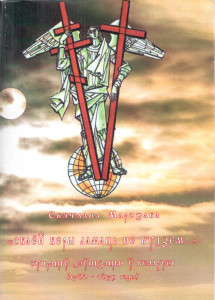
Marozava, S. V. (2014). “We Will Not Break Our Faith…”: Resistance to De-Uniatization in Belarus (1780-1839). Hrodna: YurSaPrynt, 218 pp.
Review prepared by Father Andrei Krot
The monograph by Doctor of Historical Sciences and Professor Sviatlana Valiantsinauna Marozava, “We Will Not Break Our Faith…”: Resistance to De-Uniatization in Belarus (1780-1839), was published by the Hrodna publishing house YurSaPrynt in 2014. The book is devoted to one of the most tragic pages in the confessional history of our country: the liquidation of the Uniate Church in the late eighteenth and first half of the nineteenth centuries. The author studies this event from a completely new angle: she shows the reaction of the lower clergy and Uniate believers to the incorporation of their Church into Orthodoxy.
Professor Marozava is a well-known specialist in the history of the Uniate Church. In many of her talks and publications she has raised the problem of resistance to de-Uniatization in Belarus, and these articles partly became the material for the researcher’s new monograph. The book consists of four chapters.
In the introduction, S. V. Marozava provides general information on the condition of the Uniate Church on the eve of Belarus’s incorporation into the Russian Empire, as well as on the policy of the Russian authorities toward the Union. The researcher highly assesses the significance of the Uniate Church: “The attempt at a real unification of the Christian Church undertaken by our ancestors is the most important contribution of the Belarusian people to the treasury of world civilization” (p. 5). S. Marozava gives data on the number of Uniate eparchies, parishes, priests, and believers on the eve of the partitions of the Polish-Lithuanian Commonwealth and notes that this was a very influential force, one that the Russian authorities could not ignore after the annexation of Belarus.
The attitude of the authorities of the Russian Empire toward the Uniate Church had been marked by hostility since the war of 1654-1667. “For Russian politicians, the Uniate Church, which connected millions of souls with Rome and Western culture, was from the very beginning an unpleasant and even hateful matter,” the researcher writes (p. 7). She identifies two paths toward the liquidation of the Union: from above, through the conversion of the higher clergy to Orthodoxy, and from below, through the Orthodoxization of the peasantry. S. Marozava writes that the second path was characteristic of the reign of the Russian Empress Catherine II, who at the end of the eighteenth century launched a campaign to liquidate the Uniate Church, which, however, ended in failure. The path “from above” was used by Emperor Nicholas I, and it led to the complete liquidation of the Union in 1839.
In the first chapter of the monograph, S. V. Marozava examines the historiography and sources of the process of de-Uniatization in Belarus in the late eighteenth and early nineteenth centuries. The author briefly presents the main periods in the study of the problem. The first period was that of the Russian Empire, whose authorities tried to present the liquidation of the Union to the world as the voluntary aspiration of the people; therefore official Russian historiography directed all its efforts toward proving the justice and legality of this step. “Historiography also imposed on society the idea of a universal, painless, and voluntary renunciation by the Uniates of their faith,” the researcher writes (p. 17). At the same time, she notes that the authors of fundamental studies of the liquidation of the Union, such as M. Maroshkin, M. Kaialovich, P. Babrouski, and others, saw both sides of this event. As for Soviet historiography, it adopted the official position of the authorities of the Russian Empire.
Belarusian historiography contains two approaches to the abolition of the Union. The first, identical to the Russian one, dominated from the 1930s to the 1980s and still exists today. The second, which views the liquidation of the Uniate Church as one of the techniques of colonization and Russification of the annexed territories, first appears in the works of the historian M. M. Nikolski and finds support among Belarusian historians in the 1920s. “Contemporary researchers recognize that the liquidation of the Uniate Church was not painless for the Belarusian people and their culture, and they pay attention not only to government policy but also to the attitude of believers toward the dismantling of their Church,” the researcher writes (p. 23).
The author also describes the archival sources that formed the basis for the monograph. These are documents of secular and ecclesiastical institutions preserved in the archives of Minsk, Hrodna, Moscow, St. Petersburg, and Vilnius. S. Marozava characterizes them as “a body of sources identified by the author in the 2000s in archives and manuscript departments of libraries in Belarus and neighboring countries with which Belarus in the past shared common state borders” (p. 26). Many of these sources, the researcher notes, are being introduced into scholarly circulation for the first time.
The second chapter of the monograph is devoted by S. V. Marozava to the “conversion” of Belarusian Uniates to Orthodoxy in 1780-1802. The researcher distinguishes several waves in this process. The first, in 1780-1783, was relatively mild: the tsarist authorities avoided open violence because they feared frightening the empire’s new subjects. Nevertheless, through the efforts of the Orthodox bishop of Mahilioŭ, Georgii Konisskii, and with the connivance of the authorities, 433 churches were torn away from the Union.
The second wave of the liquidation of the Union took place in 1794-1796. Parishes in which the majority declared themselves in favor of it transferred to Orthodoxy. Such a majority was achieved by various means; for example, the Mahilioŭ governor Charemisiynau conducted his “missionary work” accompanied by a detachment of gunners and a cannon.
The Orthodox “mission” encountered broad resistance in Belarusian society. S. V. Marozava cites facts of the rejection of Orthodoxy in specific parishes and lists cases of violence where the “mission” succeeded: in the Sebezh and Liucyn counties, in Liubavichy in Mahilioŭ Governorate, in Dzісna, and in Sviacilavichy in Rahačoŭ county. The researcher notes that with the death of Empress Catherine II, a mass process began in Belarus in which the newly converted “Orthodox” returned to the Union. S. V. Marozava also describes cases of Uniates converting to Roman Catholicism and notes that the Uniate Church had to defend itself “on two fronts”: against the Orthodox and against Roman Catholics, who took advantage of its temporary weakness and enticed believers to join them.
The third chapter of the monograph is titled “1833-summer 1838: The Confessional Recasting of Belarus.” After the uprising of 1830-1831, a new wave of persecution of the Uniate Church began in accordance with the will of Emperor Nicholas I. “The sudden, one-time overturning of the Uniates under Catherine II was replaced by a long-term, carefully prepared solution of the ‘Uniate question’ designed to last several years,” S. Marozava writes (p. 78). The researcher provides numerous facts of the forced conversion of Belarusian Uniates to Orthodoxy. She also describes forms of resistance, from the writing of petitions to armed struggle (one subsection, for example, is titled “Haradok: With Stakes for the Faith”). The geography of resistance is striking: Azaryčy in Pinsk county, Ciechanovičy in Klimavičy county, Sienno and Polack counties, and so on. The residents of Vileika offered significant resistance.
The facts cited by the researcher show that coercion in the liquidation of the Uniate Church was used throughout Belarus, and everywhere it provoked an anti-reunification movement. S. Marozava gives interesting information on the social profile of the resistance: Uniatism was defended not only by peasants and clergy, but also by the Roman Catholic nobility, who supported the protesting Uniates in every possible way and refused support both to the incoming Orthodox clergy and to their fellow countrymen who had betrayed the Union.
In order to bring the rite of the Uniate Church closer to the Orthodox rite, in 1834-1838 a so-called “purification of the rite” took place: icons painted not according to Orthodox canons were removed from Uniate churches, books printed in Vilnius and Supraśl were replaced with Moscow editions, altars were rebuilt, and organs were thrown out. All these changes provoked another wave of protests by believers. “A widespread form of defending one’s faith under those conditions was group and individual protest,” S. Marozava writes. The main group of protesters in this period were Uniate priests. Yet even this nonviolent resistance provoked a wave of repression. As an example of a priest faithful to his convictions, the researcher cites Father Adam Plaŭski, a priest from Liubča in the Navahrudak deanery, who was the first to set an example of refusing service books printed in Moscow.
The next stage in the liquidation of the Union considered by the researcher was the collection of signatures from the clergy expressing a desire to join Orthodoxy if that were the will of the emperor. S. Marozava describes priests’ resistance to this campaign: the protest of fifteen priests of the Białystok district, the persecution of Basilian monks in the town of Lyskava, and the martyr’s path of three priests, R. Mickievič, I. Andruškievič, and I. Saltanoŭski. The researcher pays special attention to the 1838 trip to Belarus and Ukraine by V. Skripitsyn, an official for special assignments under the Ober-Procurator of the Synod. His mission, as S. Marozava notes, accelerated the liquidation of the Uniate Church.
The final, third chapter of S. V. Marozava’s monograph is devoted to the events of autumn 1838-spring 1839. Among them were mass protests by clergy who wished to preserve the Union (111 priests signed a petition in the Polack region and 15 in the Białystok region), the deportation of the most active priests deep into Russia, and the activity of the state Secret Committee, which prepared and carried out the incorporation of the Uniate Church into the Orthodox Church. The researcher emphasizes that the act of “reunification” was kept secret from believers and ordinary clergy for several more months: the church and secular authorities were waiting for troops to arrive in Belarus in order to prevent possible rebellions.
At the end, S. V. Marozava summarizes the results of the study. “We stand in solidarity with those researchers who regard the liquidation of the Uniate Church as a shameful page in Russian confessional policy,” the author writes (p. 198). She notes that the “reunification” policy of the Russian authorities provoked a strong anti-reunification movement in Belarus: “To the dismantling of the Church, the people responded with devotion to their pastors, rite, and traditions” (p. 199). The researcher also writes that the tsarist authorities’ struggle against the Union did not end in 1839; for many decades afterward, priests and ordinary believers preserved their loyalty to the officially banned Church. “Nostalgia for the Union and for the sacred culture lost together with it persisted in Belarus until the beginning of the twentieth century,” S. Marozava notes.
It should be emphasized that today S. V. Marozava’s work is unique: no scholar has previously studied the scale of resistance to the destruction of the Uniate Church on the territory of Belarus. The researcher introduces a whole series of previously unknown facts into scholarly circulation and challenges the thesis of the “voluntary” reunification of the Uniates and the absence of resistance to the liquidation of the Uniate Church.
At the same time, attention should be drawn to some shortcomings of the work. These are above all errors in religious vocabulary. For example, S. V. Marozava uses the word “spavedniki,” which is a calque from Russian; in Belarusian religious terminology the word “verniki” is used for believers. In Belarusian, a “spavednik” means a priest who hears confession. The word “paviartać,” which the researcher uses to describe the process of changing one’s confession, would be better replaced by “naviartać.” Most striking is the author’s regular use of the word “pop” to refer to the Uniate clergy. In Belarusian this word has long acquired a mocking and negative connotation, so it should have been replaced with the neutral “sviatar,” meaning priest.
The greatest shortcoming of the monograph, however, is its print run: 100 copies, which is certainly insufficient for such an interesting and valuable historical work. One can only hope for its swift republication and await a new print run.