
Publications · 30 June 2011
Ukrainian-Belarusian Relations: An Attempt at Comprehensive Analysis
Warning: Undefined array key "file" in /home/u475055259/domains/palityka.org/public_html/wp-includes/media.php on line 1788
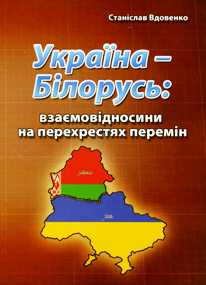 Vdovenko, S. M. (2010). Ukraine-Belarus: Relations at a Crossroads of Change. Chernihiv. 448 pp.
The review was prepared by Dzianis Melyantsou, a staff member of the Political Sphere Institute and senior analyst at the Belarusian Institute for Strategic Studies.
_______________________________________________________________________________________
The book under review is perhaps the first attempt at a comprehensive examination and description of Ukrainian-Belarusian relations after the collapse of the Soviet Union and the emergence of the independent states of Ukraine and Belarus. The publication was recommended for print by the Academic Council of the Chernihiv State Institute of Economics and Management, where Stanislav Udavenko has been a professor since 2010.
Structurally, the book consists of five chapters, of which only the last is devoted specifically to Ukrainian-Belarusian relations. Within that fifth chapter, political relations receive only 15 pages of text. In other words, of the book’s 448 pages on Ukrainian-Belarusian relations, only 15 pages discuss political relations between the two countries.
The first chapter of the book gives a detailed account of the socio-political order in Belarus. The author offers a historical excursus, stating that “the line of the Belarusian ethnos proceeds from the Indo-Iranians, Scythians, Veneti and Litvins” (p. 12). Udavenko presents a Belarus-centred version of history, recognises the Grand Duchy of Lithuania as a Belarusian state and calls the language of the Grand Duchy’s diplomatic documents Old Belarusian.
The second chapter, entitled “The Socio-Economic Doctrine: the Belarusian Specificity”, examines Belarus’s economic development after independence. The structure of this chapter resembles that of the previous one and consists of various economic data, figures and almost complete quotations from the “Main Directions of the Socio-Economic Development of the Republic of Belarus” for different periods.
As in the two previous chapters, in the third chapter we encounter a great deal of varied information, often, unfortunately, combined without any obvious logic or internal structure. It also provides reference information on Belarus’s relations with international organisations and countries of the world. This information is taken almost entirely from the website of the Belarusian Ministry of Foreign Affairs and is not critically interpreted.
The fourth chapter is devoted entirely to the Ukrainian diaspora in Belarus. This part of the book is much better developed than the previous chapters, contains many charts and tables, and includes an impressive list of sources. It appears that this chapter is a revised version of materials from the author’s monograph “The Foreign Ukrainian Community in the National State-Building Process: Identification, Organisation, Relations”, although modesty apparently prevents the author from referring to it.
Finally, on page 341 of the book we arrive at Ukrainian-Belarusian bilateral relations themselves. The author provides a detailed chronology of bilateral relations and spends more than two pages listing the legal and regulatory basis of relations between the two countries. In the subsection on political relations, Udavenko describes high-level and top-level visits, interparliamentary contacts, and examines in detail the Ukrainian side’s resolutions and official statements concerning Belarus, as well as statements by the Belarusian president regarding Ukraine.
After reading the book, one is left with a persistent feeling of incompleteness, as if the author had saved everything most important and interesting for a future publication. From such a work one expects, above all, an analysis of issues truly important for bilateral relations: the questions of state debt and the border, alternative oil supplies, regional integration projects, relations with Ukraine in the context of Russian-Belarusian relations, Ukrainian mediation in Belarus’s relations with the West, and so on. But there is virtually none of this in the book. It turns out that the author, like a true diplomat, tried to avoid the most problematic and controversial issues in bilateral relations and to give his book a politically neutral character. In this form, however, the book only loses.
In addition to the shortcomings mentioned above, the book clearly shows a bias toward humanitarian topics, which are apparently much closer to the author than politics or economics. This is not surprising: Udavenko worked for many years as a cultural adviser at the Ukrainian embassy in Minsk. Thus, in the book, the issues of the border and state debt are successfully replaced by the Year of Taras Shevchenko and the development of information systems.
What, then, is the value of Stanislav Udavenko’s book? In my view, it lies in the fact that this is the first thorough overview of Belarusian-Ukrainian relations in many spheres, collected under one cover by a single author. It seems that Udavenko did not manage to fulfil all the tasks he set out in the introduction, but he did succeed in presenting Ukrainian readers with an impartial and comprehensive overview of the history, political system and economic order of a neighbouring country with which Ukraine has much in common. Udavenko’s book may be of interest as a reference work for a foreign reader interested in Belarus and its foreign policy, while a systematic analysis of bilateral relations still awaits its time.