
Publications · 13 May 2015
The Year 1812: A Time of Trials and Hopes
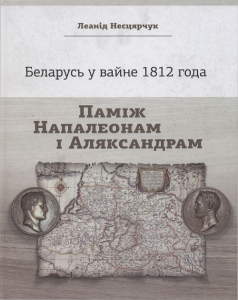 Nestsiarchuk, L. M. (2012). Belarus in the War of 1812. Between Napoleon and Alexander. Brest: Paligrafika LLC, 320 pp.
Review prepared by historian Viachaslau Shved.
The anniversary year gave readers more than one book devoted to the tragic and unforgettable year 1812. These books described regional and all-Belarusian events, recalled heroes, and opened new and little-known pages of Belarusian participation in the war on the side of both the Russians and Napoleon’s troops. Yet the book under review differs from all these publications in its systematic and comprehensive character and in its serious source and historiographical base: the bibliography contains 1,336 items in different languages, including 50 archival items from Russia, France, Poland, and Ukraine. The book is also distinguished by high-quality printing and numerous illustrations either found or produced by the author in the archives and museums of these countries.
Leanid Mikhailavich Nestsiarchuk came to this book gradually, over the course of his entire life (pp. 282–284). He was born in the village of Kharki in the Pruzhany region, where on 31 July 1812 a battle took place between Tormasov’s 3rd Western Army and Napoleon’s Austro-Saxon corps. This birthplace probably influenced the fact that Leanid Mikhailavich became a Candidate of Historical Sciences, defending a dissertation on “The Combat Operations of the 3rd Western Russian Army in the Patriotic War of 1812 on the Territory of Belarus.” In 1995 I had the opportunity to read it as a potential opponent. I liked the dissertation because the author focused precisely on the actions of the Russian army that actually fought on the territory of Belarus and whose actions are more significant and important for our history than those of the 1st and 2nd Western Armies.
Since 1995, the historian Nestsiarchuk has undergone a certain evolution in his views on the problems of the War of 1812: for example, from the “Patriotic War” to the “War of 1812” and the “Franco-Russian War” (pp. 12–13, 21, 22, 28). Over almost twenty years Leanid Mikhailavich managed to collect a great deal of interesting material, which enabled him to write a good and relevant book, both academically and politically, covering all the plots and problems connected with the topic of the War of 1812. At the same time, I would refrain from overly laudatory judgments that present it as a “new word” in the study of this war, as non-specialists sometimes do. I would advise readers to look at the monograph The Western Region of Belarus during the Napoleonic Wars, 1805–1815 (Shved, Danskikh, 2006), which the author himself cites in the bibliography (p. 293).
Compared with that book, the new topics in L. M. Nestsiarchuk’s work are those that usually did not enter serious scholarly studies by Belarusian historians: Kościuszko and Napoleon Bonaparte, Kościuszko and Alexander I, biographical essays on Alexander I and Napoleon I, events on the territory of eastern Belarus, and the commemoration of Belarusian battlefields of 1812. The book also contains a rather extensive introduction, in which the author offers a systematic review of literature, separately identifying the “analysis of Belarusian-language historiography” (pp. 27–28), and of sources, dividing them into archival materials, published sources, memoirs, the nineteenth-century press, and cartographic materials.
The reviewed book contains 58 subsections, which in my view is unjustifiably many, since most of them consist of only one or two pages. Sometimes their content is a fairly brief and not very deep text on a particular plot. Taken together, however, they form a multi-plot book that is interesting to read. It is rather a popular-scientific book, as the publisher states on the final page, than a scholarly monograph.
What, then, does L. M. Nestsiarchuk discuss in the eight chapters of his book? The first ten subsections, placed in the chapter “Poland and Belarus before the War of 1812,” are devoted to Poland and Belarus in the plans of Napoleon and Alexander I. The so-called “Polish card,” which also concerned Belarus, was being played. The author arrives at the correct conclusion: “This war began for Napoleon not as a ‘Russian war,’ but as a ‘second Polish war’ — a repetition of 1807” (p. 77).
For a historian such as Nestsiarchuk, errors like the following are difficult to forgive: that one of the slogans of the Polish legions was “For our freedom and yours!” (p. 46), and that Tilsit is now the city of Sovetsk near Kaliningrad (p. 60). The slogan in question emerged during the uprising of 1830–1831 (Shved, 2001), while Tilsit is today the city of Sovetsk in Russia’s Kaliningrad region (Encyclopedia of the History…, 2001: 548).
The second chapter, “Belarus as a Bridgehead in the Future War” (subsections 11–14), describes Russia’s preparation for war on Belarusian lands and the military plan developed for Napoleon by General Michał Sokolnicki, in which much attention was given to the territory of Belarus. Interesting biographical facts from Napoleon’s personal and public life are presented in the third chapter, “The Known and Unknown Napoleon” (subsections 15–20). The fourth chapter, “Belarus in the Campaign of 1812,” includes, among other things, biographical materials on Alexander I: his duplicity, early liberal attitudes, unwillingness to restore the Grand Duchy of Lithuania, connections with Freemasons, legends about his death, and plans in 1810 for an attack on France.
In subsection 23, which deals with evacuation plans and actions, for some reason there is no information about the Grodno Governorate, although this material can be found in the literature listed by the author. There is an unfortunate typo in the caption to the illustration on p. 143, where it says “secret meeting of francs-masons…,” whereas the correct term is “Freemasons” (Encyclopedia of the History…, 1999: 91). It should be noted separately that L. M. Nestsiarchuk includes materials on Vilnius in his study, and rightly so, since for centuries it was a historical, cultural, and political centre for Belarusians (Litvins).
The next, fifth chapter, “The Organisation and Activities of the Authorities of the Proclaimed Grand Duchy of Lithuania” (subsections 29–43), is apparently the largest in the book. It describes quite fully the organisation of power and its activities in the western and eastern parts of Belarus: the structures of the Grand Duchy of Lithuania, the Napoleonic military administration, and the governing bodies of White Ruthenia. In addition, there are sections on the patriotism of Vilnius youth, the struggle against robbery and riots, the oath of the Mahiliou archbishop Varlaam to Napoleon, and Belarusian Jews in 1812. The picture is somewhat spoiled by mistakes in surnames: Tadeusz Andrzejkowicz somehow becomes Andraikovich, Ludwik Pancerzyński becomes Pantsazhynski, and Joseph Barbanègre becomes Varbanègre. It would also have been desirable to find more material on the activity of the Napoleonic governing bodies created on Belarusian lands and on the fate of the last army of the Grand Duchy of Lithuania.
Chapter 6, “The Main Battles of 1812 on the Territory of Belarus” (subsections 44–48), presents the military operations in stages: “from the Nieman to Vitebsk,” “from Grodno to Saltanovka,” “the Brest region in the fire of 1812,” “from Druia through Polotsk to Smoliantsy,” and “from Brest through Minsk to the Berezina.” The military history is set out soundly and creates an objective picture. It is not clear why the material on the Babruisk fortress ended up in the chapter on the Brest region; it would have been better to write a separate chapter on the role of the fortress in the War of 1812 and to recall its construction on the eve of the war.
The chapter “Postwar Belarus” (subsections 49–52) is devoted to the return of Russian power to Belarus, the losses suffered by its inhabitants, and Kościuszko’s efforts to revive the Grand Duchy of Lithuania. The author draws attention to interesting points: the temporary preservation by the Russians of the administrative structures of the Grand Duchy of Lithuania on Belarusian lands (p. 240) and attitudes toward Napoleonic prisoners of war (p. 241). It is unclear why L. M. Nestsiarchuk writes in subsection 49 about Napoleon’s flight through Belarus; this plot logically concludes the previous chapter on military events. It would also have been worth mentioning the Belarusian route by which Napoleon fled, the attempt on his life, and the legend of Napoleon’s carriage.
The final chapter, “The Commemoration of Belarusian Battlefields of 1812” (subsections 53–56), logically closes the book about the war through the commemoration of its battle sites and heroes. Since L. M. Nestsiarchuk himself has worked on the memorialisation of monuments in the Brest region, he writes about this process across Belarus with great competence. The whole section is well written, but personally I particularly liked subsection 55, which discusses Belarusian battlefields of 1812 on the plaques of the Cathedral of Christ the Saviour, and subsection 56, which deals with the reflection of the War of 1812 in literature and the visual arts.
Thus we have another objective popular-scientific publication about the War of 1812 in Belarus, a talented synthesis of the scholarly work of Nestsiarchuk’s Belarusian predecessors: Andrei Lukashevich, Aliaksandr Yerashevich, Uladzimir Liakin, Viachaslau Shved and Siarhei Danskikh, Kanstantsin Tarasau, Siarhei Taliaronak, and Andrei Blinets. Despite my remarks, I advise readers to read the book under review. I am sure that L. M. Nestsiarchuk will accept them as a serious researcher, because he understands that one can criticise those who work, write, and submit their works to the judgment of readers and colleagues.
Literature mentioned in the review
- Shved V., Danskikh S. (2006). The Western Region of Belarus during the Napoleonic Wars, 1805–1815. Grodno: Yanka Kupala State University of Grodno.
- Shved V. V. (2001). Between Poland and Russia: Socio-Political Life on the Lands of Belarus (1772–1863). Grodno: Yanka Kupala State University of Grodno.
- Encyclopedia of the History of Belarus (1999). Vol. 5. Minsk: BelEn named after P. Brouka.
- Encyclopedia of the History of Belarus (2001). Vol. 6, Book I. Minsk: BelEn named after P. Brouka.