
Publications · 9 June 2011
The Theory and Methodology of a Single Department
Warning: Undefined array key "file" in /home/u475055259/domains/palityka.org/public_html/wp-includes/media.php on line 1788
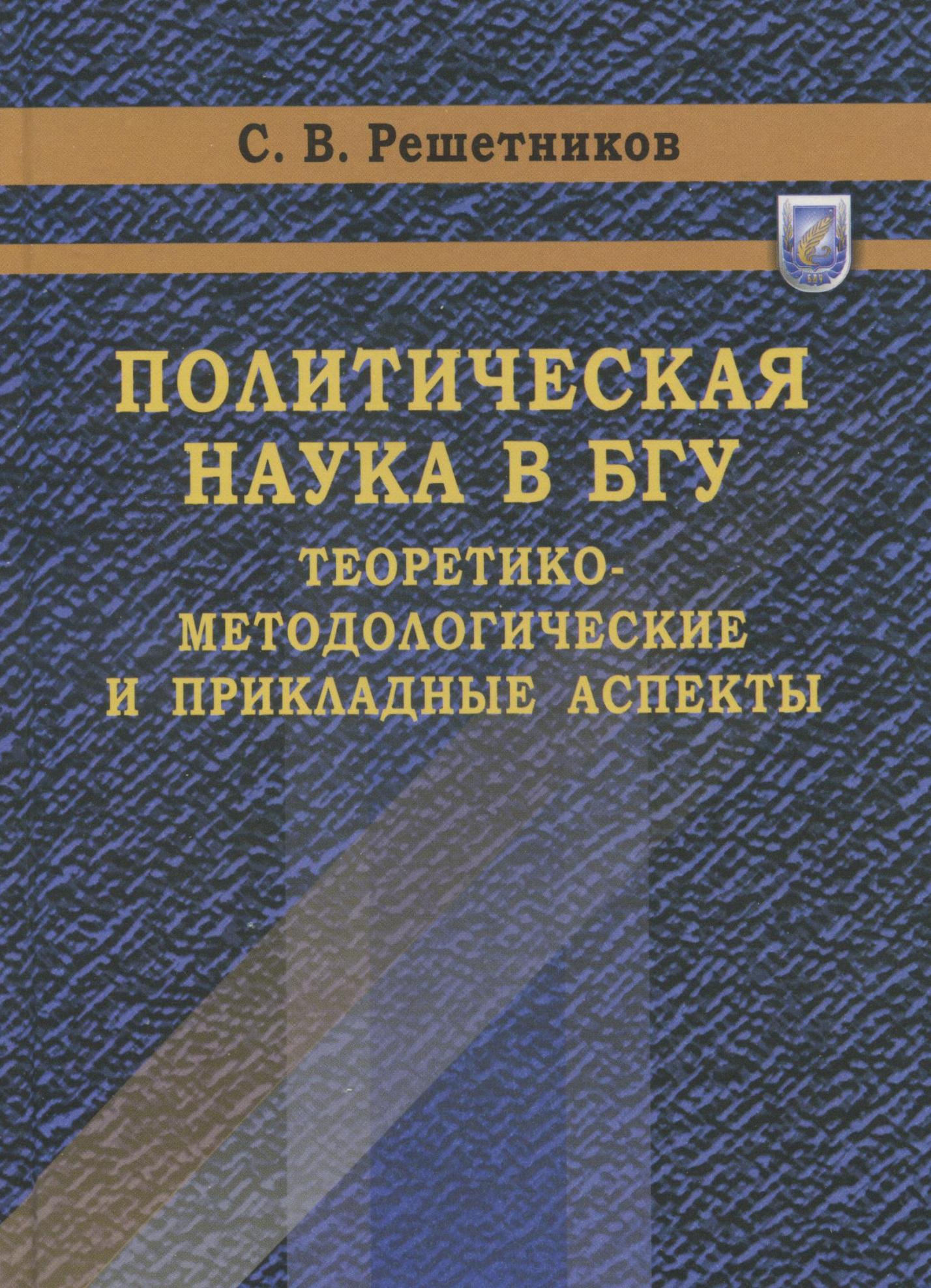 Reshetnikov, S.V. (2009). Political Science at BSU: Theoretical, Methodological, and Applied Aspects. Minsk: BSU. 175 pp.
The review was prepared by political scientist and doctoral student at the University of Warsaw Viktar Kavaliou.
_______________________________________________________________________________________
The monograph reveals the essence and content of the current stage in the development of political science in the Republic of Belarus as an academic and research discipline. It is addressed to specialists in political science, master’s students, postgraduate students, and doctoral students of higher education institutions.
In terms of its design, the publication looks scholarly, as confirmed by the corresponding note on the final page and by the presence of two reviewers: Doctor of Philosophical Sciences Lev Kryshtapovich and Doctor of Historical Sciences Aleh Bukhovets. Yet it would be difficult to formulate an abstract that reflected the content even less. The book clearly does not reveal “the current stage in the development of political science in the Republic of Belarus,” since in principle it is devoted to something else. In character, the publication is rather presentational and may be of interest mainly to department staff and graduates, not to specialists in political science or practicing politicians (p. 4).
There is practically no authorial text in it, apart from a short introduction, and most of the space is taken up by documents of very different kinds and purposes.
The book contains an entire collection of methodological materials: a description of the qualification profile of the “political scientist-lawyer,” course syllabi, and even a ten-page list of topics for term papers and diploma projects (pp. 56-66). All this specific information makes up the first chapter of the book. The second chapter opens with two interviews by the compiler/author, head of the BSU Department of Political Science Siarhei Reshetnikov: one with the newspaper Zviazda (1997) and another with the periodical Problems of Management (2002).
Then follow more methodological materials, as well as documents on scholarly activity and the dissertation defense council. The book concludes with short biographical notes on representatives of Belarus’s political science community and a list of graduates of the BSU Department of Political Science from 1997 to 2007.
The publication leaves a very strange impression. On the one hand, the book contains material on the basis of which one can analyze the development of political science in Belarus, or more precisely, one of its segments. On the other hand, the documents included are heterogeneous, often not very informative and bureaucratic, while the publication of a number of materials is puzzling.
If the information included adequately reflects the work of the department, then one gets the impression, fully confirmed by a close analysis of the texts, that the department functions steadily only as a methodological and educational institution. This is unfortunate, because in the 1990s great academic hopes were placed on the department and on the community that was emerging around it.
The first thing that catches the eye is that the logic of the book completely excludes international relations, the corresponding faculty and departments, as well as other forms of studying or teaching politics, from the field of “political science at BSU.” Political science at BSU is equated with the Department of Political Science; at times one even gets the impression that the BSU Department of Political Science, political science at BSU, and political science in Belarus are one and the same thing.
In this connection, the way the book defines the notion of a “political science community” deserves special attention (pp. 4, 148-170). Who is included in it, and on what grounds? First, the publication includes all doctors of political science who defended their dissertations at BSU, regardless of their place of work. The list even includes Viacheslav Ageev from Kaliningrad State Technical University (Russia), for whom Belarus is merely the place where he defended his dissertation.
In addition to doctors of science, all department lecturers are included in the “community,” from professors to assistants, regardless of whether they hold a degree, have publications, or possess work experience. The doctors and lecturers are supplemented by four more individuals. This is where the composition of the Belarusian political science community ends. Most scholars who work in the discipline of political science are simply not mentioned. This applies fully to both state and, even more so, non-state educational and research institutions.
The presentation of scholarly activity in the publication also looks very strange; at least no significant and visible results of such work are demonstrated, and this in an institution that claims the status of a “school” and the main center of political science in Belarus.
The state of research activity can be assessed on the basis of the “Questionnaire of the Scholarly School in the Field of Political Science” (such a school is said to have formed at the BSU Department of Political Science). The document is dated 29 November 2006. The main research areas are formulated as follows: socio-political aspects of political research, methods and techniques of political research, and comparative studies of political systems (p. 115). But it seems that, for the most part, this range remains declarative.
For example (pp. 120-121), over five years of the school’s work (2001-2006), 10 monographs, 10 textbooks and teaching aids, 24 methodological manuals, and 4 curricula were published. Thus, strictly scholarly output amounts to ten monographs, while the school’s membership is forty people. If one looks at the list of main publications, it leaves an even stranger impression. The list includes not ten but nine items, two of which were written by the Russian author Viacheslav Ageev, while two were written in 1996. Thus, in 2001-2006, forty scholars of the school published only five monographs. These figures, if they are true, are simply disconcerting.
No less problematic is the item concerning the organization of scholarly conferences (pp. 123-124). It lists two conferences in Hrodna, one in Yekaterinburg, and one in Moscow. Not a single conference in Minsk on the basis of the department; not one in five years.
The academic recognition of the school is linked exclusively to educational activity. The book names only a prize for developing the abilities of talented youth (Siarhei Reshetnikov in 2002) and two prizes for preparing winners of the Republican Competition of Student Works (Alena Hrechneva and Tatsiana Salavei in 2006).
The level of the “school’s” presence on the scholarly boards of academic journals, if the published information is to be believed, is also quite low. Of all forty representatives of the school, only two, Siarhei Reshetnikov and Leanid Zemliakou, sit on scholarly boards. Three representatives of the school sit on dissertation defense councils.
The publication notes that 90% of the department’s research is fundamental in character. But what kind of research this is remains unclear. Does everything end with writing textbooks and compiling curricula? It is quite difficult to answer this question; the documents presented in the book do not allow one to do so.
The exception is a grant application to the Belarusian Republican Foundation for Fundamental Research from 1998, included in the book. Does this mean that from 1998 until the publication of the book the department did not have a single significant research project?
An attentive researcher must treat any text as a source of knowledge. The book under review is clearly a presentational publication, despite the “scholarly” task set in the introduction. Nevertheless, the content of these documents is quite revealing.
First, it may demonstrate the high degree of isolation of the department from political science beyond its own boundaries, with the possible exception of the Academy of Public Administration. At the same time, the idea of the department’s uniqueness, central position, and leading role runs systematically throughout the publication.
Second, the publication shows the department’s almost exclusive focus on the teaching process. Unfortunately, we were unable to trace any significant scholarly activity, at least for a collective of this size, or to identify a research profile.
Perhaps this is because the publication is incomplete and does not contain additional essential information, and some of the information included is already outdated. But in this review we proceed only from the text, which provides no grounds for a positive interpretation and provokes corresponding reflections on the state of official political science in Belarus.
For the full version of the review, see Viktar Kavaliou. The Theory and Methodology of a Single Department // Political Sphere No. 15, pp. 198-204