
Publications · 20 June 2011
The Slipperiness of Analysing Belarusian Mentality
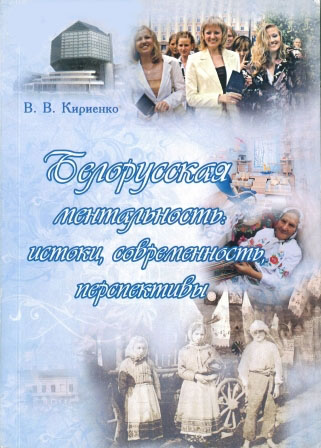 Kirienko V. V. (2009) Belarusian Mentality: Origins, Present, Prospects. Homiel: P. O. Sukhoi GSTU.
The review was prepared by political scientist Kiril Ihnatsik.
______________________________________________________________________________________
The book by Viktar Kirienko, Doctor of Sociological Sciences and vice-rector for educational work at the Sukhoi Homiel State Technical University, sets out to answer complex questions about the nature of Belarusian mentality, mentalité, and even ethnogenesis. From a practical point of view, it also claims to identify the vectors of Belarus’s social, cultural, and geopolitical orientation. The book lays claim to the interest of a broad range of specialists in the social sciences and humanities, namely philosophers, political scientists, sociologists, economists, historians, and “all those interested in the history of the formation of the Belarusian ethnos and the Belarusian nation, as well as the material and spiritual culture and mentality of Belarusians”.
The annotation to the book states that, in connection with Belarus’s acquisition of state sovereignty, society has developed a need to comprehend national distinctiveness. The author attempts to respond to this “need of the time”, in between performing his direct duties of ideological and informational work, to the extent allowed by his historical and sociological knowledge. The author’s central thesis, namely that awareness of national distinctiveness becomes necessary only after the acquisition of independence, and not the other way around, leaves a strong imprint on the reviewed text.
From a methodological point of view, Kirienko positions himself as a supporter of the Annales school, or, as it is also defined, the new French historical school. That school reconsidered historical processes in a new way in the context of the mid-twentieth century, seeking to create a “total” history and to describe all existing social connections: economic, political, social, and cultural. At the same time, the author of the reviewed book presents himself as one of the best researchers of mentality in the CIS who uses sociological methods, although it cannot be said that he does so very successfully.
At the centre of the study lies an ideologeme that the author proves throughout the book: the specific feature of the formation of the Belarusian nation consists in its location at the centre of Europe, at the junction of West and East, in the unique interaction of different cultures and peoples: Great Russians, Little Russians, Poles, as well as Balts, Jews, and even Roma. At the same time, the author in no way shows that such a situation of cultural interpenetration is characteristic of the absolute majority of European ethnic groups.
The sociological element of the book consists of the results of surveys conducted in Belarus, Ukraine, and Russia in order to reveal how Belarusians, Ukrainians, and Russians relate to themselves, to various public institutions, to private property, and how they perceive “foreign” peoples: Germans, Lithuanians, Americans, and so on. Analysing the results of the study, the author concludes that the Eastern Slavs are close to one another and that Germans and especially Americans, who formed their statehood in civil wars, are “alien” to Belarusians, who formed theirs in wars against external enemies.
Moreover, speaking of the development of the Belarusian ethnos in such states as Kyivan Rus, the Grand Duchy of Lithuania, the Polish-Lithuanian Commonwealth, the Russian Empire, and even the USSR, the author argues that in all these contexts Belarusians were not only not oppressed, but, on the contrary, developed successfully, found protection and opportunities for self-realization, and absorbed “the great achievements of the material and spiritual cultures of their stronger Slavic neighbours”.
The book also offers a rather peculiar definition of mentality. According to Kirienko, it is a powerful, largely unconscious, emotionally charged “peculiar call of the ancestors”, passed down from generation to generation (p. 7). More developed formulations of mentality are then given, along with rather questionable factors in its formation.
The idea running throughout the book is that all mental properties indicate the separateness of Belarusians from the Western world. As a result, our compatriots, by their nature, cannot adopt Western forms of governance. The state order of the Eastern Slavs, including Belarusians, is linked to autocracy, which helped them overcome contradictions, unite for creative activity, and consolidate themselves in opposition to alien, hostile external forces.
Kirienko decisively and consistently opposes the establishment of Western forms of the organization of power in Belarus, since even the natural landscape, population structure, and other factors compel Belarusians in real practice to be guided by the clear understanding that freedoms of the Western type cannot be given to them. As an argument, the author notes that in Belarusian family upbringing a “obedient boy” is a positive character, whereas in the West such a child is associated with mental deficiencies. Continuing the theme, he expresses the view that the landscape features of Belarusian nature are the reason why contemplation, rather than transformation, is characteristic of Belarusians.
Relying on surveys of Belarusians, Ukrainians, and Russians in districts bordering the Homiel region, the author finds confirmation of his hypothesis: the mental characteristics of Belarusians, Ukrainians, and Russians are almost identical and filled with very “specific sociocultural content”. In reflections on this content, the theses about the mitigation of alien Western influence through Poland and alien Eastern influence through Russia appear very revealing. As a result, Belarusians absorbed Eastern influence in an adapted Great Russian cultural form, and Western influence through the Polish cultural context.
Although Kirienko partly uses references to Abdziralovich, Karski, Dounar-Zapolski, and even quotes from the poems of Kupala and Kolas, his conclusions are largely based on the works of Russian representatives of “Russocentrism” and Eurasianism: Semenov, Sergeev, Stefanenko, Pantin, and Kara-Murza. At the same time, the author makes very little use of contemporary Belarusian studies, as well as Belarusian historical sources proper. The text contains no overview of studies by Polish, Lithuanian, or other European authors, although from the outset Kirienko claims to offer a broad understanding of the history of the formation of Belarusian mentality under the influence not only of Eastern Slavs but also of other peoples.
The author constantly tries to prove the distinctiveness of Belarusian mentality on the basis of an all-Slavic and all-Russian context, uses terms such as Great Russians and Little Russians, and directs his efforts toward proving that individualism and democracy are not characteristic of Belarusians and that they require strong paternalistic guardianship from the state. This confused concept of Belarusian mentality fully corresponds to contemporary state policy, which seeks to sustain the nation’s identity by relying on strong authority rather than on the broad layer of Belarusian cultural and historical heritage. In effect, Kirienko’s book is devoted to searching for the origins of Belarusian mentality on the basis of elusive “Slavic roots”, landscape, geographical location, and deep spiritual and moral approaches. It is difficult to regard it as a scholarly study, but in its ideological positions it fully corresponds to the demands of contemporary Belarusian policy and may serve as a useful supplement to textbooks on state ideology.