
Publications · 1 September 2011
The National Situation in Belarus at the Turn of Totalitarian Times
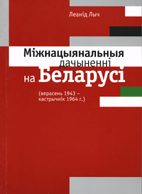 Lych, Leanid (2009). Interethnic Relations in Belarus (September 1943 – October 1964). Minsk: “Galiafy”
The review was prepared by political scientist and researcher at the Political Sphere Institute Ales Shamiakin.
_______________________________________________________________________________________
The book is devoted to the rather complex topic of interethnic relations in the context of radical social and political transformations, namely the end of the German occupation of Belarus, the collapse of the Stalinist system, and the beginning of the Khrushchev “thaw”.
In the first chapter, which deals with national life during the war, the author addresses the general aspects of the socio-economic situation in Belarus during the liberation from German occupation. He continues the theme of socio-economic development in the next two chapters as well, following the chronology of the periods under consideration.
The author raises the highly relevant question of population losses during the German occupation. Various figures are given for losses among separate categories, but the reader’s expectation of a clear calculation of total losses is not fulfilled. In fact, the author does not bring these figures together or offer a general conclusion: did Belarus lose every third person, every fourth person, or every sixth person? (It seems that the last figure is closest to reality.) Only in passing does the author mention losses among the civilian population caused by the actions of the People’s Commissariat for Internal Affairs (NKVD) after the expulsion of German troops (p. 22).
In the text of the book, Mr. Lych raises the highly debatable question of the tragedy of the Belarusian national intelligentsia, which had been destroyed before the war and which was forced to cooperate with the Germans “in order somehow to defend, often at the risk of their own lives, the interests of the Belarusian people itself” (p. 28). On the eve of the Soviet army’s advance, Belarusian patriots were forced to move westward, saving themselves from destruction by the Bolsheviks. The author describes this situation through the fates of Yakub Kolas’s younger brother Mikhal Mitskevich (literary pseudonym Antos Halina), Masei Siadniou, Yaukhim Kipiel, and other sons of Belarus. Here the author also speaks not only about the tragedy of the Belarusian intelligentsia, but about the tragedy of the entire Belarusian nation, which during the “Great Patriotic War” was in essence waging a civil war: “the blood shed by its people as a result of a fratricidal war was perceived, and will always be perceived, as a great tragedy in our history” (p. 30).
The second chapter considers such topics as interethnic processes, social and interethnic conflicts in the western regions of Belarus, as well as education, science, and religion within the system of interethnic relations. The author rightly notes that by the end of the war the central state and party bodies of the USSR had no doubts that life in Belarus would certainly not be built on a national basis (p. 74). This is also evidenced by the fact that the Centre, on its own initiative, sent party cadres of non-Belarusian origin to Belarus. Such external leadership did not consider it necessary to support local culture, as shown by the data on the negligible number of Belarusian schools.
Mr. Lych also does not avoid the painful territorial question for Belarus: the detached lands of the Vilnius and Białystok regions, where their own national dramas unfolded unnoticed by the Soviet leadership: “at first the people of the Białystok region were turned, in their own home, into the object of terrible abuse and torture by various political and military forces of Poland that were fighting for the seizure of power… In the course of such raids, many villages burned down and much Belarusian blood was shed” (pp. 81–82). The book provides data on the results of the plundering activity of former Home Army members in the western regions of the BSSR, where more than 200 civilians were killed in only a few districts (p. 98). Migration waves, both into Belarus and out of Belarus, also had an ambiguous character in interethnic processes.
National-patriotic organisations of Belarusian youth are considered separately. These include, in particular, the Slonim underground organisation “Chaika”; the Navahrudak “Union for the Liberation of Belarus”, which together with student conspiratorial groups from Baranavichy and Brest formed the Centre of the Belarusian Liberation Movement; the “Union of Belarusian Patriots”; and others.
The author describes how inhumanely and brutally Soviet power dealt with young Belarusian patriots. For example, Aliaksandra Umpirovich was sentenced to 25 years in prison for drawing the “Pahonia” coat of arms (p. 94). No one can remain indifferent to the fate of the Belarusian poet Siarhei Novik-Peiun, who was first held in Polish prisons, nearly perished during the German occupation, and under the Soviets was sentenced to the hardest punishment of his life (p. 96). Characterising the situation in the western regions of the BSSR, the author notes that “by the beginning of the 1950s the troops of the Ministry of Internal Affairs of the BSSR had still not managed to turn the western lands of Belarus into a peaceful region” (p. 96).
In the second chapter, Mr. Lych also examines the process of Sovietising Belarusian history and imposing a non-Belarusian historical vision; he describes the process of Russification in various spheres of social life and the neglect of the Belarusian language.
The third chapter is devoted to changes in national policy and attempts to formulate new approaches to its implementation after Stalin’s death. Here the author focuses on the significance of political changes at the highest level in Moscow for the Belarusian cause. Stalin’s death and Beria’s temporary rise influenced a certain reassessment of approaches to the Belarusian national question, when an attempt was made to change the top leadership in the BSSR. Criticism of the anti-Belarusian policy of the party bureaucracy of the time was used for these purposes. However, the attempt to replace the Russian Nikolai Patolichev with the Belarusian Mikhail Zimianin, sent from Moscow and speaking about the need for Belarusisation, failed, including because new changes again took place at the highest political level, and also because the idea of Belarusisation encountered strong opposition in the BSSR.
The author continues to examine how processes of assimilation in the sphere of culture took place and what they led to: serious losses in the national spiritual potential of Belarusians, to a degree not found among any other nation of the Soviet state.
Analysing the character of interethnic relations in Belarus, the author comes to the conclusion that “the factual material reflects the great complexity and contradictory nature of interethnic processes in Belarus, which resulted from the implementation of the CPSU’s national policy, whose main direction it saw in the consistent rapprochement and merging of Soviet nations and nationalities” (p. 263).
The book also touches on the question of the Belarusian diaspora, both in countries neighbouring Belarus and in the West. The author identifies the main tendencies in the development of the Belarusian population that continued to live on its own land but, as a result of decisions by the Soviet leadership, found itself outside the borders of Belarus. Unfortunately, the main tendency was the gradual assimilation of Belarusians. As the author rightly notes, not the least role in this assimilation was played by the “degradation of national culture in the Belarusian SSR itself” (p. 265). The author also turns to Belarusian diasporas in the West, describing general aspects of their life, above all activity in the fields of culture and literature.
Leanid Lych’s book is undoubtedly an interesting work that deserves close attention. The author demonstrates a strong command of the material and successfully highlights the most important aspects of Belarus’s national development during a rather difficult period of our history.