
Publications · 25 May 2017
The Deserved Return of BIGiK
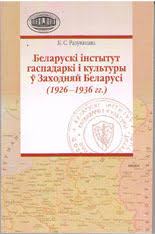 The Deserved Return of BIGiK
Razuvanova Kseniya Sergeyevna. The Belarusian Institute of Economy and Culture in Western Belarus (1926-1936). Minsk: Belaruskaya Navuka. 2013. 247 pp.
Review prepared by Andrei Vashkevich
K. Razuvanova’s monograph grew out of her Candidate of Sciences dissertation and consists of three chapters. Like all dissertations, the book begins with a first chapter devoted to the historiography and sources of the study. The second chapter accounts for more than 50% of the book’s main text and consists of six subsections. The titles of the subsections indicate a structural approach to research that is rather unusual for post-Soviet Belarusian historiography, in this case to the history of the Belarusian Institute of Economy and Culture: “Historical Conditions of Establishment and Activity”; “Chronological Framework of Activity, Organisational Structure and Sources of Funding”; “Participation in the Cooperative Movement and Economic Life”; “Work to Expand Education and Enlightenment among Belarusians; Publishing Activity”; “Work to Develop Belarusian Theatrical and Musical Art”.
The first section, more than 25 pages of text, is entirely devoted to describing the socio-economic situation in Western Belarus. Here one can find information about workers’ wages, the work of secret agents of the Polish police, and agrarian reform. What is now, for some unknown reason, required when writing Candidate of Sciences dissertations in Belarus (as if reviewers did not know encyclopaedic facts about the interwar period) could quite safely have been removed from the monograph. The only information that could meaningfully be linked to BIGiK’s activities is the data on the size of the Belarusian population in Western Belarus. But here it would have been worth digging deeper by raising the issue of Belarusian Catholics, since it was largely in Catholic regions that circles of the Belarusian Institute of Economy and Culture were opened.
In the following five subsections of the second chapter, K. Razuvanova unfolds before the reader a broad panorama of BIGiK’s activities. Relying mainly on internal organisational documents and periodical materials, she shows how BIGiK developed in space and time from the moment of its founding in 1926 until its ban by the Polish authorities in 1936. From the monograph and its appendices it is now possible to learn, more or less precisely, how many institute circles existed in a given period and where they were located. It is clear that the institute’s 400-600 activists, united in several dozen circles, although they did not match the Society of the Belarusian School in membership, nevertheless set the tone of cultural life in their localities.
BIGiK sought to promote the development of the cooperative movement in Western Belarus. Following the example of the Ukrainians, for whom cooperation became an important financial and organisational support for their national liberation movement, BIGiK leaders, above all Adolf Klimovich, organised cooperative courses, published specialised journals and books, and gave lectures in villages. BIGiK’s publishing activity was closely connected with the promotion of cooperation. Using the publishing facilities of the Francysk Skaryna Printing House in Vilnius, which was owned by Belarusian Christian Democrats, the institute issued many Belarusian-language books of literary and popular-scientific content. K. Razuvanova rightly emphasises that perhaps the strongest Western Belarusian literary and public periodical in terms of content, the journal “Kalosse”, began precisely as a BIGiK periodical.
The author gives a detailed account of BIGiK members’ attempts to establish Belarusian schools. The section “Work to Expand Education and Enlightenment among Belarusians” clearly shows how difficult it was to found a Belarusian school in Western Belarus and how hard it was to help it survive. The “theatrical” section of the second chapter continues the research of E. Mazko, supplemented with new facts and conclusions. The author stresses the fact that theatre in the first half of the twentieth century played the role of a very important factor in awakening national consciousness, and that national theatre was an important manifestation of the modernisation of Belarusian society.
Everything K. Razuvanova says in this chapter confirms the conclusion she voices at the end of the monograph: “BIGiK, as an organisation of an economic and cultural-educational orientation, occupied an important place in the public life of Western Belarus and made a significant contribution to the cultural and educational development of the region”.
The third chapter of the monograph conditionally shifts the reader’s attention from internal aspects of BIGiK’s life to external ones. Its title is “BIGiK’s Relations with Political Parties, Public Organisations and State Institutions”. In the first two sections of the third chapter, the author focuses on BIGiK’s relations with the BCD itself, as well as with the Belarusian Peasant Union, the Belarusian National Committee in Vilnius, the Society of the Belarusian School, the Belarusian Cooperative Bank and other Belarusian (and not only Belarusian) political parties and urban organisations. It should be said that the structural principle of organising the material did not benefit this section, since it is impossible to reveal, in ten or fifteen pages, the full evolution of relations within the Belarusian national liberation movement in Western Belarus over a period of more than ten years.
As a result, the content of the subsections turned out to be somewhat static. For example, the reasons for the warming of the attitude of the Communist Party of Western Belarus and, accordingly, the Society of the Belarusian School toward the BCD and BIGiK in the mid-1930s are not shown; nor are there references to the attempts of Sejm deputies of the effectively pro-communist Belarusian Peasant-Workers’ Club “Zmahanne” to establish cultural cooperation with Belarusian Christian Democrats as early as the late 1920s. At the same time, it is necessary to note the large amount of work the author carried out in uncovering new and interesting facts about BIGiK’s history, for example the attempt to send a group of Belarusian youth to study in the United States, which, judging by everything, ended unsuccessfully.
The third subsection of the third chapter, devoted to the personal factor in BIGiK’s activities, can be called the weakest part of the book. The author concentrates on the biographies of well-known founders of the institute, such as Adam Stankevich, Vincent Hadleuski, Adolf Klimovich, Yanka Shutovich and Marian Petsyukevich. There is no attempt to analyse the social structure of BIGiK members, their gender composition, or to trace the fates of ordinary village activists in the organisation. Yet it seems that very interesting conclusions could have been drawn here. One interesting example is the family of the famous Belarusian communist poet Valyantsin Taulai, whose father Pavel Taulai headed the BIGiK circle in Rudauka, while his stepmother Stefania Taulai was a teacher at a private Belarusian school financed by the institute. Women made up 20-25% of BIGiK members and even headed circles, which was an important indication of the important role of women in the formation of the Belarusian national liberation movement.
The book ends with a selection of documents on BIGiK’s activities (statutory documents, programmes of lectures and courses organised by BIGiK, and others) and the most complete list of known BIGiK circles, compiled by the author of the monograph.
Let us focus on the book’s shortcomings, both obvious and, at first glance, less noticeable. The monograph contains a relatively small number of errors, which most likely appeared because of simple inattention. For example, the village of Shauliany, where BIGiK founded a private Belarusian school, is called Shauliai by the author (p. 70). Also, in the list of Polish-language publications (p. 124), only two out of seven are written correctly.
The absence of archival materials from Polish and Lithuanian archives in the list of sources and literature used is striking. Among Polish archives, only documents from the State Archive in Bialystok are mentioned, and these can be found online. Meanwhile, a great many materials on BIGiK’s activities can be found in several archives in Warsaw and also in Vilnius. In addition, it should be recalled that since around 2013 it has been possible to work through hundreds of new files in the State Archive of Lithuania concerning the Belarusian national liberation movement of the first half of the twentieth century. A new collection devoted to BIGiK has also appeared; its documents constitute the organisation’s internal documentation and organically complement Fond No. 880 of the National Archives of the Republic of Belarus in Minsk. However, for objective reasons the author could not have read the new materials, since the monograph under review was published in 2013.
The main criticism I would like to voice with regard to the author of the monograph is her obvious desire to separate BIGiK from the BCD and to emphasise in every possible way the independence of this cultural and educational organisation. It is difficult to say what caused this tendency: the author’s sincere belief in the thesis she defends, or simply a desire to raise the significance of the topic under study on the eve of the defence of her Candidate of Sciences dissertation. In the opinion of the author of this review, the fact that BIGiK was in practice (though not formally) the cultural and educational subdivision of Belarusian Christian Democracy in no way diminishes the value of BIGiK or its significance in the history of the Western Belarusian national liberation movement.
In any case, K. Razuvanova’s book is an important step forward in the study of the history of the Belarusian national liberation movement in Western Belarus. At last, those organisations and individuals who worked most for Belarus and its future are taking their rightful place in history. It would be very desirable for studies of this kind in Belarusian historiography to become more anthropological, with central attention paid to the role of the individual in creating such structures, since the participation of particular people in the activities of Belarusian organisations in that distant era was most often the result of a very serious internal national and civic evolution.
Literature mentioned in the review
- Herasimau, Valery. (1990). “Khto tam, pad duba”, LiM, 1 June.
- Doktarau, Uladzimir. (1975). Pad hatychnymi sklyapennyami kastsёlau (The Policy of Catholicism in the BSSR). Minsk.
- Mazko, Eduard (2003). The Influence of Belarusian Christian Democracy on the Formation of the Cultural Situation in Western Belarus in the 1920s-1930s. Abstract of Candidate of Sciences dissertation. Hrodna.
- Sidarevich, Anatol (1992). “Father Adam Stankevich and His Cause: On the 100th Anniversary of His Birth”, Khrystsyyanskaya dumka, No. 1, 20-34.
- Tratsyak, Yanka (1993). The Role of Belarusian Priests in the Revival of National Culture, in: Culture in the Republic of Belarus: History, Current State and Prospects for Development: Abstracts of Papers of the Republican Scientific Conference, Minsk, 26 January 1993. Minsk.
- Moroz, Małgorzata. “Krynica” (2001). Ideołogia i przywódcy białoruskiego katolicyzmu. Białystok.
- Bergman, Aleksandra (1984). Sprawy białoruskie w II Rzeczypospolitej. Warszawa.