
Publications · 7 July 2011
The Belarusian Dictionary of Plagiarism
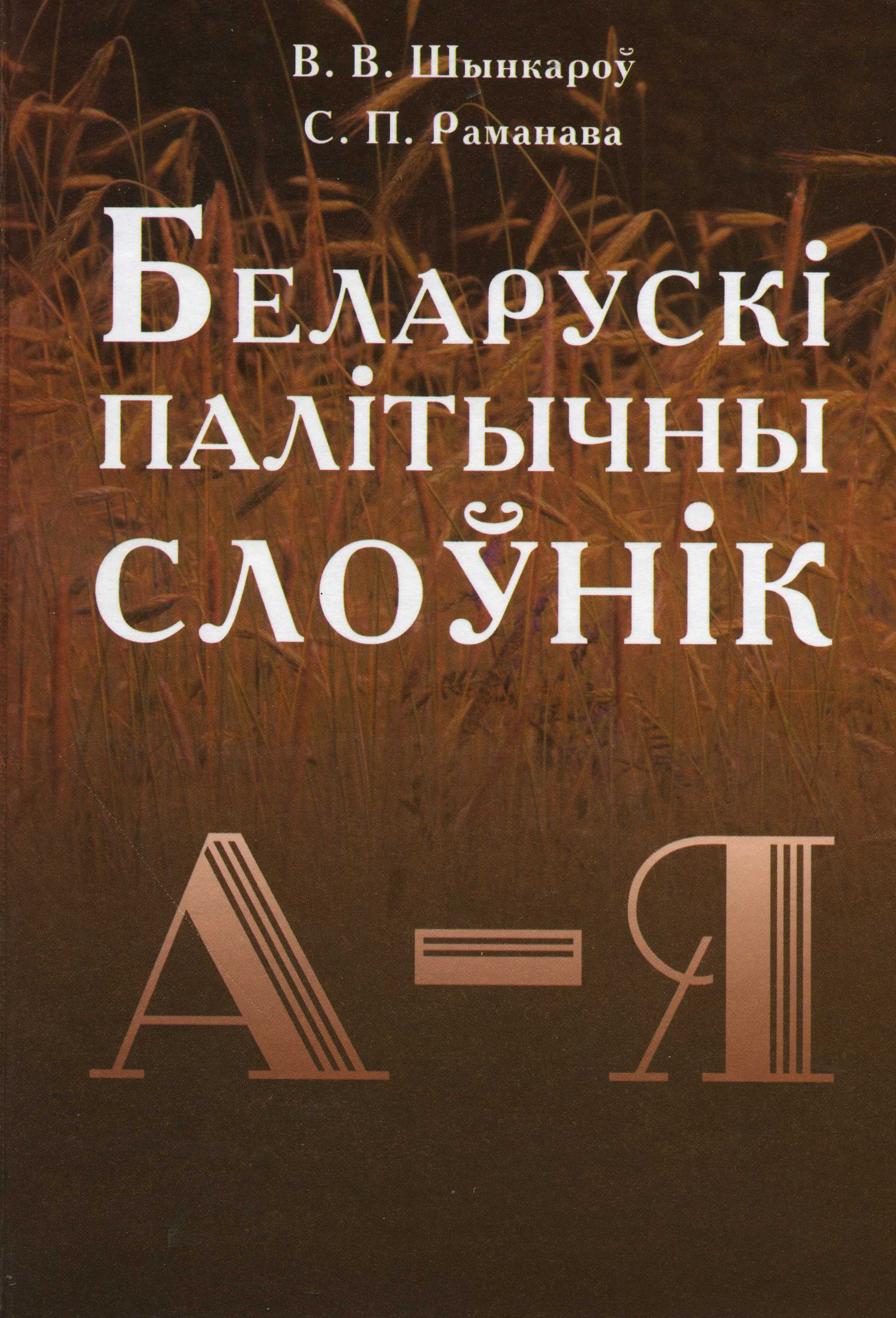 Shynkarou, V. V., Ramanava, S. P. (2011). Belarusian Political Dictionary. Minsk: Adukatsyia i vykhavanne. 576 p.
Review prepared by political scientist and director of the Political Sphere Institute Andrei Kazakevich.
______________________________________________________________________________________
Compiling a terminological dictionary is a difficult but quite important task. A successfully compiled dictionary not only systematizes knowledge in a particular field or discipline, but also makes it possible to stabilize terminology, clarify meanings, specify word usage, and carry out other work on meanings and interpretations.
In this respect, the publication of the Belarusian Political Dictionary by the publishing house “Adukatsyia i vykhavanne” attracts attention. To some extent, it is one of the first attempts at such a publication in the Belarusian language, which could be significant and useful, at least as an attempt, even if the authors did not manage to accomplish the task in full.
The dictionary was prepared for publication by Vasil Shynkarou, Doctor of Historical Sciences and professor at the Department of Political Science and Law of the Maxim Tank Belarusian State Pedagogical University, and Sviatlana Ramanava, Candidate of Sociological Sciences and associate professor at the Department of Economic Sociology of the Institute of Social and Humanitarian Education of the Belarusian State Economic University. The reviewers were rather well-known figures in the Belarusian academic establishment: Doctors of Political Sciences U. Melnik and L. Zemliakou, both at the same time prominent “ideologues of the Belarusian state”, as well as Candidate of Historical Sciences A. Kasovich.
Even a first acquaintance with the dictionary raised a considerable number of questions. These concern the selection of entries, the interpretation of individual terms, factual errors, and more. But some entries drew particular attention, mainly because of their unnatural formulations. This gave rise to certain doubts, which led me to check the dictionary for plagiarism.
Finding the corresponding phrases, translated into Russian, proved very easy. This review does not claim to provide precise figures, but it took only a couple of hours to identify several dozen stolen entries. And this does not include “borrowings” from normative acts and explanatory dictionaries. The publication contains not a single reference to primary sources, nor even any bibliographic note in the style of “the following sources were used in preparation…”.
In general, plagiarism is a fairly widespread phenomenon in the Belarusian academic community; many people do not even consider it a problem or something reprehensible. But this is not a matter of personal taste; it is a matter of the honor of the entire academic community, and therefore such cases require publicity.
The situation with the dictionary is made worse by the fact that at least a significant share of the definitions were “borrowed” from sources available on the internet. Moreover, such “borrowings” are very often random and unsuccessful: the sources used are not the best-quality publications, and they contain obscure formulations, errors, clichés, which only further intensify the confusion and the sense of the absurdity of the situation. This does not mean that the dictionary contains no authorial layer at all, but it is difficult to assess its share, and it seems to be small.
In principle, the presence of plagiarism in itself places the publication outside the bounds of normal scholarly and educational production. But the dictionary also has many other problems that make it unusable even for those who are mostly unconcerned with issues of ownership and professional conscience.
The dictionary is overloaded with various wholly unnecessary terms and definitions. Why, for example, include the entry “fire victim” – a person who has suffered as a result of a fire; in earlier times such people travelled around villages hoping to receive something for what had burned down (they were called firefighters) (p. 289). What heuristic value can there be in definitions such as: Principality: 1) a feudal state headed by a prince 2) the name of some contemporary states (p. 211). At the same time, there is no entry for “prince” in the dictionary.
The publication is full of “borrowings” from explanatory dictionaries; why this should be done in a specialized terminological publication remains a mystery. Sometimes terms from Belarusian, Russian, and Soviet normative acts are given. All this is done, as already noted, without any reference.
A large number of definitions can in fact mislead the reader. For example, “discourse” is defined as – “a communicative phenomenon, a type of mass communication oriented toward the discussion and substantiation of any significant aspects of action, thoughts, and statements by its participants” (p. 127). To put it mildly, this is a meaningless definition that will not help at all to understand how the term is used in contemporary social and human sciences.
“New Right”: “1) a movement of Western European intelligentsia for the revival of European culture. 2) an ideological movement based on a synthesis of the ideas of market individualism and social authoritarianism” (p. 281). This is completely inadequate.
The definition of “marketing” is taken from the Great Soviet Encyclopedia, which absolutely does not correspond to the contemporary meaning of this term.
The masterpiece here may be the definition of “tellurocracy” – “power by means of land” (p. 431). And that is the entire definition!!! How so? What is it about?
The definitions of “rentier state”, “traditionalism”, “supervision”, “ultra”, and so on are presented in a wholly inappropriate way; the list could seemingly be continued endlessly.
Here is another example of a gross semantic error. In the entry “economic rights” (measures of possible behavior), the definition of economic law (a set of norms) is given. In the entry “personal property”, the definition of private property is given. This kind of confusion can be observed throughout similar entries.
The definition of “state law” looks even more revealing. After a short formulation, there is a note: “in the literature of a number of foreign countries, the term ‘constitutional law’ is used” (!!!). This despite the fact that the term “constitutional law” has been used in Belarus for twenty years, while “state law” is a Soviet archaism.
Strange as it may seem, the authors also have problems with Belarusian history. For example, in the publication BNR is expanded as the Belarusian People’s Council (???), and let us leave aside the fact that it is defined as “a puppet pseudo-state formation proclaimed on 25 March 1918 by moderate Belarusian socialists under conditions of German occupation (p. 55). As is well known, what was proclaimed on 25 March was not the BNR, but its independence. These are gross errors, even though among the authors there is a doctor of sciences, and among the reviewers a candidate of historical sciences.
The ancient period looks no better. For example, one can learn about Vytautas that he was “Grand Duke of Lithuania, attacked the Principality of Moscow three times (1406-1408), captured Smolensk, one of the organizers of the defeat of the German knights at the Battle of Grunwald in 1410 (p. 78). And that is all. As a result, for the Belarusian reader Vytautas is supposed to be known for his wars with Russia and the Germans. Interestingly, in the entry on the Battle of Grunwald this “organizer of the defeat” is not mentioned at all.
The authors also have problems when translating other people’s entries from Russian into Belarusian. For example, the Russian “общность” is translated as “агульнасць” rather than “супольнасць” (see Tribe). One can find in the dictionary “civil society” rendered as “грамадзянскае грамадства” instead of “грамадзянская супольнасць”, and so on.
Dependence on the Russian “center” also shows in the fact that the transliteration into English of all Belarusian names and geographical names is given exclusively from Russian: M. Bahdanovich, naturally, becomes Bogdanovich. This rule of translating “from the normal language” even affected names with a stable tradition of Latin-script rendering. For example, Barshcheuski (Barszczewski) is given as Borshevskiy, and so on. Although against the background of everything else, this looks like a trifle.
There are many other “minor” factual and semantic errors in the dictionary.
Unfortunately, in summary, the Belarusian Political Dictionary can be strongly not recommended for use in the scholarly process, let alone in professional activity. The issue is not even the plagiarism with which this publication is densely filled, but also the numerous errors, meaningless definitions, and random interpretations that not only fail to help readers understand the main categories of political science, but can seriously confuse them.
_______________________________________________________________________________________
Five characteristic examples from different parts of the dictionary:
1) In the dictionary: Currency crisis – the aggravation of contradictions in the currency sphere, manifested in sharp fluctuations in exchange rates, payment imbalances, and movements of loan capital. A currency crisis is accompanied by increased state intervention in the form of devaluation and revaluation, the introduction of currency restrictions, and the implementation of general economic measures
Source: ВАЛЮТНЫЙ КРИЗИС – обострение противоречий в валютной сфере, проявляющееся в резких колебаниях валютных курсов, несбалансированности платежных балансов, перемещениях ссудного капитала. Валютный кризис сопровождается усилением государственного вмешательства в форме девальваций и ревальваций, введением валютных ограничений, проведением мероприятий общеэкономического характера. Большой Энциклопедический словарь. 2000.
2) In the dictionary: Political marginality – a social quality of the consciousness and behavior of a person, stratum, or subgroup; detachment from the original social substrate, the termination of social ties that determine the essence of the person and the group, as well as the fundamental impossibility of restoring such integrative ties. A marginal person is an intermediate, borderline person who senses their place in the world only when belonging to some pseudo-mass movement initiated by potestary bodies.
Source: Маргинальность Политическая
(от лат. margo – край) – термин, употребляемый для обозначения социального качества сознания и поведения личности, слоя, субгруппы. М. означает отрыв от первоначального социального субстрата, прекращение общественных связей, определяющих сущность личности и группы, а также принципиальную невозможность возобновления подобных интеграционных связей. Маргинальная личность – промежуточный, пограничный человек, который ощущает свое место в мире, лишь принадлежа к какому-либо псевдомассовому, инициированному потестарными органами, движению. Мир словарей
3) In the dictionary: Regionalism – an approach to considering and solving economic, political, and other problems from the point of view of the interests and needs of a particular region.
Source: РЕГИОНАЛИЗМ. подход к рассмотрению и решению экономических, социальных, политических и других проблем под углом зрения интересов потребителей того или иного региона. Райзберг Б.А., Лозовский Л.Ш., Стародубцева Е.Б.. Современный экономический словарь. — 2-е изд., испр. М.: ИНФРА-М, 1999. 479 с.. 1999.
4) In the dictionary: Regionalization – the development and strengthening of economic, political, and other ties between regions and states that belong to one region; the emergence of regional associations of states
Source: РЕГИОНАЛИЗАЦИЯ развитие, укрепление экономических, политических и иных связей между областями или государствами, входящими в один регион; возникновение региональных объединений государств. Райзберг Б.А., Лозовский Л.Ш., Стародубцева Е.Б.. Современный экономический словарь. — 2-е изд., испр. М.: ИНФРА-М, 1999. 479 с.. 1999.
5) In the dictionary: “Total war” – a concept for preparing and conducting an aggressive war using any means and methods of mass destruction of the armed force and civilian population of the opposing side. The concept of “total war” was first advanced by the German general E. Ludendorff in 1935 and formed the basis of fascist military doctrine.
Source: ТОТАЛЬНАЯ ВОЙНА. концепция подготовки и ведения агрессивной войны с применением любых средств и способов массового уничтожения вооруженных сил и мирного населения противника. Концепция «тотальной войны» впервые выдвинута немецким генералом Э. Людендорфом в 1935, легла в основу фашистской военной доктрины. Политическая наука: Словарь-справочник. сост. проф пол наук Санжаревский И.И.. 2010.