
Publications · 4 May 2015
The 4th International Conference of the Political Sphere Institute (15-16 May 2015, Minsk)
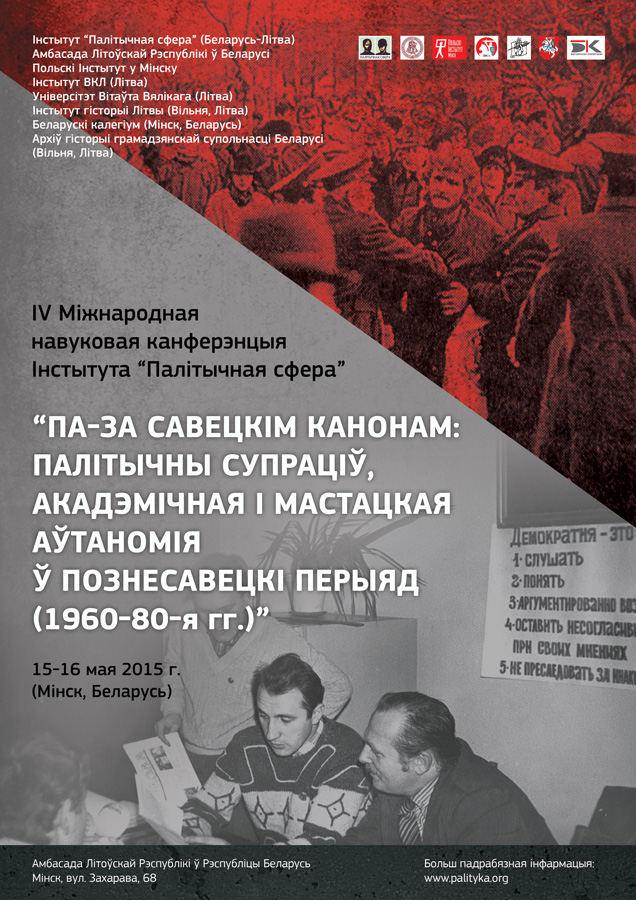
On 15-16 May 2015, the Fourth International Conference of the Political Sphere Institute will take place in Minsk under the title “Beyond the Soviet Canon: Political Resistance, Academic and Artistic Autonomy in the Late Soviet Period (1960s-1980s)”.
More than 40 specialists from Belarus and other countries of the region will take part in the conference, including Poland, Lithuania, Ukraine, Russia and Sweden.
Preliminary conference programme.
Programme of the conference (EN)
The conference will address aspects of social and intellectual life that existed outside the rigid canon of socialist society: dissident and nonconformist movements, attempts to defend scholarly and artistic autonomy, and efforts to defend national rights beyond the limits of permitted “ethnographic” expression.
A more complex picture of the Soviet past also prompts reflection on the nature of post-communist societies. To what extent are we still connected to the economic and political rules of the Soviet period? To what extent is there continuity in the structure of power? To what extent is the memory of resistance to the Soviet system preserved?
A representative of the organising committee, Aliaksei Lastouski, explains the aims of the conference: “We want to consider those aspects of social and cultural life that in Belarus are now largely outside the attention of researchers and the wider public. There is a need for a thoughtful and serious discussion about the essence of the communist project and its significance for our present situation. In this context, it is inevitable to turn to those ideas and movements that challenged or blurred the official canon of the communist period and ultimately contributed to the collapse of the seemingly unshakeable Soviet system.”
Belarusian historian Aleh Dziarnovich describes his own view of the conference’s subject: “The search for inner freedom under conditions of state pressure is a complex psychological and intellectual process. Can cultural codes transform moral costs into cultural capital? Such questions arise when studying resistance and autonomy in the late Soviet period.
The theme of our conference is the experience of secret spiritual life behind the outwardly monolithic façade of the Soviet order. Attempts to analyse this phenomenon generate methodological problems related to labelling such different phenomena as nonconformism, dissent and dissidence, as well as source-related problems of selection and criticism of sources”.
Two public discussions are planned as part of the conference: “Were there dissidents in Belarus?” (15 May, 18:30, Gallery Ў) and “Did the national-cultural movements of the 1980s influence the formation of independent Belarus?” (16 May, 14:00, Gallery Ў). Participation in the discussions is free.
It is also possible to attend the conference sections as a guest; for this, one must register on the website.
Registration closes two days before the conference begins.