
Publications · 1 June 2015
Stage, Censorship, and Intrigue: The First History of Theatrical Life in Grodno and the Grodno Region in 1784-1864
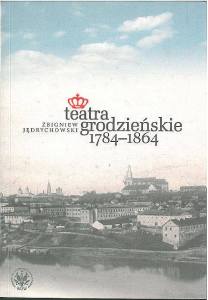 Jędrychowski, Zbigniew (2012). Teatra grodzieńskie 1784-1864. Warszawa: Wydawnictwa Uniwersytetu Warszawskiego, 504 pp., ill.
Review prepared by Andrei Tsikhamirau
It is very pleasant to hold in one’s hands large books about one’s native city. All the more so when these are books about little-known periods of its past. The monograph by the Wrocław historian and theatre scholar Zbigniew Jędrychowski, Grodno Theatres 1784-1864, belongs to this category. Work on this monograph lasted several years and is an excellent example of the difficulties a researcher faces in collecting materials and writing the text itself.
At times this is very thankless and even unpleasant archival work, when the historian has almost to beg for the documents needed for the study; at other times it is a slow and not always successful search for fragments of the past, from which an unusual and vivid mosaic is assembled.
The history of Grodno theatre from the late eighteenth to the first half of the nineteenth century has been insufficiently studied and contains many gaps. In comparison with later periods, the theatrical life of Grodno and the region has considerable appeal for contemporary readers and at the same time is surrounded by various historiographical inaccuracies. Discussions among urban historians continue to this day precisely around the question of the appearance and location of the theatre in Horadnitsa. If our ideas about the theatre in Grodno are more or less definite and most of the public knows of its existence, knowledge about theatrical life in Navahrudak, Svislach, Vysokaye, or Druskininkai is far more limited, if not simply absent from the awareness of the wider circle of people interested in this subject.
It should also be added that, for a long time and for a variety of reasons, Polish-language theatre at the end of the Polish-Lithuanian Commonwealth and up to the uprising of 1863-1864 was not an important object of study for theatre scholars. Whereas Polish researchers in the Soviet period faced difficulties in accessing archives, for a significant number of Belarusian researchers the problems were ideological traps and, at times, a lack of knowledge of Polish and other languages.
Zbigniew Jędrychowski’s book fills very significant gaps in our knowledge of the theatrical life of Grodno and the region and is the first comprehensive monograph on this topic. Over several years the author worked in archives and library repositories in Belarus, Lithuania, Russia, Ukraine, and Poland, collected unique materials, and summarized the activities of more than a dozen professional theatre troupes in Grodno and the Grodno Governorate up to 1864. The author’s familiarity with the literature on the subject is very precise and wide-ranging. In the introduction he writes not only about the works of Polish researchers but also characterizes Belarusian studies of theatre with great respect, rightly noting that they often remain unjustifiably outside the attention of theatre scholars from other countries.
The study of devoted followers of Melpomene should be conducted not only with the help of various documents of the period; the visual dimension is also very important here: theatrical props, posters, sketches, and photographs. We cannot fully experience and evaluate the theatrical art of the period under consideration, since the appropriate technical means that would have allowed us to hear singing or see acting simply did not yet exist. Preserved visual artefacts in this case are the only “window” for contemporaries through which we can at least imagine the transmission of emotions or the dialogue between stage and audience. Zbigniew Jędrychowski assembled a significant collection of illustrations and actively used them in his book. This is another excellent feature of the study under review.
Emotional involvement is sometimes not particularly helpful to a researcher at work. Yet there are sometimes topics where scholarly passion can only be an excellent stimulus and ultimately produce good results. The author of the book under review is “obsessed” with the theatrical life of the Grodno region and the former Grand Duchy of Lithuania in a very positive sense. The reader of the monograph cannot fail to notice the beauty of the language of the study, and at the same time its precision, which not only provides aesthetic impressions but also allows one to feel the period in full.
It should also be said that the book was nominated for the award of the Polish Society for Theatre Studies Research (2012) and certainly deserves the attention of Belarusian readers.
It should also be noted that the book should interest not only residents of Grodno and researchers of the city, but also a wider audience. The author studied the life of theatre companies that performed in Brest, Białystok, Dziarechyn, Druskininkai, Kamianets, Kobryn, Lida, Navahrudak, Slonim, Svislach, Vawkavysk, Vysokaye, and Zelva. The life of many of them lasted only one season, but it certainly contributed to the development of each of the listed localities and deserves further research.
The book consists of an introduction, seven large chapters, several important appendices, including translations of important documents, a register of all the enterprises and permanent theatre companies then in existence, a precise list of the repertoire, a bibliography, and indexes of persons, localities, and theatrical works staged on Grodno stages.
The first chapter, “The Times of the Polish-Lithuanian Commonwealth and Its Decline (1784-1800),” tells of the beginnings of the Grodno theatre in Horadnitsa. The reader can trace the connection between the political life of the time and theatrical art already on the first pages. Antoni Tyzenhauz’s theatre was not only a pleasant pastime but was also meant to foster the civic position of the viewer and was a testimony to the Enlightenment era. The author dwells in detail on the problem of the existence of a separate building for theatrical performances and notes that the first such building appeared in 1783, during the period when the Grodno economy was administered by King Stanisław August’s relative, Stanisław Poniatowski.
The Italian theatrical influences in opera and ballet are also traced very precisely; here one should mention the ballet master Gaetano Petinatti, in whose honour one of the Grodno confectioners of the time even named a dessert. The productions of Wojciech Bogusławski and the fame of the Grodno ballet at the very end of the Polish-Lithuanian Commonwealth are also discussed. The final tragic chords “in the opera” of the great state were also heard in Grodno, and theatrical performances were an integral part of political processes. After his abdication, Stanisław August continued to attend the theatre and, for example, was present in the Old Castle at a performance by the Italian magnetist and illusionist Pinetti.
The second chapter, “In the Governorate City (1802-1830),” is devoted to theatrical life immediately after the partitions of the Polish-Lithuanian Commonwealth. The relative freedom of theatrical activity, although not without the influence of censorship, contributed to the development of a whole range of theatre companies that worked throughout the Grodno Governorate. The best-known “star,” however, was the first director of the Grodno theatre, Salomea Deszner. Among little-known facts, the author notes one of the first productions in the Russian Empire of Vasilii Kapnist’s play Yabeda, a precursor of Gogol’s later The Government Inspector. From 1828 the theatre building became municipal property, and from that time almost endless intrigues and various scandals began around the rental of the theatre by different entrepreneurs.
The next, third chapter, “In Grodno and in the Province (1832-1840),” shows theatrical life against the background of a clear change in the imperial authorities’ attitude toward the “western governorates.” The staging of the drama Maria, Queen of Sweden, and Catherine, Queen of Poland on 18 May 1833 coincided with the arrival in Grodno of secret emissaries of the émigré government, Michał Wołłowicz and Marceli Szymański. The production not only acquired political resonance but even became the background to the political persecution of some actors, while a particular echo of it was heard in the public execution of Wołłowicz.
The researcher not only pays attention to Grodno but also describes the interesting theatrical life of Navahrudak, including a production of Hamlet and the participation of the young Adam Mickiewicz in school theatre, as well as Brest, Zelva, and other places. He tells of various theatrical adventurers, such as Tomasz Jędrzejewski. Considerable space is also devoted to the figure of Izabela Górska, the second director of the Grodno theatre.
From 1840, regular summer performances took place in the “mineral town” of Druskininkai, which very quickly became a significant resort. Z. Jędrychowski also notes important changes in the theatrical repertoire: the gradual move away from the light comédie-dramas of August von Kotzebue in favour of productions of Aleksander Fredro’s comedies and even more serious plays.
The chapter “Vilnius Actors on Tour (1841-1844)” attracts the reader’s attention with its account of the theatrical links between Grodno and Vilnius at that time. Gradual Russification pressure, including in theatrical art, had already begun to be felt immediately after the suppression of the uprising of 1830-1831. More distinct tendencies, however, can be traced from the 1840s. The author writes about seven active entrepreneurs and nine functioning theatres in the Grodno Governorate, paying special attention to the activities of the Sokolsky family, Wilhelm Szmidkof, and Stanisław Nowakowski. In 1841, landmark performances of Aleksander Fredro’s Revenge and Stanisław Moniuszko’s The Last Warsaw Lottery took place in Grodno.
Attempts to create a “Polish-Russian” or, in fact, Russian theatre in the Grodno region are described in the chapter “Certificates of Reliability (1844-1847).” The author is interested not only in the ballet in Druskininkai in 1844 and the performance of Macbeth in Grodno, but also in the activities of theatrical censorship; for a significant period, theatre plays for the “western governorates” were assessed by censors in Warsaw. In response to calls from the Russian administration for performances in Russian, Stanisław Nowakowski’s company began the appropriate steps, and in 1846 the first Russian-language performance took place in Grodno. The activity of this actor and entrepreneur began to be perceived by a significant part of the public as treacherous.
The sixth and penultimate chapter, “The Premiere of Mazeppa (1848-1860),” examines the most diverse phenomena of theatrical life in the Grodno region. The strengthening of Russian censorship and attempts to “play” with it, prolonged problems with repairing the theatre in Horadnitsa (constant cold, a bad roof, weak walls, and dampness), constant intrigues among actors and directors, and summer seasons in Druskininkai all create the general picture of this period. The reader learns not only about Stanisław Moniuszko’s tours in Druskininkai, but also about the 1849 performance in Grodno by Kamila and Miroslav Martsinkevich (it is possible that their father, Vintsent Dunin-Martsinkevich, was also in the city at the time), productions of Ivan Kotliarevsky’s operas in Ukrainian by Donat Grunwald’s company, and the major renovation of the Grodno theatre initiated and substantially supported by the Russian merchants Skvortsov and Vesnin.
The author also describes the temporary theatre building in the garden of the Radziwill palace in Grodno, which belonged to Józef Surewicz’s company (1859), and the activity of the third director of the Grodno theatre, Barbara Linkowska. Yet the most important event was the premiere of Juliusz Słowacki’s opera Mazeppa, staged by Andrzej Chełchoński’s company in December 1858 and January 1859.
The final chapter of the book, “The Liquidation of the Polish Stage (1861-1864),” shows the events and consequences of the January Uprising for theatrical life. The reader learns not only about the ambiguous figure of the actor Tytus Burbekiel and the military barracks in the theatre in Horadnitsa, but also about the first permanent Russian troupe, which arrived in Grodno from Tver under the direction of Pavel Pavlov in February 1865 with plays by Alexander Ostrovsky. Together with anti-insurgent and anti-Polish repressions, an entirely new era began in the history of Grodno theatres.
Of course, the problem of the ethnic affiliation of the theatre companies of Grodno and the Grodno region will raise many questions and interpretations. The author writes about Polish-language theatre in the “western governorates” and leaves open the question of a possible “ethnic interpretation” of this phenomenon. It should be emphasized, however, that despite the German, Italian, and French origin of a significant number of actors, singers, and ballet performers, most companies consisted of local natives. The author repeatedly notes that theatre troupes from the Kingdom of Poland were often perceived as “not our own” and visited the Grodno region rather rarely. At the same time, entrepreneurs from Warsaw or Kraków also worked in our lands.
The panorama of theatrical life in Grodno and the Grodno region presented in Zbigniew Jędrychowski’s book should arouse the interest of the Belarusian reader. The richness of the material collected, the interesting conclusions, and the little-known facts make the book a useful source and a significant stimulus for further research. The monograph is undoubtedly worthy of translation and publication in Belarusian.