
Publications · 12 December 2014
“Russia’s Unnoticed Fascism” and Other Problems and Factors in the Crisis of Central European Identity
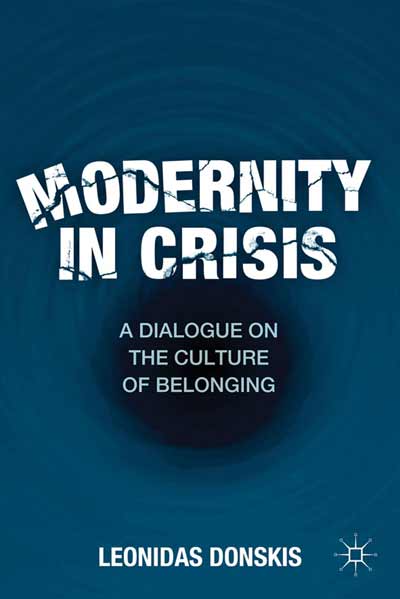 Donskis, Leonidas (2011). Modernity in Crisis: A Dialogue on the Culture of Belonging. New York: Palgrave Macmillan, XI+205 p.
Review prepared by philosopher Pavel Barkouski
What do we know about the intellectual life of our neighbours, even our former roommates in the shared Soviet communal apartment? For the most part, something from personal contacts, with the distortion of the proportions of intellectual trajectories and destinies that is inevitable for such an optics. Yet there is also a subconscious anticipation that some marginal and provincial processes and movements must be taking place there, somewhere between Warsaw and Berlin, repeating the trajectories of our own variegated intellectual life here, between Kyiv and Moscow.
Naturally, reality is more complex than such mental clichés, and the provinciality of people and ideas depends largely not on their physical place of existence, but on the attitude chosen from the outset. If we speak more specifically about the Lithuanian situation, it is adorned, if not with names of epic scale that shake the heavens of European culture, then at least with the names of modest intellectual heroes. These are people who take upon themselves the duty and the right to be witnesses and heralds of their place and time, sensitively responding to the challenges generated by the surrounding human world. The author of the book analysed here, the Lithuanian thinker with an extraordinarily rich intellectual portfolio and useful experience as a public figure, Leonidas Donskis, may also be counted among them.
His book “Modernity in Crisis: A Dialogue on the Culture of Belonging” may in fact be regarded as an attempt to draw a certain line under many years of observations on the state of oscillation in the local identity of the “new Europeans”. It is also a report with a detailed description of the challenges and problems that arise before the eyes of intellectuals and ordinary people caught in the whirlwind of social transformations within “young” national communities, from the point of view of “Old Europe”. Lithuanian society, perhaps even more than Belarusian society, is marked by a sense of being situated against the background of a civilizational fault line, where its choice in favour of one vector of development enters into a mortal struggle with ressentiment over the lost opposite possibility.
There was a time when it was easy for local intellectuals and ordinary citizens to dream about a European future, a European choice, and similar categories, when Europeanness appeared to us in the rosy colours of classical art, fundamental science, advanced technology, and reliable and respectable forms of life. Today it is much more difficult to justify one’s moral and aesthetic choice of the European path, when the European begins to be associated with economic crises in Greece and other countries of the Eurozone, Basque separatism, the explosions of short-sighted immigration policy, and so on. It seems that the doll’s house of “dear old Europe” has finally crumbled into dust, and now we somehow have to survive in harsh adult reality, seeking answers to the questions: what binds European identity together now? What does it mean to be a European, “more European than the Europeans themselves”, when one comes from Central Europe? How and where should one seek identity and authenticity when all of us have already been overwhelmed by the wave of “liquid” or “fluid modernity”?
Ontologically, the book is based on Zygmunt Bauman’s theory of “liquid modernity”, the author’s respect for which he directly acknowledges at the very beginning, and methodologically, on Bauman’s hermeneutic-critical approach, which is a very distinctive and explosive mixture of theoretical generalisations, analyses of concrete cases, poetic digressions and metaphors, as well as intellectual prophecies. At the same time, however, the author notes that he is not simply retransmitting the ideas and modes of thought of the renowned European master, but is applying his analytical optics to reflect on entirely local questions and problems.
He begins above all with the problematisation of the European canon and the extremely urgent question of memory, both individual and collective. When it comes to the identity of the modern human being, the author believes, and all the more so to the identity of the so-called “new Europeans”, it is in a peculiar state of doubling: on the one hand, there is the desire to identify with a certain community, a “collective identity”; on the other, the desire to remain separate and entirely individual. In other words, identity is in a state of crisis, although, as Leonidas Donskis aptly observes, “the expression ‘identity crisis’ looks like a pleonasm, since there is no identity that is not in crisis” (p. 9).
We have a number of cultural examples of situations in which a person is uncomfortable with their own identity and longs to exchange it for another, more attractive one. This is an old temptation for Europeans. With the arrival of globalisation, however, European identity has become problematised to the utmost: we no longer understand what stitches and binds it together. This requires us, in our modern age, to rediscover tradition and the cultural canon, the particular contours of which the author himself is inclined to outline for us, as something that can provide a foundation for our possible identity.
But the return to the cultural canon and to one’s own identity must take place through an appropriate politics of memory, the author directly argues. Such a politics does not give us an answer to the situation of modern uncertainty and fragmentation, but it helps connect the different elements of one’s own experience: without hiding painful memories of one’s misfortunes in conscious neglect and renunciation of memory, but also without fixing one’s mental experience solely on the marks of former trauma. This is an art that Central European peoples still lack, Lithuanians and Belarusians perhaps above all, although in different ways.
Here in Belarus, at the official level, we are inclined to cultivate our own amnesia and conceal all traumatic moments of our history except for the obvious martyrdom during the “Patriotic War”. Lithuanian society, by contrast, is characterised by another ressentiment: an unwillingness to rid itself of the stigmata of a martyred nation, a historical victim, still shuddering from time to time as it looks to the east. The small Central European nations have experienced so much evil during the last century of their existence that they now require proper psychological assistance in order neither to renounce their memory nor suffer because of it. “Hamlet’s dilemma ‘to be or not to be?’ here becomes rather the Central European dilemma ‘to be or to get rid of being?’” (p. 34).
Control over the mind is above all control over memory, as the anti-utopias of Orwell, Zamyatin and Aldus Huxley piercingly testify. And authoritarian means are always ready to clean up that memory. Perhaps for this reason, unlike Western Europeans, with their different attitude toward the historical, the politics of memory, or the duty to remember, according to Donskis, is today a moral imperative for the Central and Eastern European.
The author reflects on why the identity of Central European peoples was from the outset formed as a cultural rather than a political one, and why, in that case, the fate of the newest liberal Europe is in a certain sense a return to the past of Central Europe, with its baroque variety, multiculturalism and tolerance. This is now perceived by representatives of that tradition as nothing other than a “sign of trouble”, a symptom of weakness and decline in the face of the strength and aggressiveness of neighbours. The same applies to the inclination of the “old Europeans” to step on other people’s rakes: respect for left-wing ideologies in politics, searches for a “third way”, and other favourite themes-projects of liberal intellectuals. This, after all, provides grounds for a significant strengthening of the positions of local Eurosceptics: “What seems to Western Europeans and North Americans an alternative and a humanistic project of modernity is, for Central Europeans, directly a historical wound, a carefully tested and failed possibility, and the false promise of modernity with a human face” (p. 42).
Another sphere of current challenges for a person of our place and time is the space of mystery and enigma. It is a fact that modernity, in all its forms, deprives people of the mysteries of their lives and tends to expose the intimate to the surface of public attention. In authoritarian experience this is radically transformed into the concept of “double life”, or, in Milan Kundera’s words, Ketman: when a person must hide their thoughts and identity and camouflage them in socially safe forms, that is, create the appearance of the absence of mystery.
In democratic societies the problem is somewhat different, connected with the logic of a “culture of determinism”, according to the Lithuanian researcher Vytautas Kavolis cited by the author, but here too the absence of mystery is evident. Therefore the conspiratorial gradually comes to replace the mysterious: “Conspiracy theory, victimisation and technocratic demonology are spread almost equally in the liberal-democratic and illiberal parts of the world” (p. 72).
Longing to get rid of the emptiness of the enigmatic, destroyed by the Enlightenment efforts of modernity, human consciousness rushes toward the cheap effects of yet another conspiratorial explanation of the world and thereby, in a perverse way, obtains a miraculous remedy against abandonment: “if conspiracies are being organised against me, then someone needs me, the world is not indifferent to me!” This is accompanied, however, by a cynical logic and a corresponding morality: there are no innocents; if someone suffers at the hands of another, then they must themselves be guilty of it. Thus Lithuanian society contests the participation of its representatives in the Holocaust, if not the Holocaust itself, and for Lithuanian intellectuals this is an essential challenge today: an attempt to return morality to culture.
For the contemporary globalised world, an entirely different temptation is also possible: deliberate victimisation, when being in the position of a victim means claiming a certain power and significance, because I suffered so much before, and now everyone around me is obliged to respect and notice me because of it. Neither individual people nor entire nations avoid it. For the author this is a manifestation of cultural amoralism, a refusal of individual and collective responsibility and its replacement with belonging to a “suffering group”.
The world may be evil and cruel toward me, even permeated with the artificially heightened danger of technological catastrophes and other demons of modernity. The main thing is that it should not be indifferent. According to the author, this is the greatest temptation for the local community, which feels better as a victim than when it remains in separateness. Although, in the end, the magical mantra “This cannot happen here and with us” is supposed to save us from all the dangers and threats of this world. It saves us from the need to find answers to unpleasant questions and allows our identity to remain untouched for the time being, something that certain negligent politicians exploit.
In addition to challenges and questions, there are also dangers and threats for the human being of the times of liquid modernity. Central Europeans do not escape them either, perhaps reacting even more sensitively to external pressure because they feel themselves to be an outer part of Europe, extended outward toward the surrounding world. After the final death of euphoria over a world without the Cold War, one of the main threats that the author saw as early as 2010, several years before the Ukrainian events, was Russia’s “unnoticed fascism”. Here Donskis does not try to exploit the national trauma of Lithuanians or trade in the image of a small country, a victim of a merciless neighbour. He makes a sober statement that against the background of the century-defining events of the twentieth century, with the obvious horrors of concentration camps, ghettos, the Holocaust and other crimes of National Socialism and Italian fascism, an essentially similar chauvinist-imperial and antisemitic policy of the Russian state, from tsarist times to the most recent moments of history, remained unnoticed or deliberately ignored by those cultures and politicians that attempt to conduct the humanistic judgement of the age.
Donskis sternly lists the most striking moments of this ignoring: the Black Hundred reaction and the Jewish pogroms inspired by the Okhrana, justified by the forged “Protocols of the Elders of Zion”, which remained an internal affair of the Russian Empire in 1900-14; the Russian-Chechen wars of the 1990s, which in effect turned into a series of war crimes, brutal ethnic cleansing and the killings of civilians, and which the West treated quite liberally as a local military conflict and an internal affair of the Russian Federation against the background of comparison with the horrors of the Yugoslav war and the ethnic cleansing of Albanians in Kosovo; and the Russo-Georgian war of 2008, where Western politicians cynically pretended that the aggressor and the main culprit of the conflict was the injured party.
This practice of ignoring “unnoticed fascism” in order to pursue such a policy rests on the formula: “They know that we are lying, and we understand that they know that we are lying.” But taking difficult decisions is far harder than simply continuing not to notice and pretending. For this reason, realpolitik flourishes in European politics, as does the desire to ignore political challenges and focus only on economic relations, without calculating, for example, the strategic consequences of selling Mistral amphibious assault ships by a NATO country to a country that in fact remains NATO’s main potential adversary in Europe. This fundamentally shakes the entire structure of the local security system and forces the small Baltic states to tense up at the breath of danger.
Today such alarming reflections in Europe are received much more loyally than three years ago, when the threat from Russia seemed to be no more than the frustration of local post-Soviet elites. The author, however, prophetically notes: “What happened in Georgia a few years ago may be Russia’s attempt to establish a pattern for a similar scenario with respect to Ukraine or the Baltic countries” (p. 89).
According to the author, however, it is not only European politicians with their pragmatism who deserve obstruction, but also European and North American human rights defenders, who are inclined “not to notice” the threats to life and health that accompany the work of human rights defenders in post-Soviet authoritarian conditions, and who mostly take care of local violations without trying to express international solidarity at the systemic level.
The point is not that Western human rights defenders should stop criticising their own authorities and societies altogether for imperfections or failures to observe fundamental human rights and concern themselves only with problematic regions. The point is that such solidarity should finally exist and should not allow the systematic and cynical violation of human rights in one country to be placed on the same level as isolated cases of discrimination or political incorrectness in another, equating them in terms of values. This directly or indirectly betrays the memory of those who have already become victims of confrontation with the system, such as Politkovskaya (Anna Politkovskaya) and Estemirova (Natalya Estemirova) in the Russian Federation, and makes the work of those who continue to fight for those rights at risk to their lives more difficult. This is not even to mention the tendency toward the relativisation of the very concept of human rights in light of the loss of meaningfulness of many concepts as such in our modern times.
The author, nevertheless, is focused on criticising and analysing what causes the crisis of Central European identity today and poses harsh questions not only outwardly, but also to ourselves. For example, there is the question of the half-truth that Ukrainian and Baltic elites attempt to assert in their reflection on the events of the Second World War. In trying to state their truth about the perniciousness of the Molotov-Ribbentrop Pact or the policy of the Holodomor with respect to the peoples of Ukraine and the Baltic region, the adherents of national cultures consciously ignore accusations of collaboration with the National Socialist authorities or of the participation of their own populations in the Holocaust that come from the other side. Among other questions, the author explains, for instance, why in his view former Soviet dissidents are so hostile to today’s Western democracies, and how, in that case, one should explain the ressentiment in the same Baltic countries directed against the European Union and its political values. This is a relatively small and far from complete list of the themes and questions raised in this book, and it gives an understanding that reading it may prove far more interesting than reading this review.
For the sake of analytical completeness, however, it is worth noting some weak points of the book, which do not prevent one from deriving general pleasure from reading it, although they do catch the reader’s eye. Above all, the author works in the tradition respected in the West, where a book consists of almost autonomous chapters, some of which had previously been published as separate articles and parts of collective studies.
Although Donskis justifies this methodologically, by referring to Bauman’s approach to writing texts, and tries to connect these separate parts with one another in terms of content, the text still leaves the impression of a stylistically diverse and fragmented narrative, whose separate parts have different value: some introduce the context of Z. Bauman’s social-philosophical and political-science reflections; others pose current questions and formulate tasks; still others appear as an attempt at a historical-cultural description of what post-Soviet society in the Baltic countries is today. This makes it difficult to perceive the text of all five chapters as a certain integral project rather than as a set of authorial essays. All the more so because this mode of generating the book’s content sometimes leads to thematic repetitions and repeated discussion of the same material in different fragments of the publication, for example, material concerning the analysis of well-known European anti-utopias.
Second, the author is marked by a somewhat hypertrophied respect for Bauman’s concept of “liquid modernity”. This concept undoubtedly creates a productive hypothesis for describing the situation of everyday life in a globalised world, but it is not always capable of moving beyond theoretical domains and dealing with the discussion of concrete problems and challenges of the present. In other words, Z. Bauman’s approach is presented “as is”, without an attempt at critical reflection and assessment of its potential for defining the problems facing the Central and Eastern European region.
Finally, the author is undoubtedly distinguished by good cultural erudition and the ability to apply the cultural codes of classical European culture, in painting, literature and cinema alike, to the analysis of concrete problems of local identity. On the one hand, this greatly enlivens the author’s narrative and makes it emotionally rich, giving it the necessary cultural studies context. On the other hand, this same feature seriously harms the consistency with which the reader perceives the author’s design, enveloping the reader in a flow of associations from which it is not so easy to slip back to the logic of the development of the argument.
And yet, despite these imperfections and attractions of the book, or perhaps, on the contrary, thanks to them, it gives us a very sharp, very intimate and very vivid model of intellectual work here and now: a model that can be admired and taken pride in, and also one that can and should be carried out again each time, by everyone in their own place. For precisely in this today lies the main service of the Central and Eastern European intellectual.