
Publications · 27 February 2014
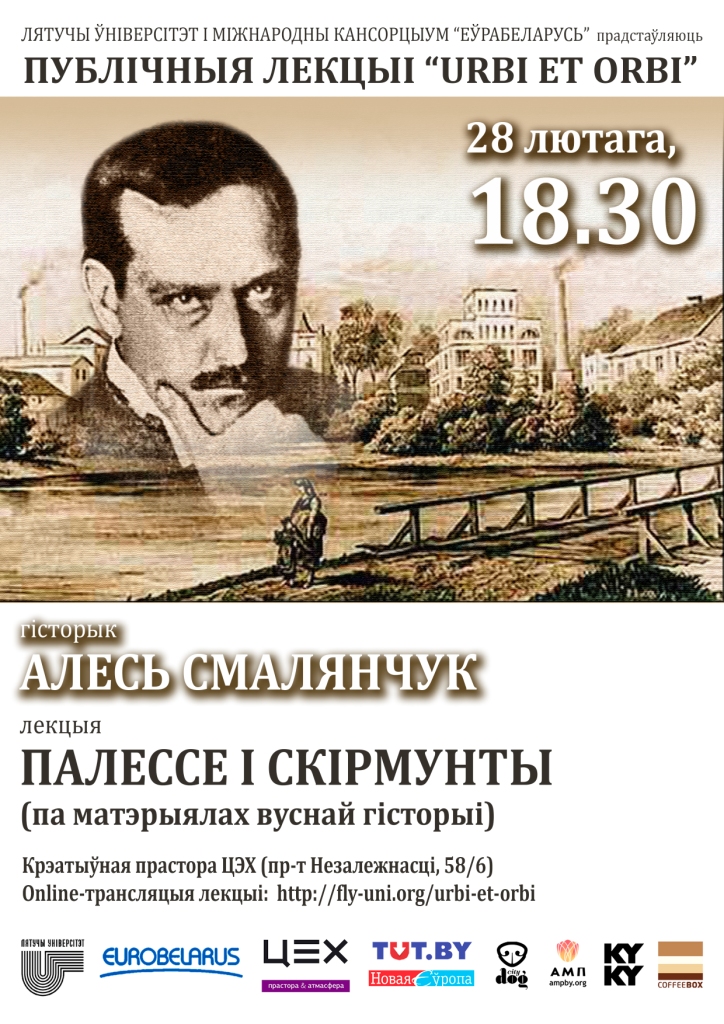
Public Lecture by Ales Smalianchuk at the Flying University on 28 February
For a long time, only a few specialists and curious readers were interested in this topic, and the available factual material was limited. For the wider public, the history of the Skirmunts was almost unknown. At the same time, many interesting facts and events in Polesia are connected with this family: perhaps the most successful example of entrepreneurship in Belarus at that time was when, in 1836, the Skirmunts established a cloth factory that attracted craftsmen from France and Germany; the Skirmunt name also appeared on the political stage, when Raman Skirmunt briefly headed the government of the Belarusian People’s Republic in 1918.
Ales Smalianchuk’s research is based on a combination of different approaches: both the traditional one (work with historical documents) and a newer one that only recently entered the practice of some Belarusian historians, namely oral history. It is precisely the use of this new historical method that makes the work especially interesting and distinctive. Interviews with witnesses of the not-so-distant past give us not only new factual material about the time of Raman Skirmunt, the period when the national movement was emerging. Here, as the researcher himself says, there is a doubled history: on the one hand, it is a recording of memories and an attempt to create a certain narrative of Skirmunt’s figure; on the other, it is a study of today’s Belarusians, their memory and consciousness, and how these have changed. What people tell us depends not only on what happened 70-80 years ago, but also on what they live by today and how they perceive life.
What conclusions did the researcher reach about Belarus at the beginning of the twentieth century and Belarusians at the beginning of the twenty-first century? What in the stories about the beginnings of the national movement in Belarus is true, and what is myth? National or social priorities: which mattered more to ordinary Belarusians? We invite you to reflect on these questions together with Doctor of Historical Sciences Ales Smalianchuk. The lecture “Polesia and the Skirmunts (Based on Oral History Materials)” will take place on 28 February at the CECH space (58/6 Nezalezhnastsi Avenue) at 18:30. Admission is free!
The organisers will provide an online broadcast of the lecture.
More details about the lecture and the speaker are available in the interview: “Historian Ales Smalianchuk: The Skirmunts Created Our Liverpool on the Yaselda in Polesia“.