
Publications · 22 March 2012
Popular Liberalism
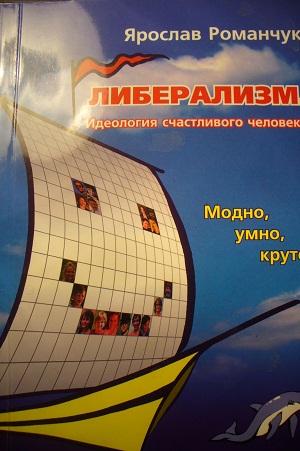 Romanchuk, Y. Liberalism. The Ideology of a Happy Person. Kyiv: “K.I.S.” – 2010.
Review prepared by political scientist Aliaksandr Shamiakin.
Yaraslau Romanchuk’s book Liberalism. The Ideology of a Happy Person claims to offer the broadest possible coverage of topics related to liberalism, including the philosophy and ideology of liberalism, various forms of interventionism as threats to freedom, liberalization in post-socialist countries, everyday manifestations of the liberal idea, and much else.
Opening Mr. Romanchuk’s book, we first encounter his autobiography, in which the author describes the main stages of his life and some important achievements, among them learning from the experience of such major politicians as Margaret Thatcher and Helmut Kohl (p. 4). There is, of course, something to add here, but one assumes that in several decades, as an elderly man, Mr. Romanchuk will complete his autobiography and clarify this interesting question.
Since the book is devoted to liberalism, the theme of freedom should naturally come to the fore. The author proposes three concepts of freedom, although from a philosophical point of view there are two: freedom in the positive sense and freedom in the negative sense. To these two concepts the author adds his own third one, based on a statement by Nobel Prize laureate George Stigler: “Freedom is wealth” (p. 17). Yet it is obvious that this definition belongs to an entirely different semantic plane.
As is well known, classical and neoclassical liberalism are grounded precisely in “negative” freedom, that is, freedom from. While criticizing “positive” freedom and defending “negative” freedom, the author carefully avoids calling these concepts by their scholarly names, so as not to create certain connotations, with only one exception, where a “negativist” (p. 18) definition is mentioned.
In his book, Romanchuk distances himself from various traditions of understanding the concept of “liberalism”: “We use the word ‘liberal’ not in the way it is used today in the political vocabulary of the United States. Not in the way it is used in many countries of the European Union… A liberal in my understanding differs greatly from the person whom Russian or Ukrainian media, elites, and ordinary people often call a liberal” (p. 20). If everyone around understands a liberal differently from Romanchuk, then what is the difference, and why is Romanchuk “one man against the field”?
In fact, with the exception of the American tradition, the author has greatly exaggerated. It is true that in the United States today liberalism denotes an idea that has moved to the left of classical liberalism. This situation originates in the early twentieth century, with the emergence of so-called “new” or “social” liberalism. As for the European tradition, the term “liberalism” is used here in its traditional meaning; it is another matter that the liberal idea itself has to some extent experienced social influences. And Romanchuk is quite wrong to dismiss post-Soviet liberals who, in his words, were in fact not liberals but “under the banner of liberalism increased the size of the state…, redistributed state assets into the ownership of several groups, and violated property rights” (p. 20). In doing so, Romanchuk forgets that these same people wrote programs in the spirit of neoclassical liberalism, and that Romanchuk and his political allies have closely cooperated, and continue to cooperate, with these people and their ideological successors.
Romanchuk continues the fashion of listing the eighteenth-century Scottish thinker and economist Adam Smith among the classics of liberalism (p. 30), a widespread but rather questionable move, since if Romanchuk had asked Smith himself about liberalism, Adam Smith would obviously not have understood what was being discussed. In other words, can fully formed ideologies be projected back onto a time and onto people who preceded their emergence?
In Chapter 2, “The Enemies of Liberalism. Wolves in Sheep’s Clothing and Without It,” the author, among other things, determines what is not “true” liberalism, and it turns out that it exists nowhere. The author notes that “not a single country in the world has yet taken the step of removing the state from the money market, from education, healthcare, the mass media, infrastructure, and network sectors” (p. 192).
The author calls mistaken the ideas that “liberalization supposedly brought deep changes that reflect the essence of right-wing politics and ideology” (p. 193). Romanchuk is, of course, right that liberalism as an integral model in its classical form has never been implemented anywhere. But is it worth proceeding from doctrinaire positions here? After all, the policy of economic liberalization did achieve great success, especially during its renewed rise in the 1980s and 1990s. Romanchuk’s regret over the presence of the state in certain spheres of social life in capitalist countries prompts a thought that repeatedly came to mind while reading this book: a thought about Mr. Romanchuk’s ideological convictions, which he does not state directly, namely libertarianism, an underground branch of the liberal idea also known as anarcho-capitalism.
If “true” liberalism has still not been embodied anywhere in the world, then let us sarcastically note that Romanchuk has invented an absurd slogan for his book: “Fashionable, smart, cool!” For it follows from the content of the book that liberalism is not so fashionable after all.
From the pages of the book the author simultaneously tries to discuss serious topics involving ideas and political economy and to joke in a language that is entirely unsuitable for this. For example, while criticizing the Briton G. Harcourt, a supporter of the idea of a “third way” between liberalism and socialism, Romanchuk compares his approach to the behavior of characters from the animated film Shrek (p. 209).
The book looks like an attempt to set out everything Romanchuk thinks and knows about liberalism, as well as about matters that have nothing to do with liberalism. For that reason it is not coherent, and its semantic lines are lost. There are especially many such objections to the fourth chapter, entitled “Liberalism: The Science and Art of Being Happy.” It is a mixture of everything Romanchuk wished to comment on: dissatisfaction, quality of life, pleasures and enjoyment, self-awareness, culture, sex, hearing, work, friends, and much more. Evidently all of this is directly connected with achieving happiness according to the author’s liberal recipe, in which, without doubt, he is a specialist.
Here, for example, is how the author writes about sex (quoted in the original language): “One and the same sexual act can be painful, frightening, disgusting, neutral, pleasant, or ecstatic depending on how it is connected with a person’s goal…. One may say that sexual stimulation is pleasant in itself. To enjoy sex, one must be healthy and have desire. No special skills are required“ (p. 460). Apparently the author sees some connection between this topic and indices of human development, the dynamics of gross domestic product, the structure of trade, and other scholarly indicators that he examines in the first chapter.
It should be noted that the author has literary talent, since the book is written in a language that is easy to perceive, and throughout the book a high emotional intensity is maintained, which makes it possible to read it, as they say, “in one sitting,” despite its considerable length.
Liberalism. The Ideology of a Happy Person is a popular apologetics of economic liberalism. However, it is not suitable for readers who want to learn about liberalism as one of the influential ideologies of modernity. For everyone interested in the subject of liberalism, Romanchuk’s book may be of interest perhaps in isolated moments, and even then without the final chapter.