
Publications · 26 March 2013
Passions over Nationalism
The review was prepared within the framework of the joint project “Book Review” of the Political Sphere Institute and the Centre for European Studies in Minsk.
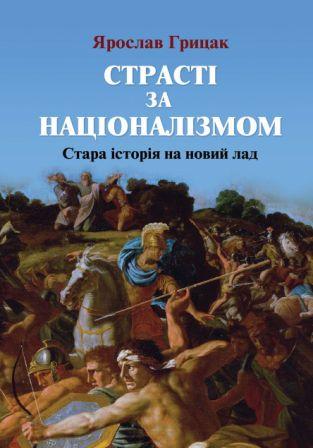
Yaroslav Hrytsak. Страсті за націоналізмом. – Kyiv: Krytyka, 2011. 352 p.
The review was prepared by a staff member of the Political Sphere Institute, Aliaksei Lastouski
I thought for a long time about how one could write a review of this book. The standard approach, with a brief summary of its contents and main ideas, somehow did not fit very well here. Yes, this is a collection of essays on the problems of historical memory, the formation of national identity, and the development of nationalism in Ukraine. This is already the second edition of Страсті за націоналізмом, and it differs substantially from the first version, since the older essays make up only a third of the book; moreover, many of them have been edited and changed. Incidentally, Belarusian readers have already had the opportunity to read some of these essays in Belarusian translation (“Passions over Lviv” (Hrytsak, 2003) and “Games with a Poker: Seriously and in Ukrainian” (Hrytsak, 2004)). But such a dry extract does not convey a living sense of the pathos and authorial intentions embedded in this book.
And as a key to it, the idea arose to describe the book through the role, function, and purpose that it is meant to perform in Ukrainian society. This is by no means a collection of scholarly texts intended to disclose some problem objectively and in detail. Not at all. What we have in our hands is a book addressed to the ordinary reader and meant to have a predetermined effect both on the local elite and on public opinion. At least this is the impression that arises while reading it, and it is unlikely that the author himself would dispute it.
If we turn to the terminology used by Yaroslav Hrytsak, one can argue that through this book he consolidates his position as a public intellectual. In the essay “What Remained after the Orange Revolution?” the author directly places himself not only within the professional community of historians, but also within the more general category of the “intellectual elite,” which is assigned an exceptionally responsible mission: “to change the way of thinking about what Ukraine is and what its place is in the contemporary and highly changeable world” (p. 319).
I will try, using this book itself as an example, to answer three questions: 1) where the position of a public intellectual (or a representative of the intellectual elite) emerges from and what it is based on; 2) what ideas are embedded in the message to other intellectuals and, indirectly, to society; 3) what we get as a result, as the imagined effect of these efforts.
Hrytsak’s authority as an intellectual is built through the use of various professional competences that allow him to speak on painful topics concerning the whole country. Of course, no one will doubt his competence as a historian, and the basis for this is not only his brilliant monographs, above all Пророк у своїй вітчизні: Іван Франко і його спільнота (Hrytsak, 2006), but also his very careful and profound handling of historical material, which can be found on the pages of this book. This is most characteristic of the famous essay “Theses for a Discussion about the UPA,” where a very painful and acute question is examined from a multidimensional perspective, in which it is difficult to find simple answers, but possible to understand as deeply as possible the motivations of people who acted and fought in very difficult historical times.
But professional knowledge alone is clearly insufficient for moving into the privileged estate of public intellectuals, and therefore Yaroslav Hrytsak also actively manifests himself as a sociologist and political scientist. Here, quite predictably, questions arise about his work with data and methods of generalization. If he uses sociological data quite cautiously and accurately (the author himself explains that he underwent special training in an international research project), then in the position of political scientist he appears rather as an idealist humanist. Yet this probably must happen with any intellectual who steps outside the limited field of his own research and says something socially significant.
It is also worth noting the author’s brilliant style, which really makes it possible to read a fairly thick book in one breath. Yaroslav Hrytsak makes very active use of the achievements of Western humanities scholarship, but he does not engage in its banal retransmission, which has become a widespread misfortune; rather, he very effectively tests conceptual schemes and moves. In addition, he exceptionally successfully weaves various quotations and interesting thoughts into the fabric of his narrative, which also adorn the text. It must be acknowledged that Hrytsak is one of the best reviewers the author of these lines has encountered: he tells about different books briefly, brilliantly, and interestingly, and here he is clearly without competition.
But what can be singled out as the main prescriptions that Yaroslav Hrytsak proposes for Ukraine? One can still suspect him of retransmitting those values and projects that were formed in Western intellectual circles. And there will be a certain share of truth in such accusations. Indeed, what the author offers as advice to historians, politicians, and ordinary Ukrainians very much resembles the same things that have become established in Europe as a public consensus in recent decades.
First of all, this concerns the aspiration to achieve a harmony of diversities without eliminating differences (which is, of course, highly relevant for Ukraine as an exceptionally heterogeneous country), for example: “Ukrainian historians should learn to consistently use the plural instead of the singular” (p. 278). Secondly, there is the introduction of the principle of responsibility, which clearly concerns Ukrainian politicians directly, but for Hrytsak it is also of fundamental importance that contemporary Ukraine (or, more precisely, the Ukrainian elite) acknowledge responsibility for the participation of Ukrainians in the Holocaust, a step he considers necessary for Ukraine’s prospects of European integration. Finally, in his texts Hrytsak consistently advocates the principles of tolerance, correctness, compassion, dialogue, and understanding. All of this is entirely sound and right; all educated and honest people are ready to subscribe to such a set of values and recommendations. But while reading these beautiful and entirely correct lines, a mischievous little worm gradually begins to raise its voice, destroying all this beauty with one thrust: perhaps all this is banal?
The author of the book is, on the one hand, in an advantageous position, since in his appeals to Ukraine he can rely on the entire wealth of the European intellectual tradition, with its ranks of authorities, bright minds, fruitful debates, and established conventions. And it should be noted that Yaroslav Hrytsak uses these resources to the full, which is why his voice can indeed sound convincing. But not always. When ready-made recipes of continental bureaucracy are transferred onto some local soil, they begin to exude the coldness of steel constructions devoid of life and happiness. Personally, in the “instructive” part, I miss originality, irony (which the author successfully displays on other planes), and “Ukrainian origin.” This does not mean that everyone must find separate national bicycles, but I think that the richness and diversity of human cultures, embodied in the multitude of nation-states, should in some way also lead to the birth of their own local answers to global questions.
Fortunately, Страсті за націоналізмом is not limited to prescriptions in the style of “How We Should Arrange Ukraine.” This book contains many excellent essays (incidentally, I consider those translated into Belarusian to be the best in this collection), many apt observations and fresh thoughts. In addition, there is a selection of excellent reviews. It is a rich treasury with many pearls, so I advise you to look into it.
List of literature mentioned in the review
Грицак, Ярослав (2006). Пророк у своїй вітчизні. Франко та його спільнота (1856-1886). Київ: Критика.
Грыцак, Яраслаў (2003). “Жарсьці па Львове”, ARCHE, №2, URL (accessed 16.03.2013): http://arche.bymedia.net/2003-2/hryc203.html.
Грыцак, Яраслаў (2004). “Гульні з качаргою: усур’ёз і па-ўкраінску”, ARCHE, №1, URL (accessed 16.03.2013): http://arche.bymedia.net/2004-1/hrycak104.htm.