
Publications · 15 September 2011
On the Path to the Formation of the Belarusian Nation: Historiographical Achievements and Problems
Warning: Undefined array key "file" in /home/u475055259/domains/palityka.org/public_html/wp-includes/media.php on line 1788
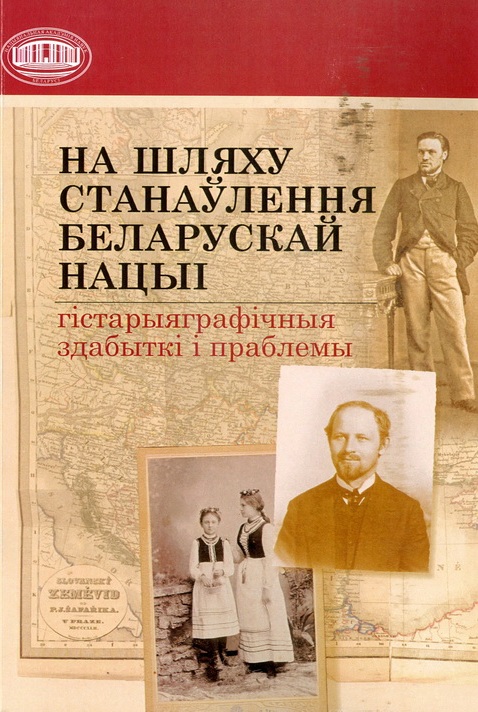 On the Path to the Formation of the Belarusian Nation: Historiographical Achievements and Problems. – Minsk: Belaruskaya navuka, 2011. – 311 p.
The review was prepared by a research fellow of the Political Sphere Institute, sociologist and Candidate of Sociological Sciences Aliaksei Lastouski.
______________________________________________________________________________________
Recently we have been able to observe a significant expansion in the number of books dealing with the problems of the formation of the Belarusian nation, the emergence and development of Belarusian nationalism, various national projects, and so on. Of course, in this respect we are still very far from Ukraine, where such subject matter has already been fully institutionalized and has acquired the character of a production line. Still, there is already a great deal of literature; unfortunately, however, its quality is not always satisfactory. It includes many para-academic publications with dubious methodology, as well as plainly ideological and speculative works.
Therefore, the appearance of a collective monograph on the historiography of national issues, prepared and published by a team of scholars from the Institute of History of the National Academy of Sciences of Belarus, was much needed. The need has long been ripe to set more or less precise reference points that would separate serious studies based on deep knowledge of sources from politicized opuses distinguished mainly by their use of social-constructivist rhetoric. Who, if not a solid academic institute, can set the framework that would allow us to distinguish the grain from the chaff? True, the reputation of the Institute of History has recently been seriously damaged, as evidenced by the extremely critical articles by H. Sahanovich, A. Smalianchuk, and a number of other authors, who have simply branded our “official” historiography. But whatever grounds there may be for such remarks, it is obvious that the Institute of History still retains very strong potential, and this monograph, “On the Path to the Formation of the Belarusian Nation,” is a vivid confirmation of that.
Under conditions of heightened pressure on our academic historians, it is pleasant to see that they preserve objectivity, restraint, and at the same time — and this is quite fundamental — loyalty to the principles of national historiography. These are precisely the basic grounds for analyzing historiographical debates on the formation of the Belarusian nation.
The book consists of three parts. The first is devoted to the development and transformation of ideas about “nation” and “national sovereignty” up to the beginning of the twentieth century, as well as to the methodological foundations for studying the history of the nation-state. It should be noted that the author of this section, Maryna Sakalova, does not reduce her account to the usual scheme of a transition from moss-grown primordialist prejudices to progressive constructivism, but rather describes in considerable detail the plurality of meanings and senses invested in these concepts at different times and in different contexts. There is, however, one critical objection: the statement that “the conceptual framework of contemporary domestic historiography consists of the following postulates: the world consists of a mosaic of ethnic communities (nations), nations are natural unities based on cultural homogeneity,” and so on (p. 45), clearly contradicts the material of the second and third sections of the same monograph, where Belarusian historiographical literature is analyzed and where no special conceptual essentialism can be found — unless one takes into account certain individuals, such as L. Lych.
The second section is devoted to the historiography of ethno-cultural and ethno-political processes in Belarus in the nineteenth century. The main disagreements in views between representatives of historical schools are described consistently and thoroughly. Particular attention is paid not only to contemporary Belarusian historiography, but also to the first historical works created back in the nineteenth century, to the development of historiographical views in the Soviet period, and also to the “new imperial historiography,” which is now being very actively developed by our eastern neighbors.
On the other hand, the reflection of the diversity of views is most often reduced to the scheme: X thinks this, Y thinks that; only occasionally are references made to contextual matters, such as the political motivations of researchers. For the most part, it is difficult to form an idea of the reasons for the divergences in views, since it is obvious that they most often went beyond the methodology of historical research. Yet if one remains within the tasks of historiographical work, the authors of this section deserve credit for reflecting in considerable detail the debates on the main issues of the formation of the Belarusian nation in the nineteenth century, and for bringing into circulation many important works that, for some reason, remain on the margins of contemporary discussion.
Personally, I liked the third part of the monograph the most, on the Belarusian national-state idea from the end of the nineteenth century to 1917, written by Andrei Unuchak. Perhaps this is because the author’s position crystallizes most clearly here: he does not merely retell certain disputed points, but also tries to assess them from the standpoint of a competent researcher of these questions. One can only agree with the skeptical thrust directed at the now fashionable constructivist trend, which hides rather limited work with primary sources behind complex terminology (A. Bendzin and V. Bulgakau receive the most criticism here). Again, it is worth emphasizing the author’s principled commitment to national views, which nevertheless in no way prevents him from maintaining detachment in assessing the phenomena of Western-Russism and krajovcy thought, as well as their influence on the formation of the Belarusian national idea.
Yet while giving the work an overall positive assessment, I have several not very substantial remarks. The obvious tilt toward Russia, visible in the first two parts of the monograph, is very strange. Thus Maryna Sakalova devotes much space to how the understanding of “nation” and “people” changed among various Russian authors of the nineteenth century, beginning with Karamzin — and this is in principle correct, since these concepts had a direct and immediate impact on intellectual processes in the Belarusian lands — but she completely ignores the evolution of Polish, or more precisely Polish-language, thought on this subject. Yet it had perhaps the greatest influence on the development of the Belarusian national movement, and such a gap is very significant.
The dependence on Russian sources is even more evident in paragraph 2.4, co-authored by A. M. Filatava and V. V. Yanouskaya, which deals with the use of the modernization paradigm to analyze the socio-economic development of Belarusian lands within the Russian Empire. A special subsection is devoted to the evolution of the modernization paradigm in contemporary studies by Russian historians, although it is obvious that Russian works are only a small part of modernization theory, which has long been developed by a number of authoritative Western authors (and the monograph notes this: “this macro-theory was born in the analysis of Western civilization,” p. 160), and Russian authors often either rely on these conceptual works or simply copy them. Accordingly, it is high time for Belarusian historians to speak with the world without mediation. Otherwise, we will continue to allow ourselves judgments such as the claim that theoretical and methodological developments must be adapted “to the study of Russian, including Belarusian, realities” (p. 160).
A number of small mistakes are also disconcerting. They cannot be compared with the dreadful scholarly apparatus of Anatol Astapenka’s “study of Belarusian nationalism,” but they clearly do not adorn a professional monograph on historiography. For example, Liavon Hmyrak is listed as L. Hmylak (p. 21) — although it is strange in general that exactly the same passage, but with the author’s name correctly given, can be found in one of Ales Smalianchuk’s articles; the founder of the theory of “banal nationalism,” Michael Billig, is called Billing (pp. 39, 46); the well-known Russian historian Alexei Miller, who is mentioned quite often in this publication, became S. Miller on p. 75. For a historiographical work, it also does not look very good to cite a book by a Belarusian author (Y. Shautsou) from a review by an American geographer (R. Ioffe). The description of Anton Mironowicz as a “representative of contemporary Polish historiography” (p. 180) also looks debatable, since this is the chairman of the Belarusian Historical Society in Białystok.
Still, we have received a substantial historiographical work, and we will hope that in the future we will be pleased with specialized studies on this subject.