
Publications · 6 June 2011
On Some Deputies of Independence…
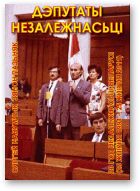 Siarhei Navumchyk, Zianon Pazniak (2010). Deputies of Independence. Warsaw, New York, Vilnius: Belarusian News, Belarusian Cultural Society in Lithuania, 304 pp.
The review was prepared by political scientist Tatsiana Chyzhova.
______________________________________________________________________________________
The book Deputies of Independence by Zianon Pazniak and Siarhei Navumchyk is devoted to the events of 1990-1991, or more precisely, to the activity during this period of the opposition faction of the Belarusian Popular Front (BPF) in the Supreme Soviet of the BSSR (Republic of Belarus) of the twelfth convocation. As the authors themselves note, they decided to publish the book on the occasion of the approaching anniversary of granting the Declaration of Sovereignty of Belarus the status of a constitutional law, on 25 August 2011.
The publication consists largely of articles published in the émigré periodical Belarusian News, as well as texts that appeared in 2008-2010. It does not claim to be a scholarly, historical, or political study; rather, it is a memoir, a subjective view by direct participants on historical turning points in the former Soviet and new Belarusian society. From precisely this perspective the book may be of interest to a researcher of Belarusian politics.
The book consists of fifteen parts devoted to the activity of the BPF parliamentary group in the Belarusian parliament, the authorial interpretation of Belarus’s political development in the first half of the 1990s and later. In addition, it includes a short memoir-essay by the authors about each of their former comrades-in-arms, as well as biographical information on the 27 deputies of the BPF parliamentary group (pp. 216-271). The publication is furnished with a fairly large number of illustrations. Most of the photographs are well known from the press of the 1990s, but some come from personal archives and had not been published before.
In general, it is not difficult to notice that the entire whirl of rich and complex events of that time, in the interpretation of both authors, revolves around the 27 deputies from the BPF. Throughout the book one can observe an emphasis on the subjective aspect of events, the active work of a small group against an inert majority and, moreover, in unfavorable conditions: “I will note that in the communist Supreme Soviet of the twelfth convocation there were 345 deputies, of whom 27 were deputies of the BPF Opposition. And even so we moved along a victorious path. This is a unique fact… ” (p. 16).
Most of the epithets used in relation to the BPF faction are intended to demonstrate the “heroic” dimension: “In the hall there was a sea… hundreds of red faces, determined to ‘restore order,’ and our incomplete opposition thirty, which set itself the task of defeating this horde” (p. 22). This evokes associations with characters of a heroic epic, where a handful of brave and determined people, thanks to their outstanding abilities and internal organization, defeats a far stronger and larger enemy. “Our advantage lay in intellect, in good education and erudition, in the ability to think quickly, formulate thoughts correctly and express them correctly; finally, in better organization and self-discipline,” Pazniak emphasizes (pp. 60-61).
Some remarks directly evoke the biblical legend of David and Goliath: “The opposition David was ready to move mountains. I consider it a major tactical achievement of ours that immediately, from the very start, we began to win, to crush, confuse, and scatter this ossified nomenklatura mass, not allowing them to come to their senses” (p. 69). It is obvious that under those conditions the BPF was indeed the only political force alternative to the effective authorities, active and mass-based against the background of other groups. Therefore the authors’ words about an “avant-garde of change” are largely justified. At the same time, however, external factors are almost entirely ignored, even to the point of simply denying their role in the change of the situation in 1990-1991.
As before, the non-independence of the Belarusian-Soviet nomenklatura is emphasized, along with its lack of any national consciousness, and another well-known participant in those events, Stanislau Shushkevich, is again mentioned in an unkind way. Throughout almost the entire book, both authors bestow unpleasant epithets on him, since they consider him a betrayer of national interests in favor of the nomenklatura majority.
Pazniak also turns to more recent events. The author mercilessly criticizes the united opposition of the second half of the 1990s, which, in his view, was formed by the joint actions of the “regime (first of all the KGB), Moscow, and European Union policy” (p. 171), contrary to the “all-Belarusian Liberation Movement against the pro-Moscow regime and Moscow’s imperial policy” proclaimed in 1997 at the Fifth Congress of the BPF under the leadership of the Front (p. 170). Moreover, at the head of these destructive forces, according to Pazniak, stood “the German intelligence officer Hans-Georg Wieck” (p. 170).
Such an entirely subjectivist position forces one to question the truthfulness of a number of moments described in the book, for example: “…the BPF Opposition won the struggle in the communist Soviet parliament for Independence, for the truth about Chornobyl (which was carefully hidden from society), for a national army, for national money, for the legislation of an independent state, for the Belarusian flag and the Pahonia coat of arms, and in general, for the state existence of independent Belarus, while also stopping the activity of the CPB (CPSU). The minority stopped the activity of the majority!” (p. 59). The authors do not separate what was achieved entirely through the efforts of the parliamentary opposition group from what was aided by external factors and what happened under the influence of the general trends of the time.
Statements such as “April 1991 was marked by mass protests of Minsk workers (organized by the BPF, which had its branches at the factories) against the anti-people social policy of Moscow and the CPSU (price increases, etc. )” (p. 21) further undermine trust. Even if representatives of the BPF were present in strike committees, this does not mean that the most massive workers’ protests in the history of Belarus, in April 1991, were directly “organized by the BPF,” as the author claims.
No fewer questions are raised by the statement about the presidential election, according to which in the “Kebich-BPF confrontation, Soviet voters who were already against Kebich would have voted for the BPF (there was no other alternative). But when a candidate entered the campaign with the position of punishing Kebich and promising to return everything to the way it had been under the USSR (because things had become worse under Kebich), more than half of the Soviet electorate shifted to the side of the Soviet candidate. It turned out that Lukashenka automatically benefited from the results of our work” (p. 46). It is difficult to deny that the first president came to power on a wave of popular dislike for Kebich and his nomenklatura team, but it is doubtful that this attitude was the result exclusively of the BPF’s work, rather than of the former prime minister himself.
Incidentally, while criticizing the well-known thesis that independence fell unexpectedly into the laps of Belarusians, the authors not only emphasize in every possible way their own struggle on the political field, but also assert that their activity, as well as that of the entire BPF, was “the natural result of generations of Belarusians struggling for Independence” (p. 108). Without dwelling on the historical continuity between the Belarusian People’s Republic and the Republic of Belarus, they plunge deep into the centuries, to the times of the Grand Duchy of Lithuania and the Polish-Lithuanian Commonwealth: it is emphasized that the struggle for independence had been conducted for no less than two centuries, but only in 1990-1991 did these aspirations finally manage to be realized.
The political goals of the BPF of the early 1990s remain for the authors a timeless constant and are not reconsidered, while the description of political and parliamentary struggle focuses on tactical moves, psychological techniques, and tricks used in relation to the parliamentary majority. The details of this struggle, described in the book, contain many interesting and revealing moments and nuances that can be found only in memoir literature of this kind.
The description of the BPF opposition’s relations with Supreme Soviet speaker Stanislau Shushkevich, as well as Siarhei Navumchyk’s detailed account of the role the West played in the formation of an independent state, may also arouse great interest. One feels the authors’ strong emotional involvement, as if with every word of the memoir they relive those events anew. Yet this involvement deprives them of the possibility of looking at the events of twenty years ago from the standpoint of the present. One gets the impression that for them the present remained there, in the first half of the 1990s.
For the full version of the review, see Tatsiana Chyzhova. On Some Deputies of Independence… // Political Sphere No. 15, pp. 205-212