
Publications · 3 March 2014
“New Wave”: First Attempts at Interpretation
 This review was prepared as part of the joint “Book Review” project of the Political Sphere Institute and the Centre for European Studies in Minsk.
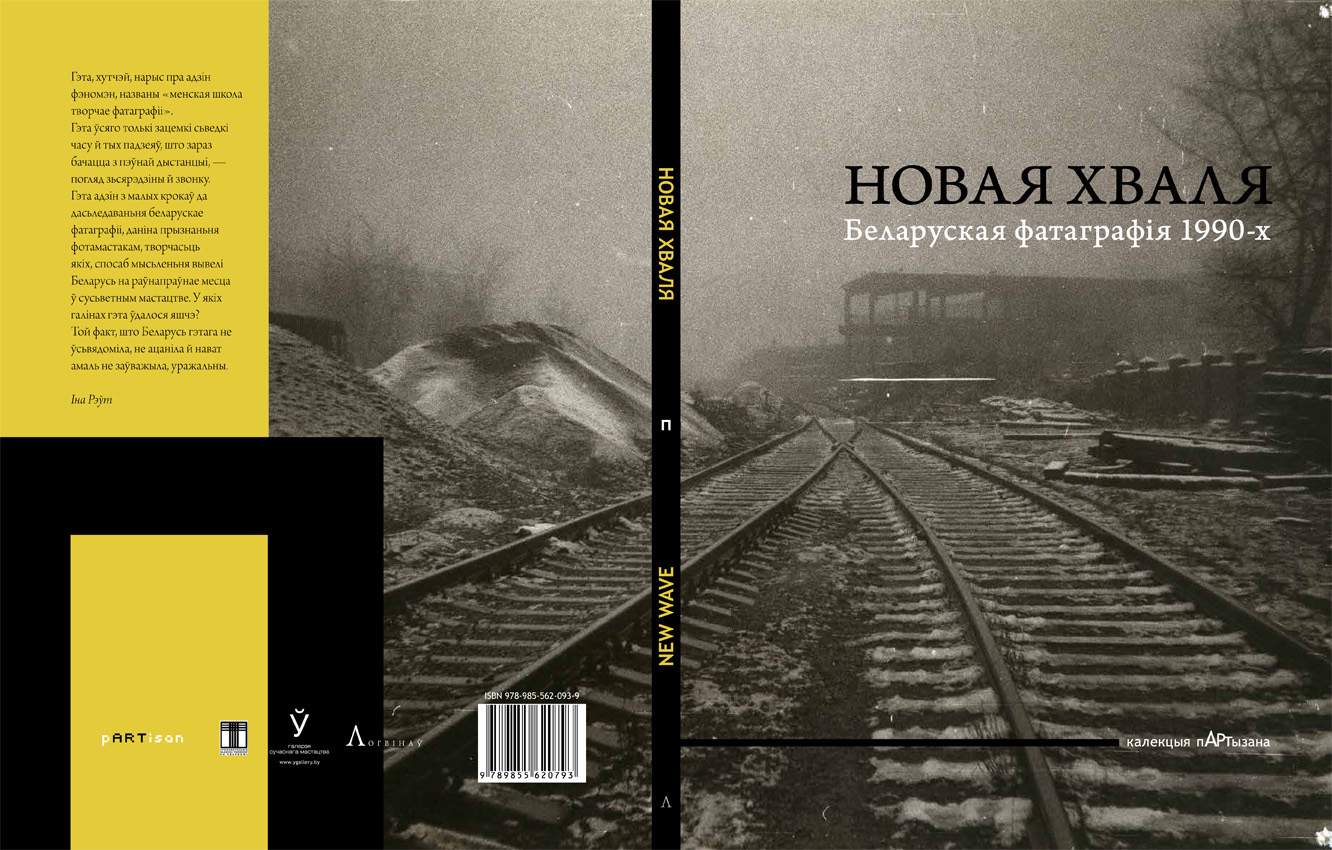
New Wave. Belarusian Photography of the 1990s. New Wave. Album. “pARTisan Collection” series. Minsk, I.P. Lohvinau, 2013.
Review prepared by Daria Amialkovich.
In February, Gallery “Ў” hosted the presentation of the album New Wave: Belarusian Photography of the 1990s, published at the end of 2013 in the special “pARTisan Collection.” This publication identifies the phenomenon of creative Belarusian photography within the context of art history.
Its compilers turned to the concept of the “Minsk School of Photography” and, more broadly, the “new wave” of photography, making an attempt to record and show the viewer a unique cultural phenomenon that unfolded here in the 1980s and 1990s and was recognized internationally, but which, unfortunately, still remains insufficiently understood in its homeland. The text accompanying the photo album, which offers above all a historical overview of what was taking place in the Belarusian photographic milieu of the 1980s and 1990s, was prepared by art historian Ina Reut.
From the amateur photography movement to the work of Valery Labko
The term “Minsk School of Photography” was first used by foreign curators and art historians in the late 1980s. It was from outside that the designation came for a special approach to photography among Minsk artists, one that set them apart from other practitioners in the Soviet space.
Many people know about the active amateur photography movement, the work of the Minsk photo club in the 1960s and 1970s, and, in particular, about the “Photographica” festival, which was held in the capital of the BSSR and brought together photography enthusiasts from across the Soviet Union. Yet alongside this trend, in the 1980s, a new association of photographers emerged on the basis of the same Minsk photo club, distinguished by a different approach to the “practice of photography.” This refers to the studios of the outstanding photographer and teacher Valery Labko, for which he began recruiting students in 1983.
Valery Labko followed unusual principles when admitting people to his “courses”: what interested him in potential authors was not excellent technical mastery, but the ability to express one’s own thought and originality of thinking. Strange as it may seem, the experiment bore fruit: as a result, on the basis of “Minsk,” a creative milieu was born that erupted with the emergence of remarkable authors and, consequently, a new photography unlike anything that had been created here before.
Projects and exhibitions
In 1988, a group exhibition by Labko’s studio members and their creative allies, entitled “The Beginning,” took place at the House of Cinema. This exhibition did indeed become the beginning of the new authors’ path toward international recognition. The creative photography of Minsk photographers was noticed by foreign specialists: the first to point out its distinctiveness was the Finnish curator Hannu Eerikäinen, then the Russian photography researcher Valery Stigneev, then the American critic Grant Kester… And it was indeed distinctive: it did not merely record events and objects nominally, but was a photography that interacted with reality, fusing the image and the author’s sensations into works of art.
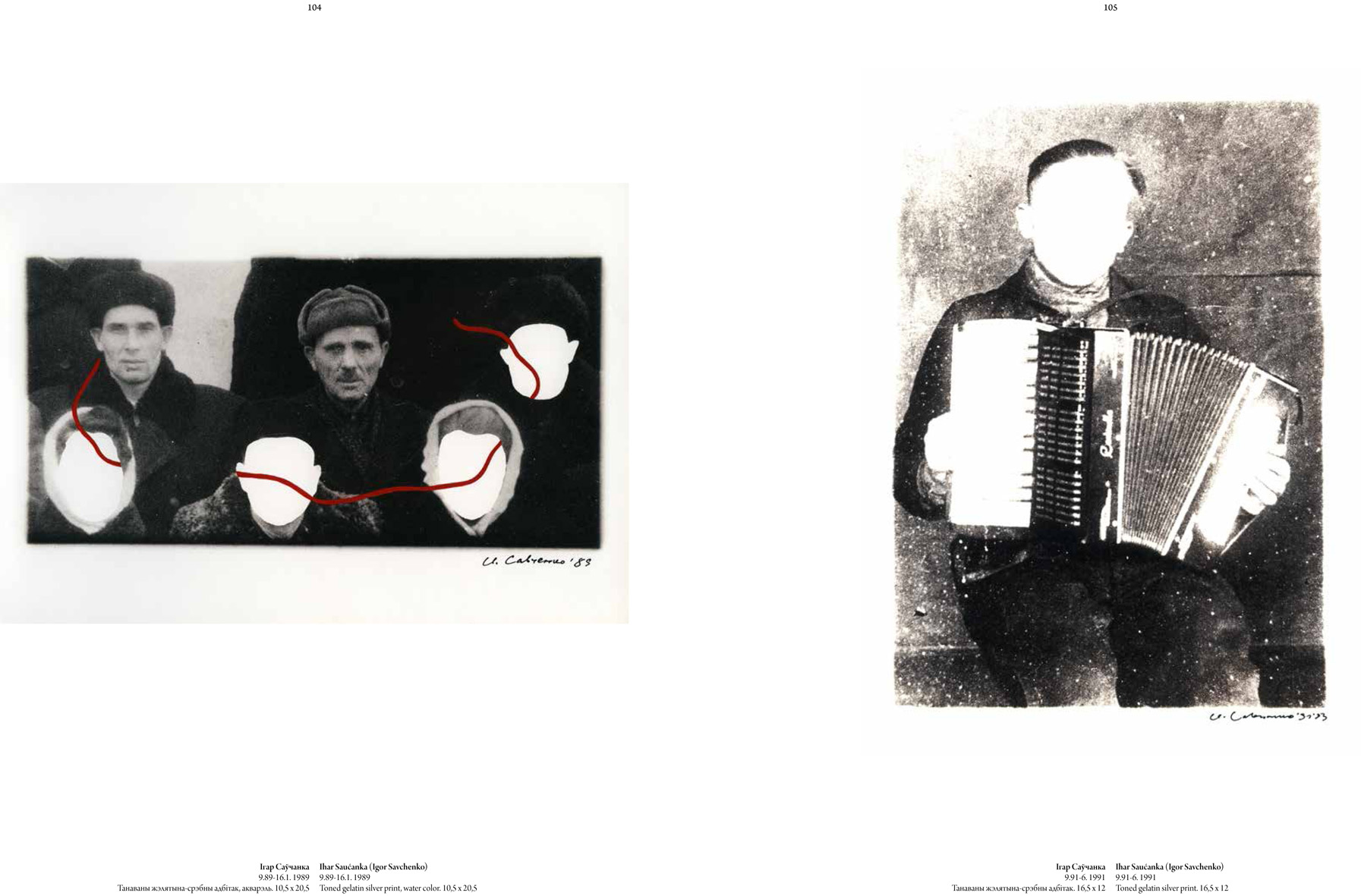
The authors worked with themes of collective memory, trauma (Igor Savchenko, Sergei Kozhemyakin), the identity of Soviet/post-Soviet people (Uladzimir Parfianok, Galina Moskaleva, Uladzimir Shakhlevich, Aliaksandr Uhlianitsa, Viktar Kalenik), and the city as a mental body, a part of collective consciousness (Ivan Piatrovich, Vadzim Kachan, Mikhail Harus)… They used photography as performance (the group “Belarusian Climate”). The use of series, of sequences of photographs, became a fundamental approach here, giving photo artists the opportunity to convey messages to the viewer that were complex in emotional and semantic content.
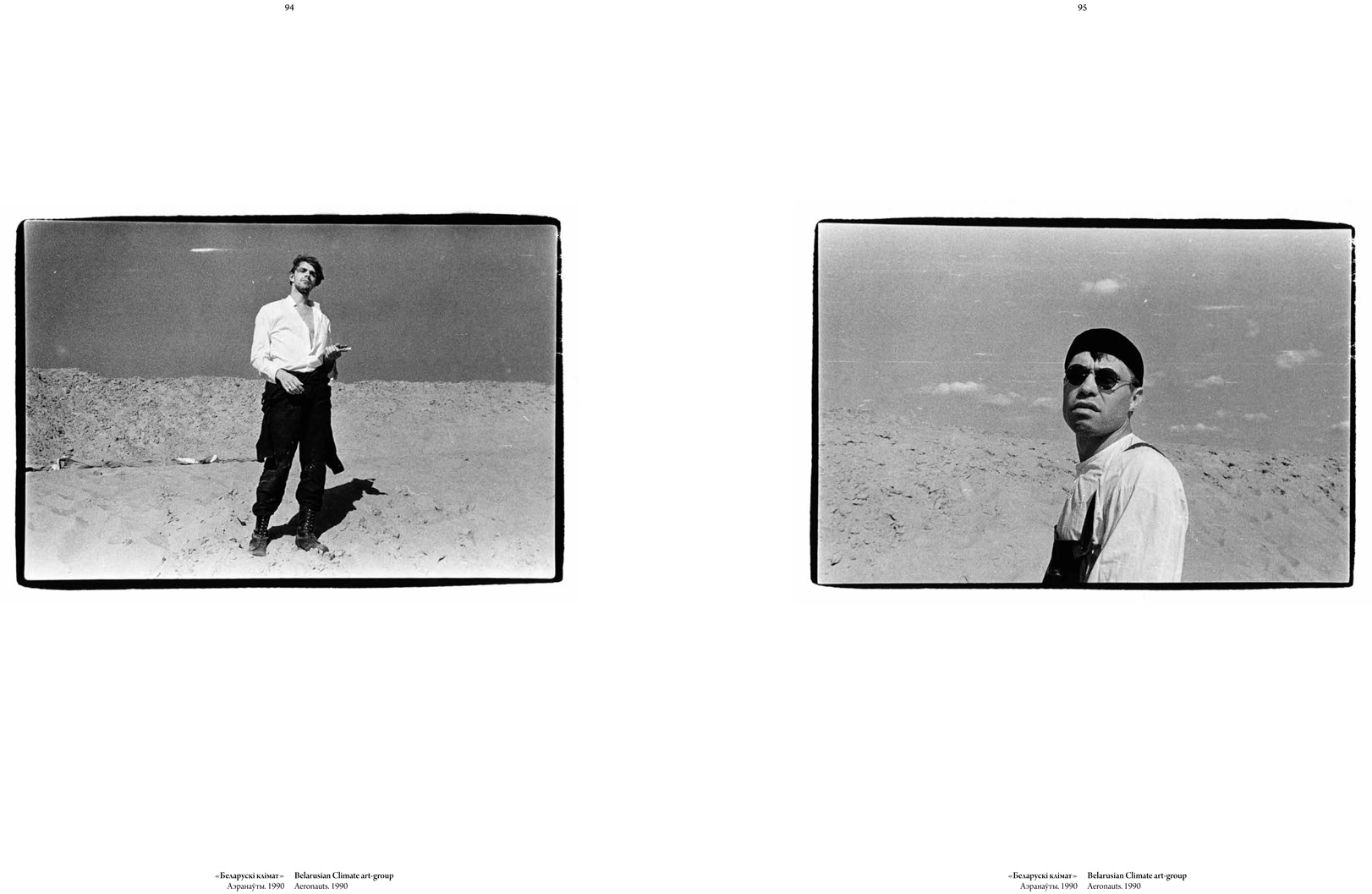
“Belarusian Climate,” the series “The Conquest of the Belarusian Deserts” / from the album “Belarusian Photography of the 1990s”
Exhibitions in cities of Belarus, the Baltic states, Russia, Ukraine, and Georgia, followed by participation in European and American international projects: the distinctiveness of the photography of the representatives of the “Minsk School” was truly evident, and interest in it kept growing.
Here is only a partial list of projects in which works by Belarusian artists occupied a central place: “New Soviet Photography” (Finland, Sweden, Denmark, 1988–1989), “Eroosio/ Erosion. Soviet Conceptual Art&Photography of the 1980’s” (Finland, 1990), “USSR Photo. Photographers from Minsk” (Denmark, 1990), “Contemporary Photography from USSR” (USA, 1990), “Photo Manifesto: Contemporary Photography from USSR” (USA, 1991), “Contemporary Photography in New Independent States” (USA, 1992), “Past–Future: Point of Intersection” (Sweden, 1998), and so on. One should also add publications in well-known photography journals around the world and the acquisition of works by Belarusian authors for European museum collections.
The success was neither imagined nor exaggerated: the art phenomenon of the “Minsk School” sounded on the international art scene, and later also that of the Belarusian “new wave,” which included authors who, although not students of Labko’s school, nonetheless followed corresponding creative approaches: photography as an instrument for comprehending reality, photography as a means of grasping changes in one’s own consciousness. I believe this was a cultural phenomenon capable of changing from within the attitude toward contemporary Belarusian culture as secondary and incomplete, but, unfortunately, it was not particularly noticed by Belarusian society itself.
The “Minsk School of Photography” in Artur Klinau’s album
The album produced by the team headed by Artur Klinau is, in essence, the first attempt to tell the story of this unique legacy, the essence of which, unfortunately, is still not understood by the majority. The very appearance of the album is undoubtedly a major step forward. But do the compilers of the publication manage fully to tell the story of the phenomenon mentioned above?
In a certain sense, yes, and a significant part of the work here was done by art historian and curator Ina Reut, who set the necessary context in the introductory text, the coordinate system within which this cultural phenomenon should be considered. Yet there are certain problems in the construction of the visual sequence, and I would like to discuss them in more detail.
What makes up the album’s visual sequence? For the most part, it consists of outstanding series by Belarusian artists: those that have repeatedly been exhibited in prestigious halls in Europe and America, printed in well-known foreign photography collections, and finally opened up to the attention of our viewer. Uladzimir Parfianok’s provocative and vivid series “Persona non grata,” Galina Moskaleva and Uladzimir Shakhlevich’s visually wild and powerful work “Madhouse,” Igor Savchenko’s metaphysical prints, the “modest” portraits of an era shown in Uladzimir Shakhlevich’s cycle “Portraits for a Collective-Farm Honour Board,” Sergei Kozhemyakin’s haunting series “Phantom Sensations,” as well as his “unspoken memories,” the work “Blue Butterflies,” and the impressive “Children’s Album.”
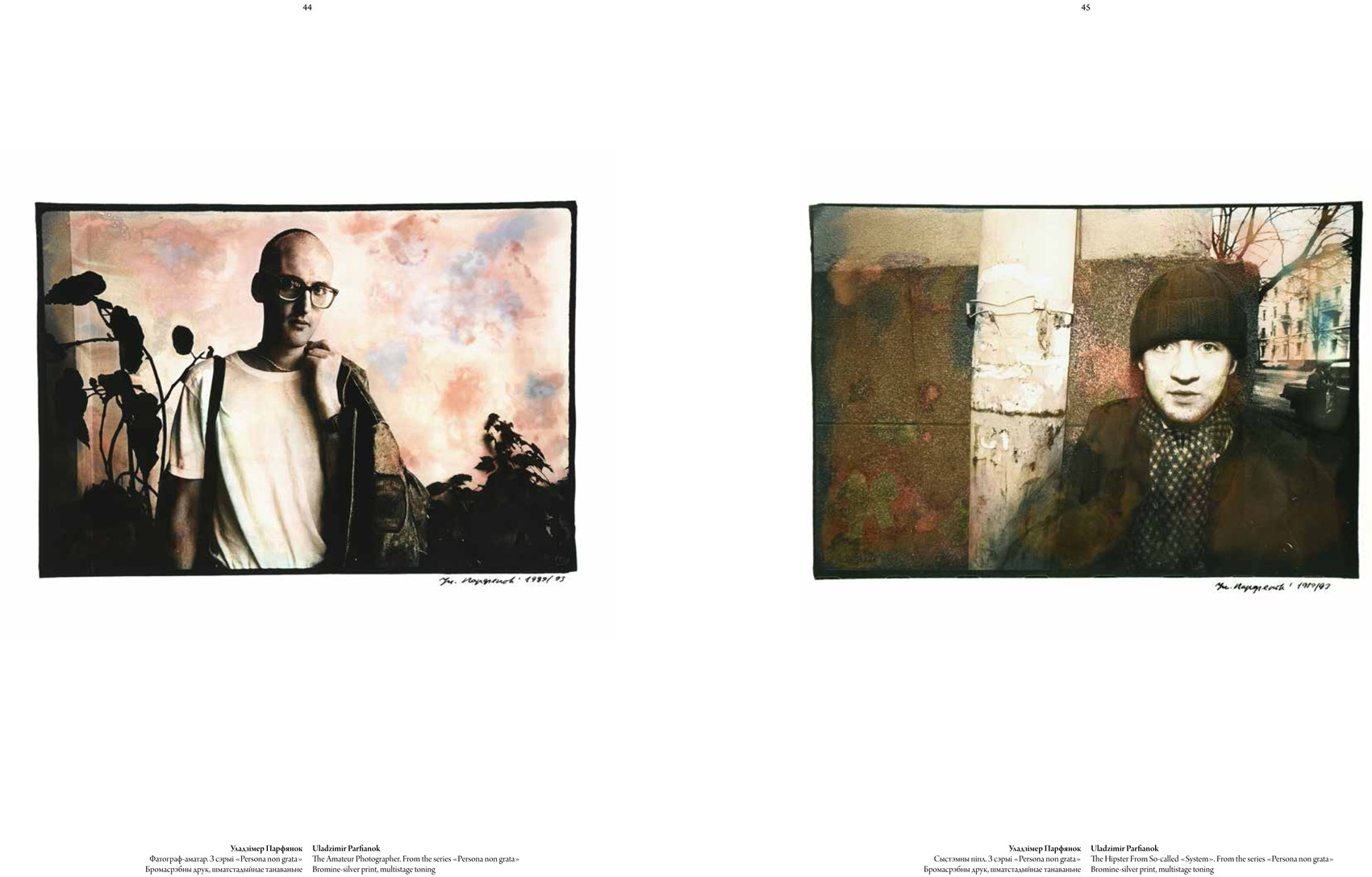
Uladzimir Parfianok, the series “Persona non grata” / from the album “Belarusian Photography of the 1990s”
Of course, part of the publication is also devoted to Valery Labko’s expressive portraits and collections. The fresh and rock-and-roll (there is no other way to put it) “photo performances” by “Belarusian Climate,” which were a genuine gift to the public, as well as extremely interesting material; perhaps less widely known but significant cycles by Mikhail Harus, Vadzim Kachan, Ivan Piatrovich, Aliaksandr Uhlianitsa, and photographs by Viktar Kalenik.
Everything seems quite good, but the impression is badly spoiled by a strange detail: the arrangement of the authors’ works. The photographers’ works are presented in an arbitrary order. Series replace one another without leaving a clear sense of the author’s figure and creative search, something that could well have been achieved by dividing the visual content into individual authorial chapters.
Another approach could also have been chosen: arranging the material by themes, which would have made it possible to understand the meanings with which the authors work. But this is absent, and as a result the main feature of creative photography, its conceptual component, is “washed out” into the purely visual.
There is also no clear position regarding the chronology of the works (in any case, this arrangement of the works is not based on chronology). Perhaps the compilers wanted to preserve the stylistic appearance of the “pARTisan Collection” publications, but as a result of this construction of the visual sequence, the conditions for understanding the authors’ works have not been created.
In her review, Ina Reut very precisely notes the distinctiveness of the “Minsk School of Photography”: “The works of the Belarusian photographers we are considering are interesting not only for their experiments with the image, but above all for their work with consciousness. Memory, for instance, occupies a significant place in their works. They know how to show the invisible. They raise existential problems that have a universal human dimension, independent of ideologies. Free of provincialism, the “Minsk School of Creative Photography” struck a universal human nerve.”
In this sense, it would have been very appropriate to see and trace how each author represented in the album finds his or her own path to revealing the time of the “break of epochs” in which he or she happened to live, how the author reflects on it through the means of photography, why he or she works precisely with these themes and images, and how the evolution of his or her views takes place. The format mentioned above, however, unfortunately offers only a panoramic introduction to artistic experiments. As if to say: this, too, existed.
The first step toward the “new wave” of Belarusian photography
Let me go once more through the pages of the album. The publication opens with Sergei Kozhemyakin’s already “canonical” photograph, which once appeared on the cover of the American Photo/Manifesto in 1990: an infant girl on the red flag of the Soviet Union. Then, accompanying the introductory text, comes a portrait of Valery Labko from the “Belarusian Climate” series; the level of intrigue is maintained by the photograph placed next, Uladzimir Parfianok’s “slap in the face of public taste” from the series “Persona non grata”… A work by “Belarusian Climate,” a work by Vadzim Kachan, Uladzimir Shakhlevich and Galina Moskaleva, Igor Savchenko, Sergei Kozhemyakin, and again Uladzimir Shakhlevich. This beginning, vivid works as illustrations to the text, is a typical device for publications in the “pARTisan Collection,” but for some reason this arbitrary formula, this algorithm, is preserved further in the construction of the visual narrative. A certain cycle by one author is followed by a series by another, then by a collection by a third, and suddenly by a new series by the first author. Unfortunately, it is impossible to discern any intelligible motivation behind this device, any reason why it is being done.
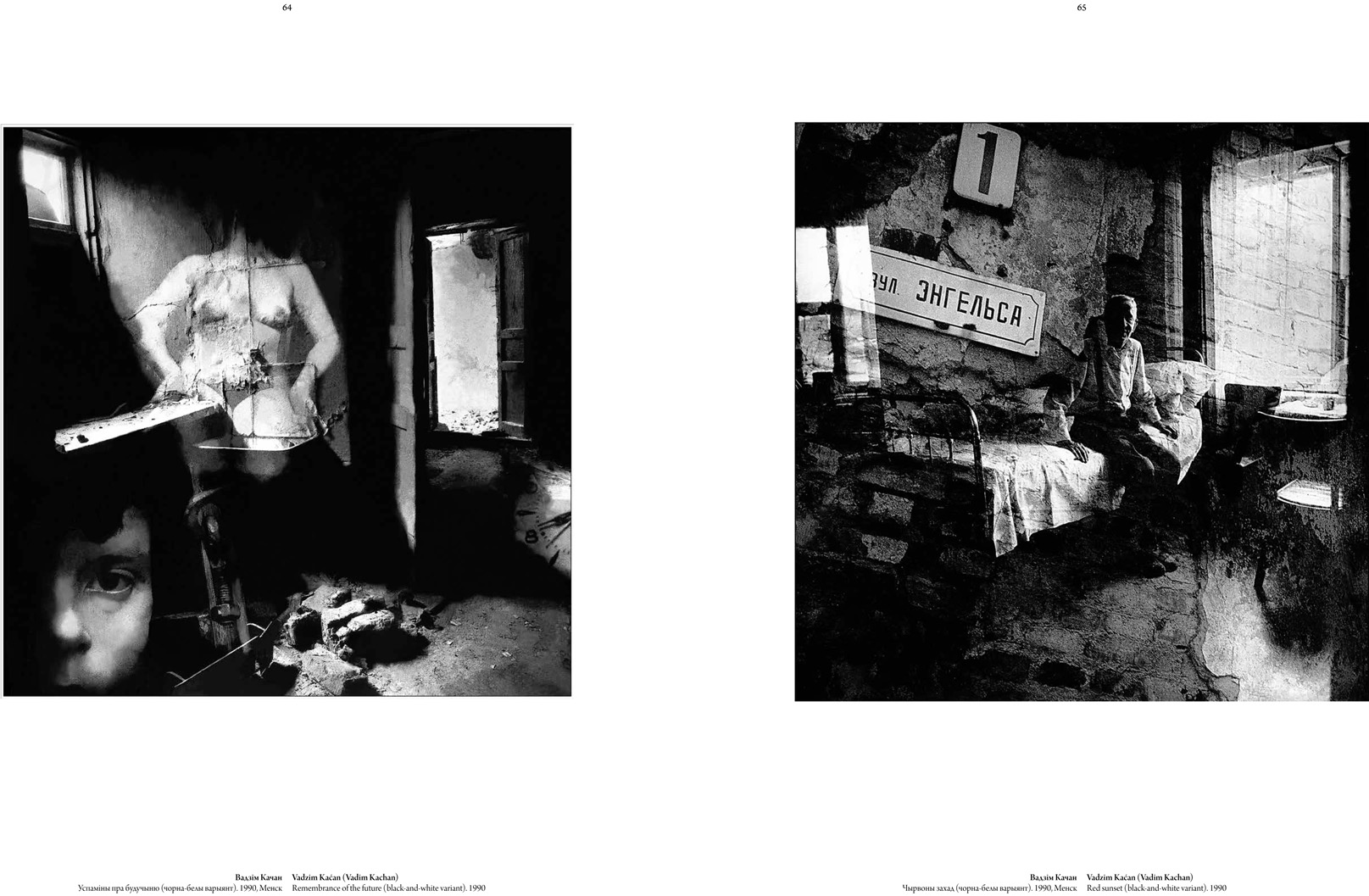
Vadzim Kachan, “Memories of the Future,” “Red Sunset” / from the album “Belarusian Photography of the 1990s”
A major success of the album is the inclusion, alongside the “canonical” photo series known to a certain circle of viewers, of works that had not previously been widely presented or had not been published at all: for example, Galina Moskaleva’s collection “Childhood Memories,” Valery Labko’s triptych “Little Dog,” Uladzimir Shakhlevich’s series “A Cheerful Sunday,” Ivan Piatrovich’s cycle “Fracture,” and so on. True, many of them are heavily abridged. As a result of this editing, some authors have suffered considerably: Mikhail Harus and Ivan Piatrovich, in my view, are represented in the album almost formally. I understand that the creators of the publication faced a difficult task: to show the “hits” thanks to which Minsk creative photography is known in the world today. But precisely a balanced selection between the publication of little-known, non-reproduced collections and “those very” works could have become its successful concept.
Galina Moskaleva, Uladzimir Shakhlevich, the series “Madhouse” / from the album “Belarusian Photography of the 1990s”
This, unfortunately, did not happen. As a result, what we have before us is a wonderful collection that, in a certain sense, demonstrates an excellent stratum of photography, but not a full-fledged album that, through its visual component, would give a sense of the distinctiveness and expressive force of the “new wave.”
Nevertheless, despite all the remarks, one cannot fail to support the publication of New Wave. It is the first attempt in this direction, something that no one had managed to carry out until now. And when, at the presentation, one sees the moved faces of photographers who, after participating in Finnish, Swedish, and Danish projects, after exhibitions in prestigious halls in New York, Baltimore, Berlin, Stockholm, Budapest, Copenhagen, and Sopot, after their collections were acquired by the Moderna Museet in Stockholm, the Royal Library of Denmark, the Museum of Photographic Art in Odense, after the publication of their works on the covers of Time, PHOTO&video, the Sotheby’s catalogue, and so on; when one sees and feels their joy at recognition, even if for now only within a small circle of compatriots, one understands how important it is that this phenomenon is beginning to be interpreted in Belarus as well.
I hope that the album New Wave. Belarusian Photography of the 1990s will become the beginning of the interpretation of this undeservedly unnoticed cultural phenomenon, whose creators and active participants, incidentally, live and work alongside us.