
Publications · 11 September 2012
Memoirs of an Ambassador
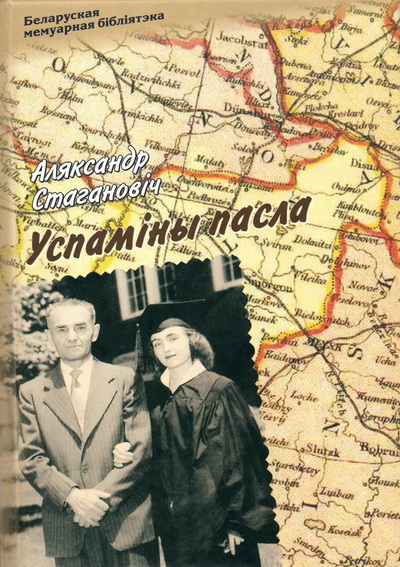 Aliaksandr Stahanovich. Memoirs of an Ambassador. – Minsk: Limarius, 2011. – 270 pp. (Belarusian Memoir Library).
Review prepared by historian Andrei Mastyk.
It is well known that memoir literature is published in Belarus only sporadically, especially when it concerns the memoirs of people who do not belong either to the official mainstream or to the classical Belarusian pantheon. Therefore, the appearance of another set of memoirs on bookstore shelves has already become something of an event, both for researchers and for history enthusiasts. Aliaksandr Stahanovich’s “Memoirs of an Ambassador” can be counted precisely among such phenomena, all the more so because this book opens the “Belarusian Memoir Library” series, announced as a publishing project intended to print a large cycle of memoirs and epistolary works by Belarusian public figures and cultural creators.
The seriousness of these intentions is indicated by the composition of the scholarly and publishing council: Aliaksei Kauka, Vitaut Kipiel, Adam Maldzis, Mikola Nikolaeu, Vital Skalaban, Ales Smalianchuk, Zakhar Shybeka, and Lavon Yurevich. To launch the memoir series, its editors chose the recollections of a rather interesting but little-known figure in the Belarusian movement, Aliaksandr Liavonavich Stahanovich, who is noted in our historiography above all as an activist of the Belarusian emigration.
Memoirs, of course, are not only a literary genre, but also a special source for historiography. In terms of factual accuracy, memoirs are significantly inferior to documentary sources. Yet at present their relevance lies not at all in the transmission of historical facts. Memoirs are important as an additional source that reveals the anthropological factor in history and reflects the presence of the human factor within it. It is precisely this factor that allows us to see human logic in the events of the past and to interpret them not from the standpoint of our own worldview and set of socio-political assumptions, but in accordance with the mentality and views of the people of that time, the contemporaries of the events.
Like everything human, memoirs are a highly subjective phenomenon, although in accordance with the laws of the genre they must preserve a correspondence to historical facts. But again, unlike diaries, for example, memoirs are based on retrospection, turning to a distant past. Long-past episodes and events are therefore inevitably re-evaluated from the height of the experience acquired by the memoirist.
All of the above applies fully to “Memoirs of an Ambassador.” The memoirs are interesting above all for their highly emotional and categorical assessment of the events the author had to live through. And this assessment, which is very important, proceeds not exclusively from personal and emotional attitudes, but from the author’s ideological premises and political views.
Briefly, this work can be described as the memoirs of a “Belarusian politician.” As is known, politics is a rather combative phenomenon, one that always implies conflict, a certain external and internal confrontation. Confrontation, in turn, entails struggle against an opponent — and the memoirs are permeated by this struggle.
Aliaksandr Liavonavich began his struggle back in 1905, while still an adolescent; he reached the peak of his political activity in “Zmahanne” (the parliamentary club in the Sejm of the Second Polish Republic); and he continued his struggle into old age, already in emigration.
The emotional narrative of the memoirs reveals to us the strange, winding, and at times very tangled relations of the Belarusian national movement with its enemies and opponents in the form of Polish governmental and punitive bodies and communist organizations financed by Soviet power. The relations among competing groups within the Belarusian movement itself are also examined. In his memoirs, Aliaksandr Stahanovich very clearly reflected the contradictory and tense situation of the 1920s and 1930s, a situation of constant confrontation and political hostility.
The memoirs contain a severe assessment and at times an overly categorical view of the activities of individual Belarusian social and political figures: Y. Stankevich, V. Rahulia, A. Luckievich, R. Astrouski, and many others. In general, many names appear in these memoirs, both famous and little known. The distinctive feature of the memoirs is that the author’s categorical and critical tone breaks the positive aura of the Belarusian movement, its external, illusory integrity, and presents compromising information about specific well-known figures.
Naturally, this cannot mislead a thoughtful and measured reader. On the contrary, the author’s statements emphasize, so to speak, the authenticity and vitality of the events described, with all the intrigues, betrayals, and grievances inherent in human life. An attentive reader or researcher, on the basis of the author’s testimony and with due allowance for its undoubted tendentiousness, can arrive at his or her own conclusions.
As for the factual material, it is quite interesting and unusual in this edition. In principle, as stated in the preface to the memoirs, they are devoted to one stage in Aliaksandr Stahanovich’s life — the year of his work as an ambassador/parliamentary deputy. In reality, however, the memoirs, as memoirs should, describe the deputy’s life path from birth to 1944, the time of his forced emigration from the Homeland. The author’s journalistic works included in the edition, written and published later in emigration, more likely reflect the features of Stahanovich’s émigré life and activity.
The main focus of the memoirs is directed at the short period of Stahanovich’s parliamentary activity and everything connected with it. The 1928 elections to the Sejm and Senate, in which the author was a direct participant, are illuminated in an exceptionally interesting way, because their circumstances are not very well known and are almost absent from our historical literature. Here again, the situation around these elections turns out to have many contentious and ambiguous aspects. The work of the “Zmahanne” parliamentary club, created by Belarusian parliamentarians, is full of intrigues and conspiracies. Here we again see the collision of interests and ambitions among different currents of the national movement, now within the Belarusian faction of the Polish Sejm.
In addition to the main theme, the memoirs contain many interesting and unexpected episodes. For example, the author writes about his participation in the First World War, recalling little-known episodes of the combat operations of Russian military units in the Balkans and in France. In his memoirs, Aliaksandr Stahanovich also shares the difficult experience of being a prisoner in Polish jails.
Aliaksandr Stahanovich also describes the events of the Second World War, touching on the process of the establishment of Soviet power in Western Belarus. The author does not ignore the difficult period of the German occupation, nor the participation in these events of Belarusian civilian and military organizations in the Navahrudak region that cooperated with the German occupation administration.
Speaking of the edition, it is worth noting the work of those who prepared it for publication. The memoirs are accompanied by necessary and precise comments by historians Aliaksandr Pashkevich and Aleh Hardzienka, which allow even a reader unfamiliar with the history to navigate freely through the historical and political context of the memoirs. The memoirs are also richly illustrated with photographs. Among them, in my view, are some quite unique images, for example those taken in the Balkans during the First World War. Special attention should be paid to the preface to the memoirs, which fully corresponds to its title, “A Portrait against the Background of an Epoch.” In fact, it is a full-fledged scholarly article by Aliaksandr Pashkevich, which can serve as a good introduction to the historical context of Stahanovich’s activity.
In addition, the article reveals the history of the Polish parliamentary elections of 1928 in Western Belarus (especially in the Navahrudak region), offers the necessary information on the parliamentary system of interwar Poland, and reconstructs the history of the activity of the “Zmahanne” parliamentary club, which may be quite useful for specialists and enthusiasts of this period.
To sum up, it should be noted that “Memoirs of an Ambassador” is an example of a high-quality edition of a memoir text. One can welcome both the publication of Aliaksandr Stahanovich’s memoirs — the memoirs of a distinctive figure in the Belarusian movement, whose name may return to the Belarusian cultural and intellectual field thanks to this edition — and, more generally, the establishment of the “Belarusian Memoir Literature” series, from which we may expect new and interesting publications.