
Publications · 17 April 2013
Is There Happiness If There Is Love?
 The review was prepared as part of the joint Book Review project of the Political Sphere Institute “Political Sphere” and the Center for European Studies in Minsk.
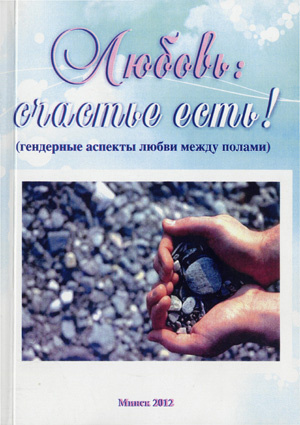
Love: Happiness Exists! (Gender Aspects of Love Between the Sexes). Collection of Materials / Compiled by S. N. Burova and Yu. V. Ivanyushkina; under the general editorship of S. N. Burova and Yu. V. Ivanyushkina. Minsk: Pravo i ekonomika, 2012. – 140 pp.
Review prepared by Tatsiana Shchurko.
In the book Love: Happiness Exists! (2012) the primary responsibility for relations between the sexes, especially romantic relationships, is placed on women. It is girls, rather than boys, who are expected to attend a specialized session, and it is from them that greater responsibility for their sexual life is expected.
In 2012 an interesting publication appeared in Belarus, intended to raise the issue of the gender aspects of love. The collection is a set of trainings, materials, and exercises for conducting gender education among young people.
Gender education in Belarus
The relevance of this collection is due to the fact that, according to the Education Code adopted in Belarus in 2011, gender education is one of the main areas of education as such. In theory, gender education is intended to free the educational environment from rigid gender stereotypes that become the basis for discrimination on the grounds of sex.
Thus, research data and statistics indicate different forms of discrimination against women that still flourish in our country: domestic violence; gender segregation in the labour market (the predominant concentration of women in low-paid non-production sectors); inequality in wages; and the strengthening of conservative tendencies that confine women to a narrow circle of social roles (mother, homemaker, child educator).
Accordingly, the implementation of gender education in educational institutions should contribute to the development of egalitarian relations between the sexes and to the strengthening of women’s participation in the socio-political and economic sectors. Today Belarus faces a shortage of educational and training complexes that could be used for classes and trainings on gender education among young people.
The composition of the collection
The collection was prepared by the public association “Belarusian Association of Young Christian Women” (BAYCW). The book was compiled by S. N. Burova, Candidate of Legal Sciences and deputy chair of BAYCW, and Yu. V. Ivanyushkina, General Secretary of BAYCW. The reviewers of the publication were O. A. Yanchuk, Candidate of Sociological Sciences and associate professor, and N. V. Kurilovich, Candidate of Sociological Sciences and associate professor.
In the most general sense, the collection seeks to rehabilitate the concept of “love” as an important form of close interpersonal relations. The creators of the collection set themselves a practical task, seeking to answer the question of how one can speak about love with the younger generation. This is why the book contains many exercises designed to stimulate discussion about various aspects of love and the development of this concept in a socio-historical perspective.
The collection includes three main modules: “Man, Woman, Love”, “Choosing a Partner, Marriage, Family”, and a third module containing additional materials (mini-lectures, exercises) on the topics of the first two modules. The collection is especially valuable because it was developed during seminars for trainers in the BAYCW network, after which the trainers independently conducted information and educational events. Accordingly, the main part of the publication consists of developed and tested training sessions: the first module includes seven trainings on the concept of love, and the second module includes three trainings on the concepts of marriage and family. The third module offers materials for mini-lectures and additional exercises.
In what sense do men and women exist, and what are they responsible for?
First of all, it should be noted that the collection is written within the framework of sex-role theory rather than gender theory, and is oriented toward a fairly conservative model of relationships.
The gender approach in education is based on the conviction that biological differences are not determinative in the formation of the psychological and social characteristics of women and men. The decisive role in the formation of gender differences is played not by biological sex, but by the social and cultural meanings that society ascribes to anatomical differences.
The sex-role approach, by contrast, proceeds from the notion that there are two biological sexes (male and female) that are fundamentally different, which also leads to differences in their roles in society. Predictably, the educational component is aimed at reinforcing these differences: orienting boys and girls toward the performance of different roles and supporting gender differences in their interests and activities.
Men and women are treated in the collection as “naturally” different categories: “After the participants have answered, the trainer concludes that nature created man and woman as different not only in their physiology, but also in their psychology” (p. 11). The main goal of education is seen as creating conditions for the development of a “correct” identity and an integral understanding of one’s belonging to a particular sex. This is understood as the formation among students of knowledge about traditional gender roles; about the life purpose of men and women; about the positive qualities and character traits inherent in them; and about the physiological, psychological, and ethical features of the sexes.
The sex-role approach presupposes a differentiated attitude toward girls and boys in the educational process. The emergence of separate assignments for boys and girls emphasizes and legitimizes differences between the sexes and forms social norms and rules of behaviour for each sex. Accordingly, some exercises in the collection, and even some trainings, are intended to be conducted separately for boys and girls. Thus, the first module contains a training intended only for girls: “How to Behave in the Company of a Boy”, the goal of which is to “show the meaning and essence of moral norms in the system of intimate interpersonal relations; to develop in girls the skills for organizing optimal communication with representatives of the opposite sex” (p. 24). In this case, it is interesting that the collection does not include an analogous training for boys.
Accordingly, the primary responsibility for relations between the sexes, especially romantic relationships, is placed on women. It is girls, rather than boys, who are expected to attend a specialized session, which means that greater awareness among girls entails greater responsibility for their sexual life. Such shifting of responsibility onto women is a fairly dangerous tendency and in no way promotes equal relations, since it substitutes for the essence of gender equality, which presupposes responsibility for shared life on the part of both men and women.
Sexuality and reproduction
The creators of the collection believe that education should form “real” men and women and orient them toward love, family, marriage, and childbearing. Relations between the sexes are relations of love, which should subsequently lead to the creation of a family and the birth of children.
The collection considers only relations between a man and a woman and does not include even assumptions about the possibility of, for example, same-sex relationships. Love is linked to such concepts as family and marriage. The topic of sexuality is deliberately excluded because love is seen as the basis of moral and ethical education. In addition, the concept of reproduction and the continuation of the lineage as the main goal of relations between the sexes is placed at the centre of attention.
“Even the most superficial look at the role of sex reveals that its original purpose is the continuation of life and, under certain conditions, the development of offspring toward higher consciousness and abilities” (p. 70).
Moreover, within the mini-lecture “Modern Families”, a eugenic discourse is widely represented, placing on women responsibility not only for reproduction but also for the birth of healthy and “proper” children: “The main role in improving the quality of offspring belongs to the woman. This directly depends on the choice of the father for the future child. A woman who can choose a strong and better man but gives herself to a weak or inferior one because she has lost the proper assessment of her own feelings commits the gravest crime against nature” (p. 70).
At the same time, violence against women is included among the manifestations of the “weaker” type. On the one hand, one might suppose that this is an attempt to motivate women to treat themselves with respect and not to tolerate domestic violence. On the other hand, however, linking this point to reproduction from the “better man” completely nullifies the possibility of such motivation on the part of the collection’s creators, since the woman is again deprived of choice and the right to self-determination. It is also logical to ask: is it really assumed that violence against women is the result of natural predisposition? And, moreover, of a predisposition transmitted by heredity?
Nira Yuval-Davis [1], in her work Gender and Nation, notes that eugenic discourse links the quality of the nation to selective conception and childbearing; it presupposes intervention in reproductive processes in order to bring into the world only children “desirable for society”. Contemporary eugenic discourse operates with concepts such as the “gene pool of the nation” and “genetic potential”, on which the health and future of subsequent generations depend.
Such discourse politicizes the female body and reduces its value to the level of reproducing the population/nation. A woman’s value is determined by her ability to perform the function of childbearing “well”.
The egalitarian family
The dominant idea in the collection is that the family is a natural and integral cell of society. Education is intended to form a value-based attitude toward the family and child-rearing. This component of education emphasizes the transmission of the value of family life for every student. The model of the family presented in the collection is quite conservative and does not include other types of families/relationships. Accordingly, all models other than a registered monogamous heterosexual family are excluded, silenced, and ignored, which is a discriminatory practice toward everyone who does not fit the normative matrix.
At the same time, it should be noted that many exercises in the collection are oriented toward the transmission of egalitarian values in relations between the sexes and toward respectful attitudes between partners: “The ability to accept, understand, and respect another person and another opinion is very important for good relationships, including those that will develop between you and your life companion in the future” (p. 11).
In the collection, the egalitarian family is treated as a core value. Accordingly, gender equality is understood as a respectful and attentive attitude toward the specific features of the other sex. This is why education is intended to acquaint participants with the features of each sex and to form a tolerant attitude toward them. The question of preparation for creating a family and the formation of readiness to enter into marriage is also raised. This becomes the basis for creating clear rules and moral prescriptions that must guide relations between the sexes.
This understanding of gender equality, transmitted in the collection, apparently should serve the purpose of preventing domestic violence in the family. However, its description corresponds to the basic assumptions of the traditional sex-role approach, which proceeds from the idea that one must not beat a woman because she is weaker, and so on. Moreover, it is precisely in the development of qualities necessary for the successful performance of the roles of husband and wife that the foundation of “family happiness” and the elimination of conflicts is seen.
The goal of the gender approach, by contrast, is to undermine this stable power dichotomy (weak–strong). A woman must not be beaten because one must not beat a human being at all; it is a violation of the right to personal inviolability. In addition, while the sex-role approach sees the solution to the problem of domestic violence in the formation of readiness to follow traditional roles (which allegedly reduces conflicts in the family), the gender approach questions such a formulation because it restricts the life choices of both men and women.
Conclusion
The study of the collection makes it possible to note that it transmits a conservative model intended to orient young people toward the traditional division of gender roles. However, this model already takes into account the trends of modernity, noting the importance of the professional sphere in a woman’s life and the development of egalitarian forms of relations in the family. It should also be noted that, despite the clear position of the collection’s authors, most exercises in the trainings are nevertheless described in a fairly “open” manner, not limiting the course of discussion to rigid instructions. Accordingly, one may assume that this format will stimulate discussion of various aspects of “love”, even if this was perhaps not initially intended by the authors.
Notes
[1] Yuval-Davis, N. (2001). Gender and Nation. Riga, Sage: Elpa.