
Publications · 30 September 2011
In the Ideological Process: An Unrestrained Flow of Facts and Ideas
Warning: Undefined array key "file" in /home/u475055259/domains/palityka.org/public_html/wp-includes/media.php on line 1788
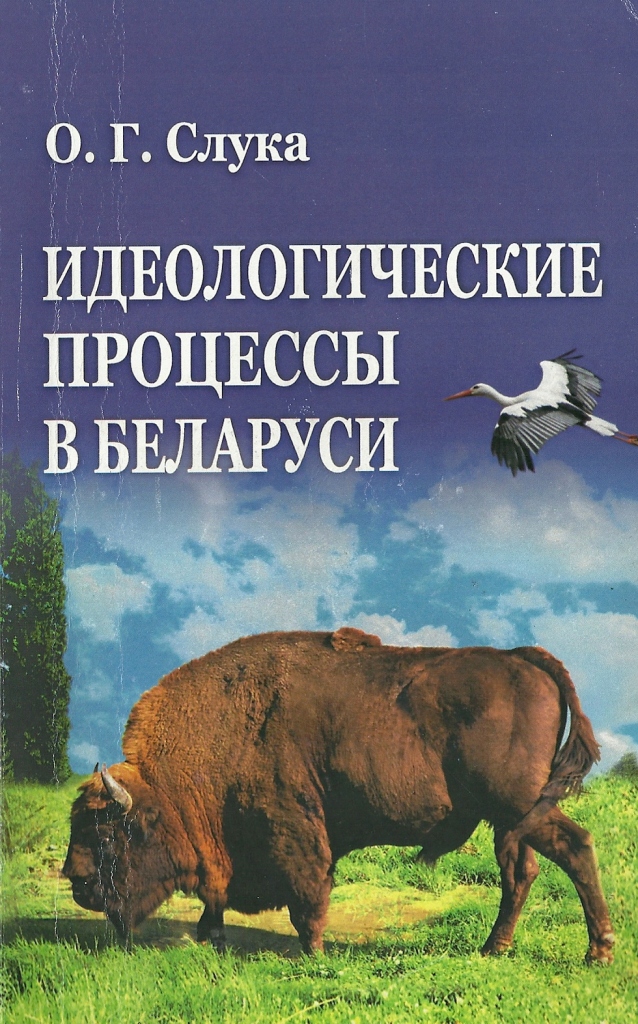 Sluka, O. H. (2010). Ideological Processes in Belarus. Minsk: RIVSh. 220 p.
Review prepared by Andrei Asadchy, a fellow of the Political Sphere Institute.
The book by Doctor of Historical Sciences and Professor of Belarusian State University Aleh Sluka is aimed at analyzing ideological processes in contemporary Belarus. The work is presented as a scholarly publication and was recommended by the editorial and publishing council of the Republican Institute of Higher Education. From the annotation to the book we learn that the work “is addressed to university students and teachers, trainees in the Ministry of Education’s system of professional development, practical workers of the ideological ‘vertical’ of the Republic of Belarus, and all those who study the processes of formation, development, and implementation of the innovative ideology of Belarusian statehood” (p. 2).
Sluka presents his book Ideological Processes in Belarus as “an organic continuation of the scholarly search for effective forms and methods of implementing the ideology of Belarusian statehood as a system of ideas for organizing society and governing the state” (p. 5).
Turning directly to his work, Sluka notes that the aim of the book is “an attempt to study the development of ideological processes in contemporary Belarus and to show the degree of their influence on the most important spheres of the life of society and the state” (p. 8). The author tries to clarify the specificity of the formation of civil society and to explain the need to form a new cultural space. Sluka notes that in his book he turns to the works of “well-known domestic scholars” (p. 8), among them Y. Babosau, H. Vasilevich, L. Zemlyakou, M. Yermalitski, and others.
Nevertheless, the introduction to the book leaves more questions than answers. How exactly were ideological processes in Belarus analyzed? What are the chronological boundaries of this work? What methodology did the author use? The questions could continue endlessly. It is also not entirely clear which of the named “scholars” studied this problem and in which texts their findings can be found. Which issues in this field are the most urgent at present?
The author does not address the historiography of the problem at all, apart from the mention of the above-mentioned surnames, noting only “that the named and other authors did not turn directly to the study of ideological processes in Belarus” (p. 9).
The first section of the book is devoted to an overview of the geopolitical context of Belarusian ideology. The author is critical of the processes taking place at the international level. He calls the assertion of the ideology of globalization in the contemporary world a negative process, one that led to the collapse of the USSR and the entire socialist system, as well as to a gradual redistribution of spheres of influence in the world. Sluka calls Western criticism of Russia and Belarus “conflictual ‘hysterical wailing’ by puppet states and governments used by world reaction to bark at the elephant” (p. 12). Criticizing the foreign policy of the United States, the author accuses the United States of applying “medieval politics” (p. 13).
Sluka calls the contemporary model of the world order an empire, noting that “the empire is fighting for undivided possession of the world” (p. 26). This struggle creates the need for an adequate response, toward which the activity of the CIS is directed. At the same time, it appears that the liberal model of the economy is a global evil. The liberal economy is placed on the same level as debauchery and a “thieves’” redistribution.
The title of the second section, “Methodology for the Formation of a Contemporary Cultural Space,” does not correspond to its content and misleads the reader. The section contains no discussion of research methodology. In this part of the book the author tries to substantiate the need to form a new cultural space in Belarus, which is necessary for the country’s further development.
Assessing the Belarusian education system, Sluka emphasizes the need to reform it. He notes the failure of the attempt to introduce twelve-year schooling and the half-hearted transition to three-level training (bachelor’s, master’s, doctor’s). The author sees a significant problem in the migration of scholars, which he calls the robbery of personnel. To overcome the existing situation, a number of measures are proposed, among them the transfer of school to twelve-year education and the nationalization of the education program through the development and study of the Belarusian language, history, and literature.
Speaking of the need to educate Belarusian patriots, Sluka suddenly shifts to “national” positions, which is not at all characteristic of official state ideology. The author notes the significance of the Belarusian language. Language is called a distinctive feature of the people, an instrument for preserving and developing the Belarusian nation, and the need for a thorough development of a concept of national history is emphasized. The author sees the origins of statehood in the Principality of Polotsk, “our ancient cultural pearl” (p. 78), whose traditions and achievements predetermined the existence of the “Belarusian Grand Duchy” (p. 78). The Grand Duchy of Lithuania is called a Belarusian feudal state, and the “golden age” of the flourishing of national Belarusian culture and science is mentioned.
The third section of the book is devoted to the National Idea and to an examination of its main components. The National Idea is assigned a significant role in the country’s future development: “The National Idea is the main direction of the Belarusian people’s movement into the new millennium-long history” (p. 133). The realization of the National Idea, in the author’s view, will make it possible to achieve a stable and effective economy and a high intellectual culture, in which an important role will be given to social justice.
The fourth section of the book is devoted to the role of communication and the media. Sluka speaks of the need to form a national information space and notes the necessity of an ideological orientation of national mass media; he names the National Idea as the basis for forming the national information space: “the Belarusian people’s awareness of its historically objective path toward freedom and justice” (p. 158). The three components of the National Idea, freedom, independence, and justice, are the ideal of contemporary Belarusian society and should become the ideological direction of media activity in Belarus.
In the author’s view, the ideology of Belarusian statehood is grounded in the country’s history, its culture, and the values of the people, and is a development strategy. An information space saturated with the ideology of Belarusian statehood is a powerful institution for forming a new society. Through the media, an ideological formula is consolidated in mass consciousness: “the ideology of Belarusian statehood is the ideology of a society in which the state is the mechanism for fulfilling its interests” (p. 176).
In the final, fifth section of the book Sluka attempts to examine the phenomenon of civil society.
Sluka sees the path toward strengthening the country’s “young democracy” through the formation of civil society in Belarus. Speaking about the regularity of the development of the Belarusian nation and state, the author turns to the period of Soviet power, which “had a decisive influence on the formation of democratic consciousness among citizens and the development of the principles of national statehood” (p. 206).
Sluka’s work certainly cannot be called a scholarly publication. Nor can it be called an ordinary textbook on state ideology. The book reflects the author’s vision of the country’s development and the role of ideology in this process. The text leaves contradictory impressions. On the one hand, the author tries to bring numerous problematic issues to the fore. In doing so, he allows himself rather critical and bold statements about the current state of affairs. On the other hand, Sluka idealizes Belarusian state ideology, sees in it the solution to all problems, and permits mockery of ideological opponents. The informational unwieldiness of the publication should also be noted. While reading the book, it is sometimes difficult to find a single logic of the narrative.
One gets the feeling that the author consciously sought to demonstrate his “erudition” on various problems. But as a result he managed to write about everything and, at times, about nothing. The book is heavily loaded with ideological clichés. Emotionality in statements and assessments does not add any advantages, while the distinctive style of presenting information and, in places, excessive pathos provide no grounds for speaking of any significant literary quality of the text.