
Publications · 13 June 2013
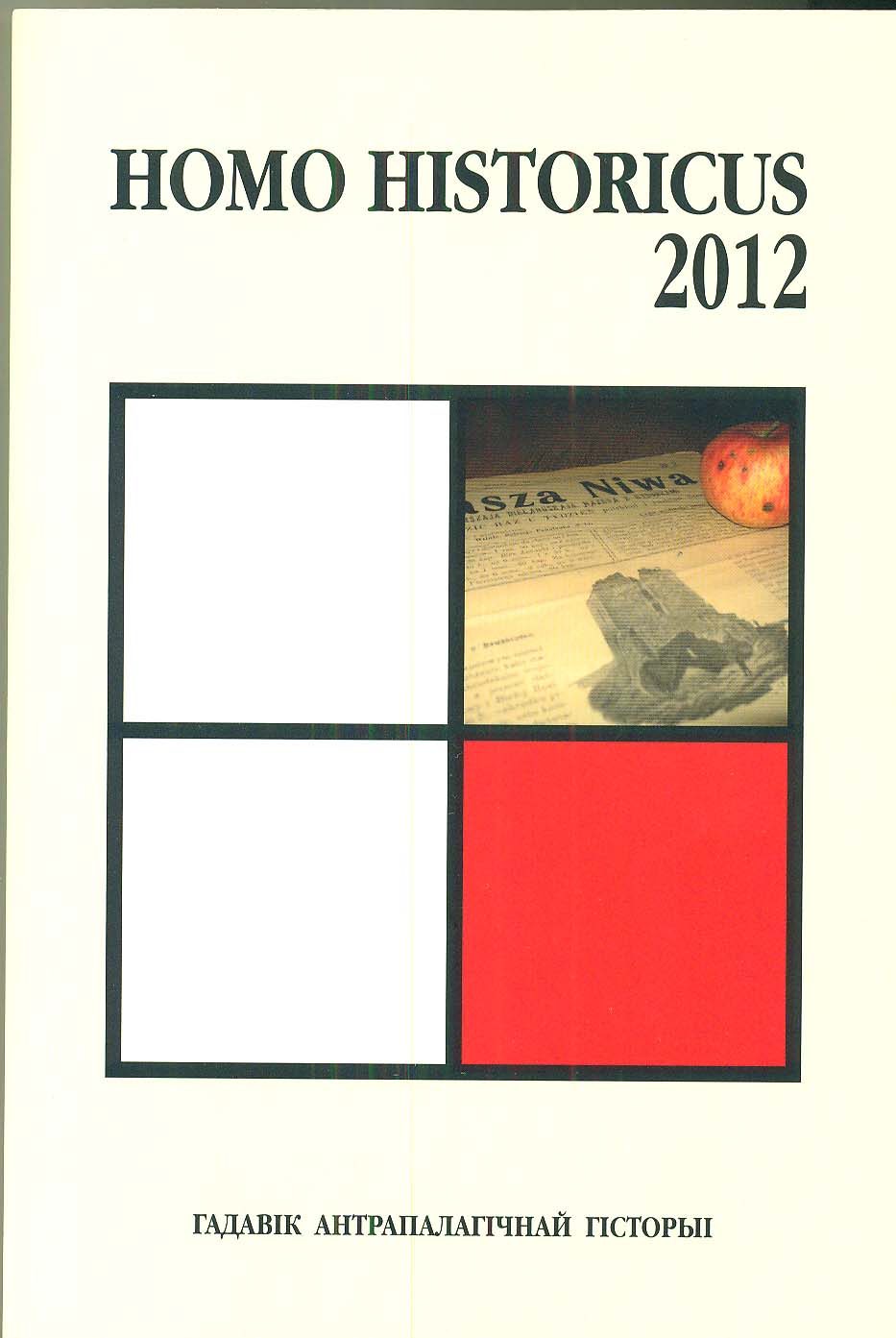
Homo Historicus 2012
 This review was prepared within the joint “Book Review” project of the Political Sphere Institute and the Center for European Studies in Minsk.
Homo Historicus 2012. Yearbook of Anthropological History. Vilnius, EHU, 2012. 526 pp.
Review prepared by Stsiapan Stureika.
Reviewing a collection of scholarly works is not easy. It is often difficult to define the very object of the review: should one evaluate individual articles and materials, or the general concept and the work of the editor? Within the limits of one review, let us try to combine both approaches.
The publication under review is already the third issue of the yearbook. A periodical publication has emerged, which cannot but please the reader. How could it be otherwise, when the idea that captured the editors continues to live, develop, and must, in one way or another, bear fruit. With this in mind, it would be very interesting to know how the editors themselves perceive the dynamics of their own work. Unfortunately, the review has to begin by noting the absence of any introduction that would reconceptualize the idea of the publication in a new way.
The absence of an introduction and an explanation of the structure somewhat confuses the reader. It is clear that the previous two collections began with introductions. Incidentally, the very first introduction became the subject of a meticulous analysis in one of the few critical reviews.
The collection consists of seven sections, but it seems that the first two are the most central and conceptual.
The first section is “History, Anthropology.” The very title itself (the words separated by a comma) shows that the editors are aware of the difficulty of gathering specifically historical-anthropological texts. Here one finds perhaps the strongest materials that in some way correspond to the stated directions.
The very first text in the collection, by Father Alexander Nadson, is presented as a scholarly article, and the fact that it stands at the very beginning raises the expectation that this is a model example of anthropological history. All the more so under such an intriguing title: “A European in a European City: Skaryna in Vilnius.” In fact, however, the text is a transcript of a public lecture delivered by Fr. Alexander on a solemn occasion at EHU. Publishing such a text is an honor both for the publication and for the author himself. Yet perhaps it should have been placed in a separate section, since an honorary lecture is a specific genre requiring a different presentation.
Next comes a genuinely interesting historical article by Volha Babkova, devoted to the analysis of a previously unknown poem by the Shubravets Franciszek Grzymała, in which the fates of Adam Mickiewicz, Adam Czartoryski, and Adam Suzin, a member of the Vilnius “Blue Union of Philarets,” allegedly intertwine.
The following text, by Aliaksandr Radziuk, is also an analysis of family lists of residents of five villages in Grodno Governorate who were exiled deep into Russia after the 1863-1864 uprising. The main value here, of course, lies in the author’s notes, which take up more than 16 pages. The painstaking and almost jewel-like quality of the work is simply impressive. True, the text very much lacks some general conclusion, a formulation of tendencies or regularities.
Andrei Tsikhamirau’s text is the first text in the collection genuinely written from the standpoint of historical anthropology. On the basis of articles from Vestnik Zapadnoi Rossii, the author attempts to reconstruct images of women and femininity in the West-Russianist worldview. The text is indeed very interesting and reads in one breath. The depth of the author’s analysis of the topic only makes one regret the relatively small size of the article.
The next text presented, Hanna Engelking’s “Between the Lord and the Jew. Notes on the Structure of Identity of Belarusian Collective Farmers at the Turn of the Twentieth and Twenty-First Centuries,” offers the results of an ethnological study. Somewhat surprising is the thesis stated in the English summary that the Belarusian village is one of the last refuges of premodern mentality today. In the text itself, however, this thesis is explained more carefully.
The author used the classic method of field research: interviews with residents of 70 villages in western and 40 villages in eastern Belarus. Yet the geography of the informants actually used, as presented at the end, does not appear very representative. Thus, from the Mahiliou and Vitebsk regions the author had only one interlocutor each, both women. Moreover, almost all of the interview quotations used by the author are in Polish. For some reason, the author uniformly calls all her informants collective farmers, which also seems not entirely correct. In general, the article is an example of an external view of the cultural realities of residents of the contemporary Belarusian village, which is undoubtedly very useful for Belarusian ethnologists. This is not to mention the opening of another methodological perspective for studying village culture and the transformation of identity.
Larisa Mikhaliuk’s large article “The Catholic Church of Belarus, Its Believers and Priests during the German Occupation” is a more traditional systematic historical study, built on methodological techniques familiar to Belarusian historians: a gradual and careful analysis of written sources.
For some reason, the section ends with the only untranslated article, by Amir Weiner, with the complex title “The Empires Pay a Visit: Gulag Returnees, East European Rebellions, and Soviet Frontier Politics.” The article demonstrates a methodological mixture, using traditional sources as well as the memoirs of political prisoners and dissidents. The author addresses the topic of social instability in the second half of the 1950s in socialist countries. The topic is historical and to some extent political-scientific in nature. It is not entirely clear, however, why the study ended up in this section, especially given the presence of a special “political” part in the publication.
By way of an interim summary, one can say that all the texts are of high quality and interesting, but whether they fit into the declared concept of the yearbook remains an open question.
The next major semantic section is called “Translations,” and contains texts selected by the editors on the grounds of their relevance to the current state of Belarusian scholarship. These texts are: the classic introduction, long available in Russian, to the scholarly collection “Ethnic Groups and Boundaries. The Social Organization of Culture Difference” by Fredrik Barth. There are different opinions about the usefulness of duplicating in Belarusian scholarly literature that already exists in Russian translation, so we will not dispute the editors’ intention here.
The next highly interesting text, almost ten years old, belongs to Miroslav Hroch and Jitka Malečková: “Historical Legacy: Continuity and Discontinuity in the Construction of National History.” In it, the contemporary Czech classic does what he loves best: compares the nationalisms of Czechia and other European countries. This time the cases are Norway, Greece, and Turkey. The final text of the section is “Serfdom in the Memory of Poleshuks” by Józef Obrębski. Overall, one can say that the selection of texts written in the field of cultural anthropology indeed corresponds to the concept of the collection. But the question remains: why were precisely these three chosen from the boundless ocean of good foreign texts, and what unites them?
The third large section, “Studia Mithologica,” includes a text by Iryna Dubianetskaya devoted to Hittite mythology, and texts by Nadzeia Khrapavitskaya and Hanna Kavaliova comparing Hittite and Belarusian myths.
The fourth section, “Homo Politicus,” is ostensibly devoted to political studies, but in fact, through a slightly adjusted research lens, it offers quite traditional historical subjects: for example, Makoto Hayasaka’s “The Kraj Idea in Historical Reflection. A Comparative Analysis” (the comparison is with Japan, which is understandable given the author’s background), as well as Aliaksandr Smalianchuk’s “The Kraj Idea and the Belarusian National Movement in Western Belarus in the 1920s-1930s.”
The fifth section, dedicated to the memory of Vital Skalaban, is “Belarusica in Archives and Libraries Abroad.” In it, Leanid Smilavitski surveys archival collections of documents and materials in Israel (the only material in Russian in the collection), while A. Smalianchuk provides a corresponding survey of Lithuanian archives and libraries. Volha Labacheuskaya writes about the folklore archive of the Belarusian Museum named after Ivan Luckievič in Vilnius. There is also a publication of the “Foundation Privilege of the Polotsk Collegium of the Society of Jesus,” prepared by Hanna Paulouskaya and Iryna Krauchuk.
The sixth section, “Expedition Notes,” contains materials from the 2009 Polesia expedition led by A. Smalianchuk, as well as a reconstruction, based on testimonies, of the scheme of the “Lunna-Wola” ghetto, prepared by Ruth Marcus and Liavon Karpovich.
Finally, the collection includes a review by Hanna Zielińska of the Polish edition of the “Dictionary of Bilingual Residents of the Region (the Braslau Dictionary).”
If one tries to give a general assessment of the efforts of the editors of the collection, they have indeed succeeded in bringing together under one cover interesting and diverse scholarly works by researchers who study primarily Belarusian topics. Obviously, especially given the geography of the authors, this required considerable organizational effort. At the same time, there is an acute lack of continuation of the discussion (if one believes such a discussion ever began at all) on the methodology of anthropological study of our past, a discussion that would be grounded primarily in local Belarusian material.