
Publications · 16 June 2011
“History of Belarusian Thought” – Volume Two
Warning: Undefined array key "file" in /home/u475055259/domains/palityka.org/public_html/wp-includes/media.php on line 1788
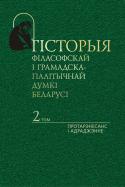 History of Philosophical and Socio-Political Thought. Volume 2. Proto-Renaissance and Renaissance. Minsk, 2010. 840 pp.
Review prepared by Aliaksei Lastouski, sociologist, Candidate of Sociological Sciences, researcher at the Political Sphere Institute.
_______________________________________________________________________________________
Every nation-state has its own history. A specially written, verified, and coordinated one. From the creation of brief sketches at the beginning of a national revival, the writing of history acquires increasingly complex and monumental forms during the period of state-building. In this sense, the History of Philosophical and Socio-Political Thought in Belarus is difficult to perceive solely as an academic project in which philosophers, in a self-contained environment, objectively and calmly examine their origins and teachers. This project is conditioned by the entire context of persistent searches and long-standing reflection on what our country was, is, and will be. In fact, it is a very important stone in the foundation of Belarus’s intellectual self-understanding, bringing together previously scattered figures, texts, theories, and approaches.
The six planned volumes are intended to create a comprehensive and rich history of thought in our land, and this initiative itself testifies to the high degree of concern among the community of Belarusian philosophers for their intellectual traditions. To write a history of thought, one needs not only some “material” or factual substance to process, but also an awareness of one’s mission (why this multivolume history?) and a high degree of responsibility.
Here the question of where thought is localized is of fundamental significance: the land, the space, the country now called the Republic of Belarus. Yet this name conceals political whirlwinds and radical changes in symbolic geography, which only a researcher who sees their work as confirmation of ready-made schemes can calmly ignore. Accordingly, an extremely difficult task arises: to define those people and ideas that may safely be marked as “Belarusian,” to study them, and to fend off the claims of neighbors who would label them “Lithuanian,” “Polish,” “Russian,” or “Ukrainian.”
The authors of the History of Philosophical and Socio-Political Thought in Belarus largely adhere to an approach tested in practice, in which the present-day territory of the Republic of Belarus is projected onto the past and, accordingly, this defined territory is understood as the locus in which “Belarusian thought,” and not only that but everything “Belarusian,” was born. This approach has long demonstrated its usefulness and therefore dominates national historiography not only in our country. Another approach, based on ethnic markers (language, identity), would clearly leave little useful or valuable from the past.
On the other hand, intellectual production has always had many problems with national and state borders. This also applies to the period to which the second volume of the History is devoted: the epoch of the Proto-Renaissance and the Renaissance. The biography of Francysk Skaryna is highly indicative in this regard: if we left from it only those parts tied to Belarusian territory, what would remain? In this sense, it seems entirely justified not only to attempt to inscribe the work of individual thinkers into a broader context of cultural influences, transfers, and interactions, but also to pay attention to figures who clearly had a different ethnic origin, yet whose activity changed the intellectual landscape of this land in a distinctive way (the same Cyprian or Filippo Buonaccorsi Callimachus).
The editors of the multivolume work insist in principle on methodological plurality, on a diversity of theoretical approaches, modes of understanding, and tools of analysis. Indeed, the second volume consists of texts written at different times and from different positions, and only a single cover compels one to perceive it as an intellectual product coordinated and united by one program. The reader must quite often switch the register of perception when texts created in the 1980s flow smoothly into contemporary ones, with their corresponding vocabulary of “identity” and “narrative.”
And yet one has to acknowledge that the backbone of the second volume consists of works created back in the BSSR by such classics of the history of Belarusian philosophy as Siamion Padokshyn and Uladzimir Konan. The point here is not only the difference in vocabulary (well, they could not have known at that time the words fashionable today!), which has never been of fundamental importance. These texts are distinguished above all by very stable and vivid stylistic features.
This concerns the obvious dominance of an evolutionist understanding of the history of philosophy, in which the history of thought is analyzed through the prism of a teleology of humanity’s progressive development from the realm of savagery to the advent of enlightenment and civilization. For example, the same Francysk Skaryna appears as a thinker who changed something for the better, who understood certain progressive tendencies, who influenced further development, and so on. We see him as a key figure on the ladder of human development, as a “titan of the Renaissance.” But we do not see him as a living person who studied, proved things, argued, made mistakes, and probably wanted not only the arrival of the kingdom of reason and justice, but also something more concrete and useful for himself. We still do not understand with whom and about what Skaryna was speaking in his works, but we can grasp very well the titanic nature of his figure. Strangely enough, the influence of the communist philosophy of history is evident here, having entered into an interesting interaction with attempts to nationalize the past within the limits permitted at that time.
One might say that since the time of the BSSR an entire tradition of apologetics for the figures of the Belarusian Renaissance has developed, affirming their “Belarusianness” and intellectual significance. Of course, at that time such works countered the destructive plans for building a “Soviet person” without any roots and contributed to the gradual self-awareness of the Belarusian nation, which has its own history worthy of pride. This diligent and inconspicuous work had its consequences during the collapse of the Soviet Union. To gain independence, it must first be thought.
Interestingly, such apologetics proved fully relevant in later times as well, which is clearly felt in the texts of another generation of researchers who formed in the 1990s.
On the other hand, it becomes clear that it is possible to write differently about Skaryna, about Budny, and about those times in general. More calmly, more carefully, without a sense of threat or a mission to propagate “Belarusianness.”
Yet the image, understanding, and lesson concerning our “giants” have been created, codified, and for now are not subject to revision. A younger generation of historians of philosophical thought, as can be noticed without much effort from the second volume, either relies on the established tradition of interpreting them or works in other, less developed areas (where theories of symbolic fields, wars of narratives, or multiculturalism can already be used).
Therefore, the size of the second volume of the History of Philosophical and Socio-Political Thought in Belarus, as many as 840 pages, is fully justified. It covers not only the current state of reading and understanding the works of the Renaissance era, but also gives a fairly good sense of how this current state took shape and was formed, with special significance attached to the work carried out back in Soviet times.
Credit must be given to the compilers and authors, who managed to create a well-developed and rich intellectual picture of that era. Yet this volume, and probably the publication of the entire multivolume work, does not remove or close all questions directed toward the past. In my view, the value of the History of Philosophical and Socio-Political Thought in Belarus lies rather in the fact that this work signals quite precisely which questions we need to pose now. Connections with the intellectual tradition have not only historiographical significance; they give us a sense of groundedness and belonging. The “canonization” of the figures of the Belarusian Renaissance became one of the most substantial attempts to think Belarus, but self-awareness in the categories of state, country, nation, or people is an endless process that challenges us as well. And it is impossible either to ignore it or to bypass it.
Aliaksei Lastouski