
Publications · 27 June 2011
From Brest to the BSSR
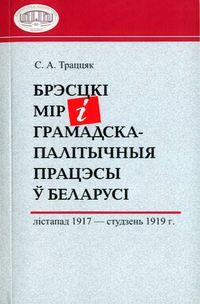
Tratsiak, S.A. (2009). The Treaty of Brest-Litovsk and Socio-Political Processes in Belarus: November 1917 – January 1919. Minsk: Belarusian Science. 208 pp.
The review was prepared by historian, political scientist, and researcher at the Political Sphere Institute Ales Shamiakin.
_______________________________________________________________________________________
The book by Belarusian historian Siarhei Tratsiak is devoted to the events surrounding the Brest-Litovsk peace agreement between Bolshevik Russia and the countries of the Quadruple Alliance, as well as to the socio-political situation that emerged after the October Revolution in Russia and lasted until the formation of Belarusian Soviet statehood.
The monograph is written in a solid scholarly style. Its structural parts aspire to a logical and consistent presentation of the subject of the study, while the list of sources and literature contains a fairly large and diverse range of materials. A distinctive feature of the publication is that it includes an appendix with archival documents, fifty-three documents in total.
Structurally, the monograph consists of an introduction, three chapters, a conclusion, and an appendix with archival documents. The first chapter is devoted to the socio-political situation in Belarus during the peace negotiations in Brest-Litovsk. It covers such aspects as the conclusion of the armistice on the Western Front, the peace talks in Brest-Litovsk, the peace conference, and the situation in Belarus.
The second chapter, “The Impact of the Treaty of Brest-Litovsk on Socio-Political Processes in Belarus,” examines the establishment of the German occupation regime, the proclamation of the Belarusian People’s Republic and its activities, the supplementary Soviet-German treaty, and the withdrawal of German troops from Belarus.
The third chapter addresses the influence of the Treaty of Brest-Litovsk on the development of political processes in Belarus. Its main themes are the socio-political situation in the Belarusian lands and the creation of Belarusian statehood on a Soviet basis.
On the first pages of the book, one can see the influence of the general line of official ideology: the author writes that Belarus acquired its own sovereign statehood in early 1919 (p. 3). This implies that the history of Belarusian statehood should be counted from the BSSR, that is, that Soviet power so generously bestowed it on the Belarusian people. Yet Mr. Tratsiak, when speaking of the sovereignty of the BSSR, does not take into account that the main feature of sovereign statehood is subjectivity in international relations. But did the BSSR possess such subjectivity? The decision to create a Belarusian Soviet government was taken by the Bolsheviks in late 1918 in Moscow, for opportunistic political reasons. Decisions on the creation of the Lithuanian-Belarusian Soviet Republic and on the removal of the Vitebsk, Mogilev, and Smolensk governorates from Belarus were also made in Moscow.
The theoretical aspect connected with the so-called Brest-Litovsk system of interstate relations also raises questions. The author first mentions this term in the introduction, when he writes that “the expansion of Soviet power into the lands of Central and Western Belarus, which resulted from the collapse of the Brest-Litovsk system of interstate relations in Eastern Europe, did not lead to the restoration of Belarus’s pre-Brest status” (pp. 3–4). Unfortunately, the author does not characterize this system: how it worked, what its essence was, what it consisted of, or how relations functioned within it. There is no clear and direct answer to these questions. Throughout the text we may find only separate points, but no clear authorial vision of this system of interstate relations is offered.
In addition, Tratsiak’s monograph lacks a clear conceptual position on the existence of the Belarusian People’s Republic. Just as there are no shades of grey in the way state ideologists and opportunistic historians depict the BPR, there is also no unequivocally positive assessment of this state formation here. Yet the absence of a clear position on this question does not amount to impartiality. Rather, one gets the impression that the author consciously avoids “swimming beyond the buoys” placed by the state ideological machine.
In his account of the policy of the BPR leadership, Mr. Tratsiak explains the telegram to Kaiser Wilhelm II: such a tactical, though unpopular, step seemed justified at the time in light of similar actions by Lithuania, Ukraine, and Poland, which achieved their goal: official recognition by Germany (p. 72). As confirmation, he quotes Yazep Varonka’s words from a letter to Anton Lutskevich: “This affair has caused a great deal of noise here. Public opinion has split into two parts: some praise us, others call us traitors and German subjects. What can be done? Can one please everyone? Do they understand our pain, our aims?” (p. 72). Thus, the author presents this situation, the attempt to secure German recognition of the BPR, from a political rather than a normative point of view, which is what is most often found in historical publications on this topic, especially those controlled by the state ideological machine. The problem itself is examined in considerable detail: the futility of the revivalists’ hopes and the political consequences of the appeal to Wilhelm II are analyzed.
The book contains a considerable number of interesting details and quotations. One indisputable strength of Tratsiak’s monograph is its rich factual material. Moreover, it fully covers all the aspects examined in the monograph, thereby allowing the reader to draw their own conclusions about the significance and meaning of particular events.
The final episode in the development of the socio-political situation discussed in the monograph is the creation of Belarusian Soviet statehood. To the author’s credit, he seeks to write impartially about this complex and ambiguous process, the decisive aspects of which were revolutionary expediency and political opportunism. For example, he notes that “the final formation of Belarusian Soviet statehood, especially the determination of Belarus’s borders in the east and west, was made dependent on the development of revolution in Poland, Lithuania, and Germany” (p. 123).
In conclusion, Tratsiak’s book can be described as a strong study that deals with extremely important, complex, and ambiguous questions of Belarusian history. Its theoretical foundation, rich factual base, and interesting details make this study a notable contribution to Belarusian historical scholarship. The monograph is useful for specialists in the humanities and social sciences, and above all for historians. In characterizing this work, one important aspect must be taken into account: some of the questions examined in the monograph still have political resonance, which means that their treatment is subject to political influence and external interference at various levels of the academic establishment. The questions of the formation of the BPR and the BSSR, Bolshevik policy, and the activity of other political actors of that period still are not purely scholarly questions in Belarus, and this cannot be considered normal.