
Publications · 26 February 2015
Eastern Europe behind the “Iron Curtain”
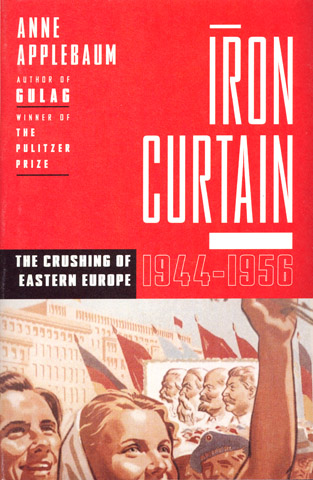 Applebaum Anne (2012). Iron Curtain. The Crushing of Eastern Europe, 1944—1956. New York, London, Toronto, Sydney, Auckland: Doubleday, XXXVII+608 p.
Review prepared by historian Liubou Kozik
The book by the American journalist Anne Applebaum is devoted to an examination of events in Eastern Europe in the postwar decade. The author divided the monograph into two parts: “False Dawn” and “High Stalinism”. Chronologically, the first covers the period 1945-1947, and the second—1948-1956. In total, the book consists of 18 chapters.
In the introduction, Applebaum discusses in detail the concept of “totalitarianism”, noting the evolution of scholars’ approaches to understanding it (XXI-XXIII). For the author, the regime established after the Second World War in Eastern Europe is unambiguously totalitarian, and the narrative is constructed accordingly. Drawing on a variety of sources from Polish, German, and Hungarian archives, as well as published documents, including Russian ones, and personal conversations with witnesses of the period, Applebaum sought to understand how ordinary people adapted to the new regime, how they cooperated with it, why they joined the Communist Party or took part in the work of state institutions, how they resisted the existing reality, and how they made choices.
Thus, by the author’s own admission, she sought to understand what “real totalitarianism” was not in theory, but in practice. As her main examples, she chose events in Hungary, Poland, and East Germany (the GDR). In addition, the work draws parallels with the situation in Czechoslovakia, Romania, Bulgaria, and Yugoslavia.
In the first part, Applebaum explains how the Soviet leadership managed to transfer certain elements of its political and economic system into the countries dependent on it (which she calls occupied). Above all, this concerns the creation of security services, the use of control over radio (the most influential mass medium at the time), the organization of pressure on independent civic and religious associations, and the carrying out of ethnic cleansing.
The author accuses the Soviet administration and its local supporters of ethnic cleansing and the expulsion of millions of Germans, Poles, Ukrainians, Hungarians, and other peoples, noting with regret that the United States and Great Britain were involved in this, as they did not fully understand the consequences of such actions. It is difficult to agree with Applebaum’s approach here. The idea of creating monoethnic states after the war had been expressed by governments in exile as early as 1939—1940, so can responsibility in such a situation be placed only on the Soviet side? (Deak, 2003) Moreover, cases are now well known in which the Red Army protected the German population from the local administration or from harsh treatment by Poles or Czechs (King, 2002).
Applebaum rightly notes that the societies of the territories occupied by the Germans were psychologically exhausted and broken after the Second World War, and therefore wanted to begin peaceful life as quickly as possible. But what follows from the author’s narrative? People who had survived German occupation suddenly found themselves under Soviet occupation. Does this mean that there had been no liberation from fascist Germany at all? The scholar’s assertions are not new in historiography or political discourse, but how well founded are they? To what extent was it even hypothetically possible for the Red Army to liberate Soviet territory (and this raises another question—which territory: as of September 1939 or June 1941?) and then stop? How would this have fitted into the actions of the anti-Hitler coalition? And why does the author justify only the postwar actions of Western leaders by pragmatism? The Soviet leadership also had its own calculation, only the ideological goal behind it was different. Interestingly, in her reflections on this issue the author from time to time cites various facts which, on the one hand, show the complexity of the postwar situation in the countries of Eastern Europe and, on the other, indicate that the scholar never fully determined her position on the “question of occupation”.
It is also difficult to agree with Applebaum’s view that in 1944 the Home Army (Armia krajowa, AK) was not among the leading anti-communist organizations. It is well known that its relations with the pro-communist movement were, to put it mildly, far from good; moreover, the theory of “two enemies”—Germany and the USSR—was never abandoned during the Second World War. The fact that in October 1943 an order was issued not to fight the Red Army did not mean a change in attitude toward it. Evidence of this can be found, for example, in the planning of Operation “Tempest” and its best-known action—the Warsaw Uprising. It is known that the main aim of these actions was the liberation of Polish territory, but the fact that indirectly they were directed against the USSR is beyond doubt for both Polish and Russian scholars.
Against this background, the question of the USSR’s “betrayal” during the uprising is also very complicated. Even the author mentions numerous arrests of Polish pro-government formations by Soviet special services and at the same time notes that during the uprising the Poles expected help from the Soviet Union. Is there not a certain contradiction in such a position?
Among the reasons for the population’s cooperation with the postwar pro-communist authorities and security services, Applebaum names exhaustion from the war and moral disappointment in prewar power. In her view, the catastrophes of 1939 in Poland, 1944 in Hungary, or 1945 in Germany led people to perceive cynically the traditions and values of the society in which they had grown up; they did not trust former leaders and were therefore ready to look for something else. As the most vivid example of this, the author chose the Polish writer Tadeusz Konwicki and his postwar fate.
Examining events in Eastern Europe, the scholar dwells on the characterization of the “little Stalins”—Walter Ulbricht in the GDR, Bolesław Bierut in Poland, and Mátyás Rákosi (Mátyás Rákosi) in Hungary. Applebaum notes that all of them had certain similarities: a close connection with the Comintern and Moscow (hence the name attached to them—“Moscow communists”).
The author rightly notes that in the first postwar years the pro-Soviet figures of Eastern Europe, following insistent “advice” from Moscow, on the one hand tried to avoid explicit communist slogans, and on the other appealed to symbols and myths already existing in society in order to legalize their power and emphasize its national character. Among examples of this, Applebaum names the organization of the Chopin Year in Poland; Goethe, Bach, Beethoven, and Schiller in Germany; a Bach music competition; celebrations of anniversaries of the birth or death of famous national figures of science and culture; and so on.
The book also addresses the question of postwar borders in Eastern Europe. Of greatest interest to the Belarusian reader will be Anne Applebaum’s position on the establishment of Poland’s eastern border. The study emphasizes primarily Polish-Ukrainian problems—both in the question of determining the border and in interethnic relations. Belarusians, like Lithuanians, are mentioned by Applebaum very rarely. She repeatedly notes that “the former eastern territories of Poland remain part of modern Ukraine and Belarus”, which suggests certain gaps in the author’s knowledge of the history of the establishment of the Polish-Belarusian and Polish-Ukrainian borders in the twentieth century.
Against this background, the author’s claim about the existence of a myth that the international communist movement paid no attention to national and ethnic differences also raises questions. As an argument, she cites the “ethnic cleansing” after the Second World War. In our view, the situation with the expulsion of Germans, Hungarians, and other peoples was connected not so much with communist ideology as with the problems that arose in multiethnic states during the interwar period. Communists were not the first to begin speaking of the need to create mono-national states. Rather, they took advantage of the situation. And here, as the author rightly notes, they found support both among the local population and among the leaders of Western European countries.
In examining the period of building the Stalinist model of socialism (or “High Stalinism”, as it is called in the book), the author focuses on the communist system’s struggle against “internal enemies”, the formation of “homo soveticus”, cultural and religious policy, and the description of changes in rapidly developing cities.
A significant place in the study is devoted to the characterization and description of “reluctant collaborators” and “passive opponents” of the regime. Applebaum classifies among the former that part of the population which was well aware of the falseness present in the everyday practice of society but was forced to submit to circumstances. These people made use of the welfare provided by the state, opportunities for social advancement, wanted a peaceful life, reconstruction of the country, education for their children, and support for their families, and therefore kept their distance from power and its structures. The result of this position was the division of life into “official” and private spheres.
In turn, the activity of “passive opponents” manifested itself in jokes, anecdotes, graffiti, anonymous letters, and so on. At the same time, as Applebaum rightly notes, the “reluctant collaborators” can also be included in this group. To a significant extent, it was from among them that active participants in the June demonstrations of 1953 in the GDR and of 1956 in Hungary and Poland emerged.
It should be noted that Applebaum’s study is of interest both to history enthusiasts and to professionals. It is attractive both in its narrative style and in its vivid examples from the history of everyday life. Yet it also has certain shortcomings. In Applebaum’s book one can clearly sense where her sympathies lie: she is drawn to active opposition to the regime established after the war in the countries of Eastern Europe. However, the examples the author cites in the book show that not everything in people’s lives was unambiguous. The complexity of the situation in the region under consideration does not allow scholars to give an unequivocal assessment of the past. It cannot simply be a “black-and-white” vision with the addition of certain shades of gray. There are very many such shades, and therefore one must be very cautious both in conclusions and in arguments.
Unfortunately, Applebaum often uses facts that are not connected to one another, since they occurred at different times and in different circumstances; in some questions she contradicts herself, which once again confirms the difficulty of assessing events in the region.
The work also contains factual errors. For example, Applebaum speaks of the existence of a Social Democratic Party in postwar Poland, whereas the Polish Socialist Party (Polska Partia Socjalistyczna, PPS) existed (the Social Democrats, as is known, joined the Communist Workers’ Party of Poland in 1918); she uses the name Polish Communist Party, although from 1938 it formally did not exist. It is correct to speak of the activity of the Polish Workers’ Party (Polska Partia Robotnicza) (until December 1948) and the Polish United Workers’ Party (Polska Zjednoczona Partia Robotnicza), while noting their communist ideology and essence. The inaccuracies also concern the history of the opposition in Poland. The Polish People’s Party (Polskie Stronnictwo Ludowe) emerged in August 1945, whereas the author writes of its existence already in June 1945 and later notes that the party was created “for the 1947 elections”. Unfortunately, there are many such “minor details” in the book.
Nevertheless, the very existence of the study under review is another step toward understanding and a more objective assessment of the situation that developed in the countries of Eastern Europe after the end of the Second World War.
Literature mentioned in the review
- Deák, István (2003). “How to Construct a Productive, Disciplined, Monoethnic Society.The Dilemma of East Central European Governments, 1914-1956”, 205-217, у Amir Weiner, (ed.), Landscaping the Human Garden. Twentieth-Century Population Management in a Comparative Framework. Stanford: Stanford University Press.
- King, Jeremy (2002). Budweisers into Czechs and Germans: A Local History of Bohemian Politics, 1848-1948. Princeton: Princeton University Press.