
Publications · 10 November 2011
Contemporary Soviet Apologetics
Reznik, A.N. (2011). “From the B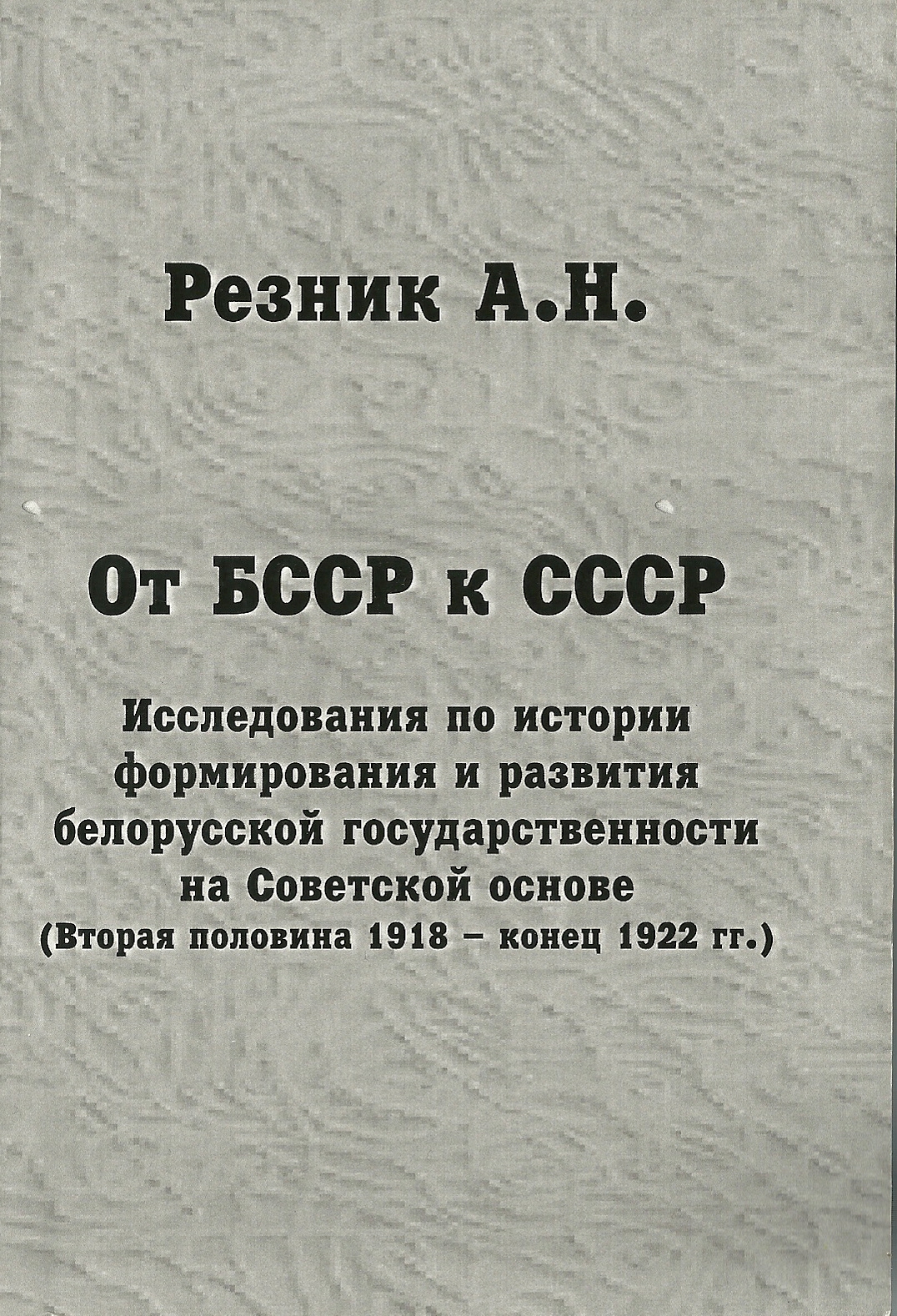 SSR to the USSR. Studies on the History of the Formation and Development of Belarusian Statehood on a Soviet Basis (Second Half of 1918 – End of 1922).” Minsk: “Entsyklopediks”.
The review was prepared by Ales Shamiakin, a researcher at the Political Sphere Institute.
_______________________________________________________________________________________
The monograph by the Belarusian historian, Candidate of Historical Sciences Anatol Mikalayevich Reznik, is devoted to the formation and evolution of Belarusian statehood on a Soviet basis. It examines the period from the emergence of the very idea of Belarusian Soviet statehood in 1918 to the creation of the USSR in 1922.
First of all, the publication itself should be characterized, or more precisely its design and technical execution, because holding and leafing through this book leaves many unpleasant impressions. On half of the pages the text is crookedly printed; the publication contains many misprints and errors, as is also evidenced by the insert with corrections at the end of the book.
In the introduction, the author emphasizes the significance of the topic in light of the evolution of national statehood, but for some reason marks only the proclamation of the BSSR and the creation of the USSR as milestones in this evolution (p. 5), while such a project as the Belarusian People’s Republic is not considered at all in the context of state-building. In the introduction, the author provides a historiographical overview of the topic, but it is rather poor, since only Vadim Krutalevich’s monograph is discussed in detail, several other works by historians are mentioned, and several Belarusian émigré researchers are briefly criticized.
From the very first pages one can feel the author’s ideological zeal, which is not concealed at all; this looks strange for a publication that claims scholarly status. Throughout the text one encounters phrases such as “so-called” when the Belarusian People’s Republic is mentioned (p. 12), various Soviet ideologemes – “the victory of Great October” or “the triumphant march of Soviet power” (p. 4), and terminology from textbooks on the history of the CPSU: the term “petty-bourgeois” is used without meaning, while the Belarusian People’s Republic is characterized altogether as a “petty-bourgeois political center and group” (p. 6).
The monograph does not reinterpret the events of the period in question from a methodological point of view or from the standpoint of contemporary historical scholarship. For example, when considering such categories as the “revolutionary situation” of 1917 – 1920, the author uses old formulas of Soviet historiography about “a fierce struggle against the ruling classes under the leadership of the proletariat and its vanguard – the Communist Party” (p. 25), and so on.
A persistent impression emerges that the basis of the book was a text written but not published in Soviet times, with its vocabulary and assessments only slightly corrected and edited for a contemporary publication.
The first chapter of the monograph is devoted to the ideological and political struggle around the project of creating the BSSR. The author tries to demonstrate the ideological disagreements on the eve of the proclamation of the BSSR between two approaches to the existence of Soviet Belarus: the regional vision of Obliskomzap and the autonomous vision of the Belnatskom and the Belarusian sections in
the RCP(b). But, as the author himself notes, the main dividing line between them was the question of the form of organization of Belarusian territories within the RSFSR – as a region or as an autonomy (pp. 25-26). Analyzing the struggle between the positions of Obliskomzap, on the one hand, and the Belnatskom and the Belarusian sections in the RCP(b), on the other, the author arrives at the main and very intriguing conclusion that the views of the latter “were not fully Marxist, and in their concrete everyday work they lacked political experience as well as the desire to reach an acceptable compromise with the figures of Obliskomzap” (pp. 39-40). However, the author did not consider it necessary to point out that the question of the form of statehood in Belarus was decided not by the desire, or lack thereof, of Belarus-oriented communists to compromise with the local non-Belarusian Bolshevik leadership, but by a decision at the very top in Moscow.
Moreover, one senses the author’s sympathy for Obliskomzap in its rivalry with Zhilunovich’s group, while the criticism of Zhilunovich’s group is justified only by the arguments of their inner-party opponents, in particular Wilhelm Knorin (p. 60). In the end, Reznik even accused the Belnatskom and the Belarusian sections in the RCP(b) of a “petty-bourgeois deviation (with a sufficiently pronounced imprint of nationalism)” (p. 71).
The author’s attempt to link the question of the future proclamation of Belarusian Soviet statehood with the revolutionary situation in Europe and, in particular, with the November Revolution of 1918 in Germany seems interesting, but this issue is not examined in detail.
The second chapter of the monograph is devoted to various questions concerning the existence of the Lithuanian-Belarusian SSR. Mr. Reznik notes the buffer, rather than real state-building, role of the Litbel SSR, which was supposed to “soften the blow of international imperialism against Soviet Russia, which was the stronghold of international socialism” (p. 133). Yet this circumstance so clearly testifies to the decorative nature of the independence and sovereignty of the BSSR, which was united with Lithuania, that the author begins to use entirely fantastic arguments about “the international significance of the Litbel SSR and its responsibility for the fate of the world proletarian revolution” (p. 134). At the same time, the author so clearly signs his allegiance and loyalty to the policy of the Bolshevik leadership that he calls the views of one of the leaders of the German communists, Rosa Luxemburg, erroneous, and claims that the leadership of the Litbel SSR allegedly supported a Luxemburgist deviation in the communist movement.
In the third chapter, the author tries to demonstrate the course in which allied relations between the BSSR and the RSFSR developed before the creation of the USSR, that is, during the period when formally independent Soviet states existed. Probably the most important events covered in this chapter of the monograph concern the Soviet-Polish War and the conclusion of the Peace of Riga. The author tries in every possible way to emphasize that it was precisely thanks to the activity of the RSFSR that Belarusian statehood was strengthened, despite the fact that the eastern Belarusian territories were taken away from the BSSR and that Belarusian national interests were ignored during the conclusion of the Peace of Riga. It is stressed that the work of the government of the Belarusian People’s Republic, which sought to influence the peace conference by defending Belarusian national interests, “was in essence a destabilizing factor” (p. 210). The author further claims that the actions of the Belarusian general Stanislau Bulak-Balakhovich, and through him of the head of the BNR government Vaclau Lastouski, brought much suffering to the Belarusian people and complicated the work of the Soviet delegation (p. 209). The author took a creative approach to assessing the results of the Riga Treaty for Belarus and noted that “the bitterness of territorial losses was softened by… the expectation of a world social revolution” (p. 212).
The final chapter discusses the creation of the USSR and the role of the BSSR in this process. Again, the reader is faced not so much with scholarly analysis as with the author’s value judgments and reflections. At the very beginning, the author declares his position: “The creation of the USSR can be regarded as one of the most significant, truly outstanding events in the history of the twentieth century, which has yet to be fully understood” (p. 298). Assessing the historical role of the USSR, the author, and here he should be given credit, did not try to disguise the expansionist goals of this formation and acknowledged that it was oriented toward world revolution (p. 325). As for Belarus’s inclusion in the USSR, in the author’s opinion this “made it possible to ensure the genuine sovereignty of the BSSR” (p. 326).
Summing up the above, one can state that the monograph has little scholarly value; rather, it can be used as an additional source on the orthodox-communist understanding of Belarusian history. In the book, the author proceeds almost exclusively from his own value-based views, absolutizing the Soviet past, Bolshevik policy, and the socialist ideology of the time. Perhaps the book can be used for discussing relevant topics in courses on the “ideology of the Belarusian state,” but even for state ideology it looks too radical and, it seems, would provoke bewilderment in the “average” Belarusian ideologue.