
Publications · 5 March 2012
Belarusian Historical Review. Volume 17. December 2010
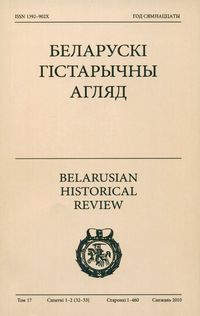
The review was prepared by Aliaksei Lastouski, a researcher at the Political Sphere Institute.
The Belarusian Historical Review hardly needs a special introduction. The journal has been published since 1994 and has long earned a very strong reputation as one of the best, perhaps even the best, historical publications in our country. One can only marvel at the persistence of Hienadz Sahanovich, who has carried the BHR forward for seventeen years.
I now have in my hands volume 17, dated December 2010, although in fact it appeared in spring 2011. Still, what matters most here is its symbolic attachment to 2010, a year remembered for the large-scale celebration of the 600th anniversary of the victory at Grunwald. Since Hienadz Sahanovich has recently been actively working on the “Great War” between the Teutonic Order and the allied Polish-Lithuanian forces, as his recent publications show, there is nothing surprising in the fact that the anniversary of this event became the central theme of the volume under review.
The “Grunwald” section of the journal offers a rather sceptical view of the transformation of a historical event into a key “site of memory”, not only, and not even primarily, for Belarusians, but also for many neighbouring peoples. In his article, the Swedish-German historian Sven Ekdahl offers a changed perspective on the battle by surveying the situation in the Teutonic Order on the eve of the battle and the catastrophic consequences of defeat for the knightly order. It is interesting that he also points to weaknesses in the established historiographical reconstruction of the battle that have long been ignored: for example, the fact that the exact location of the event has still not been established.
In a certain sense, another German researcher, Udo Arnold, continues this perspective. His article, however, focuses mainly on how the Battle of Tannenberg / Grunwald was perceived in Poland and Germany over the last two centuries. From the time when Prussia began actively to use the Order’s legacy symbolically after the expulsion of Napoleon, when the still-existing order had been completely deprived even of claims to Prussian lands, the active political exploitation of this past began, both by the Prussian state and by the Poles. For Prussian glorification of the Order’s past, the Battle of Tannenberg itself was an inconvenient theme, and Udo Arnold demonstrates the various strategies used to appropriate this event. For Poles, meanwhile, the Battle of Grunwald became for centuries a symbol of the victorious spirit over the Germans, with whom difficult and bloody conflicts continued. Only recently, in Arnold’s words, has this event turned into a “kind of folklore and spectacle phenomenon”.
The following article, by the Polish researcher Sławomir Jóźwiak, presents a more standard historiographical approach and focuses on the fate of the Teutonic Order’s prisoners of war after the Battle of Koronowo in 1410, a battle that remains almost completely in the shadow of the famous victory. The already raised issue of the contemporary use of the past for political purposes is continued by Hienadz Sahanovich, who devoted his new article to the symbolisation of Grunwald in the Belarusian historical narrative. It is interesting that for the founders of Belarusian national historiography, such as V. Lastouski, M. Dounar-Zapolski and U. Ihnatouski, this was a rather marginal event. Only the political conjuncture of a later period, connected with the revival of Pan-Slavic ideas and the demand for anti-German rhetoric, led to a gradual expansion of interest in the victory at Grunwald and to further political manipulation of this event. Even in independent Belarus, assessments of the Battle of Grunwald largely inherit interpretive schemes developed in Soviet times, with Pan-Slavic rhetoric and the image of eternal German aggression against the East.
After this thematic block, the reader can turn to the transcript of a public lecture delivered in Minsk on 19 May 2010 by the well-known American historian Timothy Snyder, who is now extremely popular not only in academic circles. In principle, this lecture may be seen as an invitation to read Snyder’s book The Reconstruction of Nations, which the BHR published last year in Belarusian translation. Snyder says nothing extraordinary in the lecture, but he emphasises important points, such as the direct influence of imperial policy on nation-building, which still await detailed elaboration by Belarusian historians.
To some extent, the next article by Halina Tumilovich echoes this task by examining the policy of the Russian Empire toward the noble estate in 1795–1863. The researcher is especially interested in the fate of the petty nobility, which was a real “bone in the throat” for the imperial authorities and gave rise to various attempts to “verify” or “sort out” the nobility.
Very interesting material is presented by Alena Markava, who studied textbooks of the BSSR from the 1920s, primarily in history and geography, and on that basis analysed the new model of Belarusian identity that emerged at the intersection of nationalist and socialist worldviews. In the researcher’s view, textbooks of the 1920s laid the foundation for a new national identity, in which an important component was opposition to others, personified mainly as Russians. This article stresses the importance of this period for the formation of the Belarusian nation, a point that sometimes remains unnoticed.
General problems in the functioning and development of Belarusian historiography are addressed in the BHR questionnaire among Belarusian historians. Here one can, of course, see clear continuity with the forum in issue no. 12 (2007) of the journal Ukraina Moderna, where standards of national historical scholarship were also discussed with an obvious eye toward the Higher Attestation Commission. Yet the painful issues raised in the questionnaire show that the state of Belarusian historiography, although much better than that of the social sciences, requires innovative changes. Reliable recipes for improving the situation, however, cannot yet be offered by anyone. It is obvious that the abolition of the hated Higher Attestation Commission will bring no benefit unless a procedure is proposed for replacing it with a higher-quality and reliable alternative institution.
As always, the Belarusian Historical Review stands out for its substantial review section, thereby filling the huge gap in reviewing that exists in official Belarusian historiography, where writing a review is a rare and purely decorative act. Among the reviews, one should note Uladzimir Bazhanau’s extensive and rather emotional review of Uladzimir Rouda’s Comparative Political Science. Among the books discussed, particular attention is also drawn to the substantial monograph by the Polish researcher Dorota Michaluk on the Belarusian People’s Republic.
This issue also opens a new section that annotates articles on historical topics in various Belarusian scholarly publications, providing an excellent opportunity to follow historical publications. The work of the reviewer Yauhen Hlinski is clearly made easier by the reduction in the number of specialised journals compared with the 1990s, something everyone else can only regret. But the work has been done very thoroughly, and one hopes that this initiative will continue.
Volume 17 ends on a somewhat sad note, with obituaries honouring outstanding historians: Juliusz Bardach, Uladzimir Isaenka and Pavel Loika. Unfortunately, 2011 was no better: this summer many distinguished people also passed away, including young people who could still have worked fruitfully for many years.
But our life goes on, and let us hope that it will continue to be accompanied by new volumes of the Belarusian Historical Review.