
Publications · 7 November 2011
Belarus in the Twentieth Century: An Unconventional Presentation of History
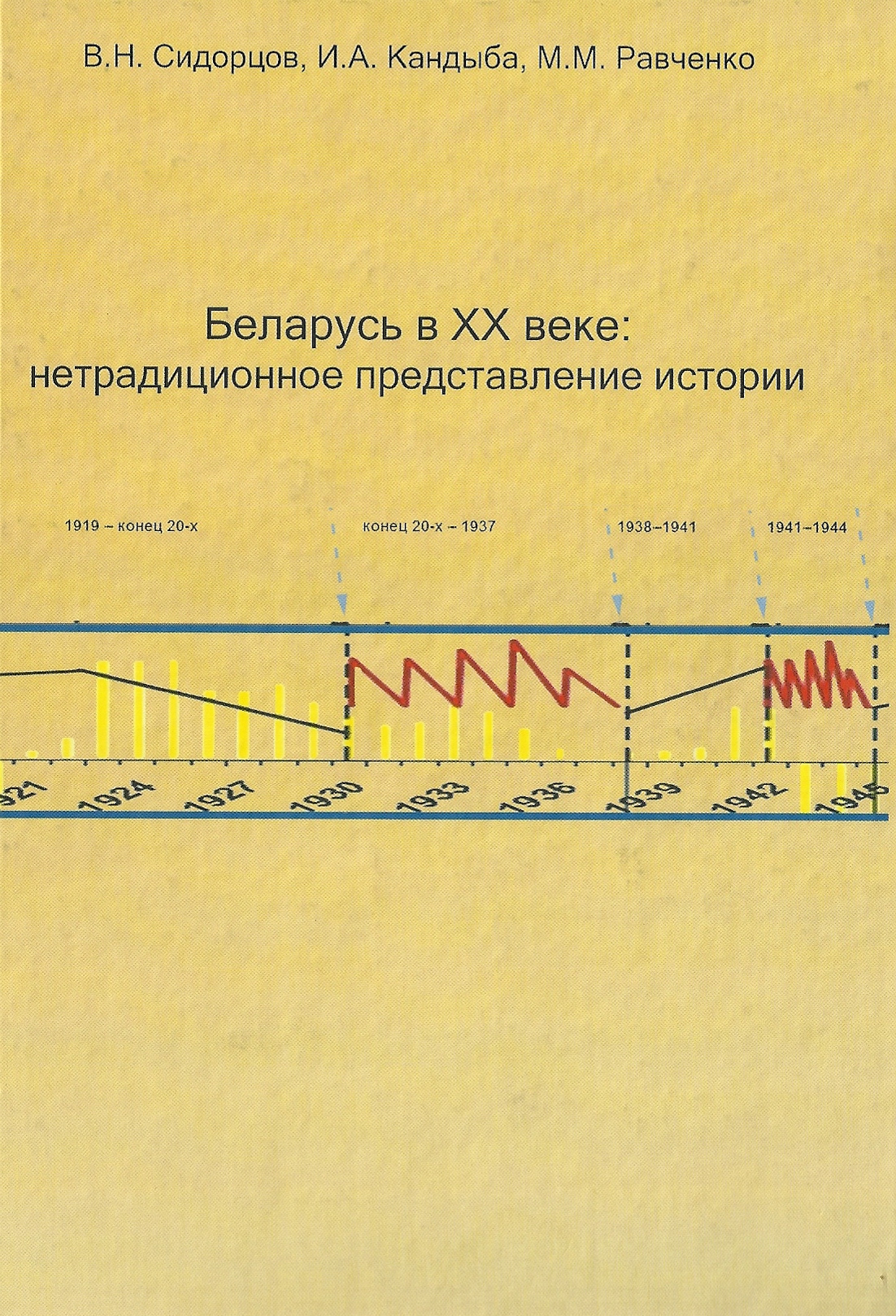 Belarus in the Twentieth Century: An Unconventional Presentation of History: Monograph / Ed. by V.N. Sidortsov. – Moscow: MAKS Press, 2010. – 272 pp.
The review was prepared by Aliaksandr Filipau.
_______________________________________________________________________________________
The monograph Belarus in the Twentieth Century: An Unconventional Presentation of History is a collective work by seven authors edited by V.N. Sidortsov. The work attempts to examine the history of Belarus in the twentieth century from the standpoint of historical synergetics and the history of everyday life. According to the authors, this will make it possible “…to present a refined scheme of the historical development of Belarus in modern times…” (p. 11).
The first section covers the period from the late nineteenth century to 1914; the second, from 1914 to 1918. In the third, it is difficult to determine which period is being examined: the subtitle is “The Belarusian SSR in 1919-1938,” but the discussion of the BSSR ends in 1937. Then follows a text titled: “Western Belarus in 1921-1939.” Thus, judging by the structure of the book, the interwar period has no precise end date: 1937, 1938, or 1939? The fourth section is devoted to the history of Belarus in 1939-1944. The fifth section is devoted to the history of Belarus in 1944-1994. This is how the authors propose a new periodization of the history of Belarus in the twentieth century (pp. 20, 22).
However, a number of questions arise here: the lower chronological boundary is the late nineteenth century, while the stated period is the twentieth century; the interwar period has no strict final date. Overall, the proposed chronology hardly differs from the traditional one. Moreover, a degree of uncertainty has been introduced into it, which forces one to look more closely at the substantive side of the work.
The authors’ proposed “new chronology” is based on a strange graph, “Dynamics of the Population of Belarus in 1897-2008 (within contemporary borders) and of the Cadres of the Communist Party of Belarus in 1917-1991” (p. 19). These two dynamics do not correlate with each other, either chronologically or territorially, yet in some unknown way the authors managed to combine them into a single line (p. 19). Moreover, on the graph they produced, the indicators are clear only along the abscissa axis: years from 1897 to 2008. Along the ordinate axis, where, one would suppose, the size of the Belarusian population combined with members of the CPB should be shown, the following values are given from bottom to top: 1400, – 900, – 400, 100, 600. No other explanations are provided.
Appendix 3 is an attempt to apply a mathematical apparatus to solve a concrete historical task. This task is not clearly formulated: “Let us try to compare the results of a study of system behavior conducted by various methods using the example of the dynamics of the population of the Republic of Belarus within contemporary borders from 1897 to 2009” (p. 243). The concrete historical problem remains unknown to the reader. After this, the author immediately proceeds to mathematical calculations, which are highly incorrect and raise numerous questions. The mathematical data themselves do not reflect real historical processes and are not connected to the declared period or subject matter.
The “new and diverse sources” also raise questions. Thus, according to the Introduction, the authors intended to achieve “a more adequate reflection of historical reality” concerning the history of Belarus in the twentieth century with the help of two “central documents”: “From a Letter of Workers of the Urals and Siberia to I.V. Stalin of 15 September 1941” and “An Excerpt from the SD Service Circular ‘Reports from the Reich’ of 15 April 1943 on the Image of the Russian Person among the German Population” (p. 17). However, they were already published in the 1990s. In addition, it is asserted without evidence that the book “contains… photographs (some of them published for the first time)…” (p. 17). No photographs could be found in the book.
The book contains many pompous phrases unsupported by facts or analysis.
One gets the impression that the authors have a very remote idea of synergetics and the history of everyday life. Thus, the definitions of “synergetics” and “historical synergetics” given in the book are incorrect and contradict one another.
The authors almost never cite specialized literature. Thus, after the Introduction there is a bibliography. Of ten items, only two can be recognized as relevant for characterizing the synergetic paradigm.
There is nothing in the book about the features of the history of everyday life, its advantages and shortcomings, the possibilities of applying it, and so on. And this despite the fact that the authors declare a synthesis of the synergetic paradigm with the history of everyday life.
The sections of the book written mainly by V.A. Latysheva and I.A. Kandyba raise the greatest number of questions. Apart from ritual phrases about synergetics and everyday life, nothing conceptually new is provided. Many sources listed in the bibliography are not referenced in the text. The text itself is full of errors.
Thus, on p. 28 the First World War is called “War the First.” It turns out that a systematic understanding of Belarus’s situation during the war can be formed only (emphasis ours – A.F.) from the standpoint of an ordinary person. I would like to draw the author’s attention to the fact that the view of the “little person,” the “ordinary participant in the war,” is reflected in hundreds of works that began to appear almost immediately after its end. In this connection, the assertion that “there is a lack of a view of the war from the standpoint of the little person” is very superficial.
On p. 34 it is asserted that in the autumn of 1917 the population of all Russia fully supported the Bolsheviks, which is an outright untruth that even Soviet textbooks did not risk reproducing. On the basis of the memoirs of only two ordinary individuals, we learn that in the autumn of 1914 the overwhelming majority of the population of the Russian Empire did not take the war too seriously (p. 37), which is strange given the surge of nationalist sentiment that swept the country at the time. On the basis of the memoirs of one ordinary civilian, the author draws a conclusion about the Russian army leadership’s negligent attitude toward the war (p. 40).
The author believes that in Soviet times a stereotype was imposed about the helplessness of Russian soldiers in the First World War (p. 43). It would seem that the glory and superiority of Russian arms, and especially of ordinary soldiers, were among the favorite themes of Soviet historiography and propaganda. On p. 61 the sentence is formulated so imprecisely that it creates the impression of “forced Polonization and mass conversion of the population to the Catholic faith” in Eastern Belarus in 1921-1938. The phrase about the alien character of the Catholic faith for the Belarusian people is alarming (p. 61). On p. 78 the author excludes social institutions from the concept of “society.” On p. 80 it is stated that the restored Polish state sought to restore its borders “within the framework of 1795.” The most relevant source for studying economic life in Western Belarus in 1921-1939 is said to be the memoirs of the artist Y. Drazdovich (p. 93). Naturally, this thesis, as usual, is not argued in any way. On p. 105 there is a narrative about the invasion of the territory of the USSR by the army of Slovenia on 22 June 1941. On p. 113 a new social structure is introduced: “encircled people.” The authors’ attachment to pseudo-scholarly language is well illustrated by the phrase: “Plan Ost envisaged the self-renewal of the Belarusian system within fascist Germany” (p. 116). All of the above, of course, does not exhaust the comments on the text.
The sections written by the postgraduate student M.M. Ravchenko are much freer from such “refinements.” However, the general methodological criticisms also apply to these sections. Thus, for example, there are great doubts that the memoirs of K.T. Mazurau, to which the author actively refers, are relevant for understanding the moods of the broad masses of the population.
In conclusion, one can state that this work is mainly a set of unrealized aims and claims. Even a quick look at the bibliography shows that the authors are practically unfamiliar with the main works in the field of synergetics and the history of everyday life. Moreover, the sources used are far from always relevant, and the conclusions are not argued, which makes the publication more journalistic than scholarly.