
Research · 2 June 2014
Belarus in the Region of the Eastern Partnership Countries (1992-2012)
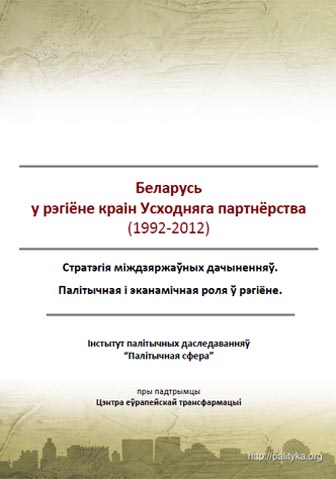 The Political Sphere Institute, with the support of the Center for European Transformation, has carried out a study of Belarus’s relations with the countries of the current Eastern Partnership region in the period 1992-2012.
In 2008, the European Union, within the Eastern Dimension of the European Neighbourhood Policy, initiated the launch of a programme for rapprochement and deeper cooperation with six post-Soviet countries, the “new eastern neighbours”: Azerbaijan, Armenia, Belarus, Georgia, Moldova, and Ukraine. In May 2009, these countries accepted the EU’s proposal to become participants in the initiative, which became known as the “Eastern Partnership”. In addition to developing bilateral relations between the EU and each partner country, this initiative also envisages the development of multilateral relations among all Eastern Partnership participants. In order to determine the place and role of Belarus in its relations, primarily at the political and economic levels, with the countries that now form the Eastern Partnership region; to describe how these relations developed over two decades (1992-2012); and to identify the potential for further regional cooperation, the Political Sphere Institute conducted a study in 2013, the results of which we invite you to read.
Andrei Kazakevich, Andrei Valodzkin, Aliaksandr Filipau. Belarus in the Region of the Eastern Partnership Countries (1992-2012) – Political Sphere Institute, 2014. – 36 p. (BLR.pdf)
Andrei Kazakevich, Andrei Valodzkin, Aliaksandr Filipau. Belarus in the region of the Eastern Partnership countries (1992-2012) – (2014) Political Sphere Institute. – p. 36. (ENG.pdf)
The study was conducted with the support of the Center for European Transformation. Its results can also be viewed on the CET website: http://cet.eurobelarus.info/ru/news/2014/04/10/belarus-u-reg-ene-kra-n-ushodnyaga-partnerstva-1992-2012.html