
Publications · 20 February 2012
A Constellation of Politicized Names
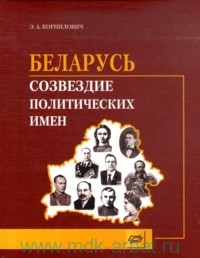
Kornilovich, E. A. (2009). Belarus: A Constellation of Political Names. Minsk: FUAinform. 408 pp.
The review was prepared by Andrei Asadchy, a researcher at the Political Sphere Institute.
The book by Candidate of Historical Sciences Eduard Karnilovich, reviewed by Doctor of Historical Sciences Eduard Zabrodsky and Doctor of Historical Sciences Nikolai Kuznetsov, was published in 2009. This publication is a historical and biographical reference book that includes, as the author believes, the “most prominent natives” of Belarus, among them Belarusian revolutionaries, political convicts and political émigrés, military-political and state figures of the BSSR and the USSR, diplomats, politicians, scholars, and others. The reference book consists of 18 thematic sections arranged chronologically, within which information is presented on 639 individuals. The book is organized according to an encyclopedic principle; the entries contain personal data: information on origin, social status, field of activity, and so on.
As the reference book notes, “the book is intended for the republic’s current and future politicians, historians, local-history researchers, teachers, school pupils and students studying history and political science, and for all those who learn ‘history through personalities,’ the person in politics, and for whom talented people matter, people ready to lead society toward prosperity, a dignified life, and socio-political progress.”
The contents of the reference book are as follows.
The section “Leaders and Enlighteners of the Tsarist Era” presents biographies of figures from the eighteenth and nineteenth centuries. What guided the author in compiling this list is unknown. In the section one can read the biographies of a number of Russian state and military figures, scholars, teachers, and others, almost half of whom spent most of their lives and professional careers outside Belarus. The author’s obvious “eastern” bias should be noted. Many outstanding people born in Belarus were not included in the section. Among scholars, such well-known researchers as Michał Bobrowski, Ignacy Daniłowicz, Iosif Yaroshevich, Ivan Loboyko, Teodor Narbutt, Adam Kirkor, and others are absent. The founders of the Belarusian cultural tradition proper also remained outside the author’s attention in this publication.
In the section “Sentenced to Death,” the author placed biographical information about revolutionaries of the second half of the nineteenth century. The list of revolutionaries is represented mainly by Narodnaya Volya members from the organization “Land and Liberty.” Insurgents of 1863 who were sentenced to death received no attention from the author; even Kastuś Kalinoŭski did not make the list.
The next sections of the book, “Professional Revolutionaries,” “Political Exiles and Political Convicts,” and “Political Émigrés. Belarusians in America,” will be of interest perhaps only to researchers of the revolutionary movement and the history of the RSDLP. In these sections one can find biographical information on little-known figures of that organization. It is generally unclear how the individuals presented here came to be counted among the prominent natives of Belarus. The author says nothing about their achievements, just as he says nothing about figures of the Belarusian national movement, who are not included in the section at all. The sixth section of the reference book is devoted to deputies of the First State Duma of Russia who came from Belarus; the seventh is devoted to women in politics. The principle behind the formation of the latter remains a mystery.
The author’s obvious tendentiousness is vividly demonstrated by the section “Political Leaders of the BSSR,” which includes the “builders of flourishing Belarus” whom, as the author notes, “political opportunists” call servants of “the great totalitarian system,” something that, in Karnilovich’s opinion, is “unscientific and immoral” (p. 213). Yet the fact that A. Lukashenka appears in a list that includes M. Dziemianciej, Z. Zhilunovich, K. Mazurov, A. Malafeev, P. Masherov, S. Prytytsky, P. Ponomarenko, A. Chervyakov, and others is highly revealing and “scholarly”; one must assume he is known as a political leader of the BSSR.
The section “People’s Commissars of the 1920s and 1930s” may indeed be of interest to researchers of Soviet-period Belarusian history. But the presentation of the material in this section should be noted separately. The author’s ideological engagement is evident, for example, in the highly “original” presentation of U. Ihnatoŭski’s biography: among the noteworthy facts of his life we find that he “carried out work against the White Polish occupiers,” “took part in Lenin’s funeral,” and so on.
Party and state figures of the USSR are the subject of the eleventh section of the same name. These are, as the author notes, “our pride and glory” (p. 275). In the section “Military-Political Figures,” one can read biographies of functionaries of the repressive system of the VChK-GPU/NKVD and the Red Army who are little known to the broader public. They, one must think, are also our “pride and glory.” This elevation of the executors of mass killings on the territory of Belarus and, in the broader context, of the USSR allows us to look anew at the principles of scholarship and morality declared by the author.
A separate section of the book is devoted to “politicians and scholars,” where, alongside Zhores Alferov, we find M. Myasnikovich, S. Sidorsky, and A. Radkov, who are rather difficult to call scholars.
Noting that “the politician and the writer have common goals: to foresee the course of history, to contribute to human development, and to create material and moral values” (p. 355), Karnilovich sets aside a section titled “Politicians and Writers,” which mainly presents biographies of the classics of Belarusian literature. It is unclear what motivated the author to single out this section of the reference book, just as the selection of the next three sections is entirely unclear: the sixteenth section is devoted to politicians from one family (two families are presented, Kliuchko and Pryshchepchyk), the seventeenth to politicians from one village (four figures are presented), and the final one to politicians from the town of Kapyl.
On first seeing Belarus: A Constellation of Political Names, there was hope that at last a publication had appeared in which one could become acquainted with the biographies of all the most significant political figures of Belarus. But gradual acquaintance with the book showed that we are dealing with an ordinary attempt to construct its own “canon,” one that would fit organically within the framework of today’s state ideology. Despite the fact that, as the author himself noted, “we have placed under one cover the biographies of figures of different ideological shades, seeking to recreate an integral picture of the political history of the given period,” many significant figures are not represented in the book, while completely unknown persons are present. The author’s ideological position is evident in his ignoring whole layers of Belarusian history; representatives of the Belarusian national-democratic movement are not represented at all.
To what has been said it should be added that ideological engagement also appears in the presentation of biographical data; at times the pathos of the text recalls the best communist times. A historical and biographical reference book of the most outstanding political figures of Belarus still awaits publication.