
Publications · 7 February 2012
A Banal History of Belarusian Nationalism
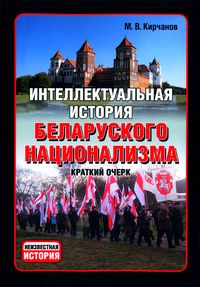
M. Kirchanov. Intellectual History of Belarusian Nationalism. A Brief Essay. – Smolensk: Knizhnyi klub “Posokh”, 2011. – 212 pp.
Review prepared by Aliaksei Lastouski, research fellow at the Political Sphere Institute and Candidate of Sociological Sciences.
_______________________________________________________________________________________
A book on Belarusian nationalism, written by a Russian author but published in Belarus (we should not be alarmed by the indication of Smolensk as the place of publication) and therefore intended primarily for a Belarusian reader, is a unique phenomenon. Belarusian nationalism is usually treated by Russian authors as an entirely marginal and underdeveloped intellectual phenomenon. Such interpretations may be very useful for justifying Russia’s cultural domination in the “North-Western Krai”, but for a domestic reader such assessments offer no cognitive benefit.
The author of this book, Maksim Kirchanov, a Russian scholar from Voronezh, has taken a different path. Throughout the book he carefully tries to maintain scholarly neutrality and to distance himself from any value judgements. He is helped in this by his use of the theoretical basis of social constructivism, according to which nationalism is interpreted as a discursive phenomenon generated by elites. Accordingly, the main research focus is directed at the examination and analysis of texts and of the basic ideas of Belarusian nationalism articulated in them. One may regard this principled neutrality of the author in different ways, but in this situation it is a perfectly acceptable approach. True, Kirchanov does not always manage to maintain it on the pages of the book, but the fact that he persistently and carefully strives to achieve it is already worthy of respect.
The author uses a fairly large source base, most of it in Belarusian. Although it seems that the sources were collected primarily by surfing the Internet. If one takes into account that the author lives in Voronezh and publishes five monographs a year (!!), and moreover on rather distant regions (Brazil, Indonesia, Latvia, Great Britain), it would hardly be reasonable to expect archival work or a comprehensive bibliographic review of the literature from him. Let us add that, in the tradition of A. Taras’s popular publications in the “Unknown History” series, the book’s reference apparatus is extremely chaotic: in the bibliography, titles of works are quite often given without any indication of their origin; several alternative citation systems are used simultaneously; and so on.
As for the design of the publication, Taras also took care of selecting illustrations, which are sometimes given extraordinarily interesting captions. For example, a photograph of a person unknown to us is for some reason captioned with the name of Andrei Kazakevich, director of the Political Sphere Institute. Some captions under photographs look altogether comic, for instance: “Nationalists are people who love their land and their people” – and this in a monograph written in an explicitly constructivist key! Another caption under a photograph is also highly revealing: “St Anne’s Church (behind it is the Church of the Gate of Dawn)”. This is very characteristic: to shout about our Vilnius heritage while having no idea what the Gate of Dawn looks like or where it is located.
But let us return to the text itself. Another interesting feature of Intellectual History of Belarusian Nationalism is the extremely high concentration of poetic quotations by Belarusian authors. On the other hand, one must indeed agree that poetry played an extraordinary role in the formation of the Belarusian national movement, and therefore this oversaturation with verse has its reasons.
Yet the author’s love of numerous quotations (and not only poetic ones) leaves a rather contradictory impression after reading. The genre of intellectual history itself requires operating with texts and ideas, but it also requires other procedures, above all contextualization, which would allow us to understand the origin and significance of the words cited. In this respect Kirchanov’s book offers very little: any attempts at contextualization are very limited and provide virtually no explanatory interpretation. As a rule, therefore, the retelling of the ideas of various authors unfolds according to the scheme “X said this, then he said that, and Y said this”. With this way of developing the narrative, genealogical continuity is almost completely lost, and the complex and contradictory intellectual landscape of our country, with competition but also cooperation among different ideological currents linked by processes of rejection and borrowing, is levelled out. In fact, there is no “intellectual history” here as such; we see only another retelling of the ideas and achievements of Belarusian historians and thinkers, presented through a constructivist lens, but this in no way enriches our knowledge of the topic under consideration.
A vivid indication of the maximum schematic nature of the description is that only Francišak Bahuševič, Vacłaŭ Lastoŭski and Ihnat Abdziralovič are counted among the creators of Belarusian nationalism. Only their views are examined separately (and even that examination can hardly be called deep). Other emblematic figures appear only in the form of a reworked pantheon of national activists. Valer Bulgakov was once accused of cutting down the history of Belarusian nationalism as much as possible, but Kirchanov has gone much further here.
And since the author nevertheless knows the situation in Belarus from a distance, from time to time he makes highly disputable conclusions that can be explained only by a superficial knowledge of the context. For example, the conclusion about the existence of numerous translations of scholarly studies on nationalism into Belarusian and the advantage in this respect over the Russian translation tradition (p. 10) warms the heart, but conscience prevents one from agreeing with it. Kirchanov takes some Belarusian authors’ journalistic attacks seriously and begins to reproduce yet more inaccuracies, such as the claim that the Institute of History of the National Academy of Sciences of Belarus offers a version of history that coincides with the Russian-Soviet imperial myth (p. 172). There are quite a few such disputable passages. Ideally, they should have been cut by a scholarly editor from Belarus, but since there is none, the fleas crawl in all directions.
I should note that, alongside the above-mentioned neutrality toward Belarusian nationalism, the author clearly has certain obvious grievances against the Poles. Passages claiming that the main goal of Polish media, governmental and public organizations is, by increasing the Polish presence, to detach the Hrodna and Brest regions from our country (p. 117), or that the Polish and pro-Polish oriented population of the country amounts to around 10% and tends to grow (pp. 129–130), look entirely unsubstantiated. The conclusion that “an infrastructure of Polish influence is in fact being created so that, under certain conditions, it can be used to achieve the maximum objective in these regions: to inflame a religious-ethnic conflict according to the ‘Kosovo scenario’, detach them from Belarus and transfer them to Poland” (p. 130) would be natural in an article in newspapers such as Slavianskii nabat, but against the general background of a more or less impartial description, these Polonophobic motifs look very strange.
If one tries to identify the book’s main positive qualities, I would say that it can be used as an introduction to the problems of Belarusian nationalism and national ideologies for a reader who is completely unfamiliar with them. Indeed, a rather large volume of materials has been compiled, and one no longer needs to turn over tons of texts; on the basis of this work, one can directly find the necessary sources. But the actual content of the intellectual debates about nation and nationalism that unfolded in Belarus is presented very superficially, and therefore, whenever possible, one can only advise reading the primary sources. The book is probably most suitable for a Russian reader who does not read Belarusian.
What truly causes sadness after reading the book is the complete absence of fresh ideas and interesting conclusions. The application of a constructivist apparatus to the study of Belarusian nationalism is far from innovative and has long ceased to be an original move. Intellectual History of Belarusian Nationalism is therefore quite predictable in content, and even its main inaccuracies are easily recognizable as local in origin.