
Publications · 23 November 2009
The Imperial Idea in Great Britain
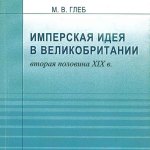
Gleb, M.V. The Imperial Idea in Great Britain (the second half of the nineteenth century). Minsk: Belarusian Science, 2007.
Although empire as a form of state formation has now almost everywhere given way to nation-states, imperial themes have not lost their relevance for researchers. Moreover, the erosion of national sovereignty caused by contemporary processes of globalization and the contradictions they have generated in the system of international relations have led to a kind of “renaissance” of imperial ideas in certain scholarly and socio-political circles. At the same time, in contemporary society the phenomenon of empire is associated mainly with a number of negative stereotypes.
Here one may recall both the Marxist definition of imperialism as the final and most destructive stage in the development of capitalism and Western notions of empire as an exclusively despotic form of statehood opposed to Western principles of democracy (Reagan’s definition of the USSR as an “evil empire”). But the history of the British Empire refutes these stereotypes in many respects. First, it shows that an empire can be created by a country that at the same time is regarded as a model of democracy and social progress. Second, it shows that the collapse of an empire can occur not only under the influence of centrifugal forces on the periphery (the national liberation struggles of subordinate peoples), but also as a result of certain impulses from the metropole itself, connected with the transformation of its political and economic system. Both of these tendencies are reflected in the reviewed work.
In characterizing the scholarly significance of the book, it should first be noted that, in addition to works by British and other researchers on this subject, the author relies on a wide range of primary sources – British newspapers and magazines of the second half of the nineteenth and early twentieth centuries. References to them and quotations from articles, which appear quite frequently in the text, allow one to speak of the introduction into scholarly circulation of new materials and data that were previously unknown, at least to the Russian-speaking reader. At the same time, the division of historiography into “Russian” and “foreign” [p. 8] is surprising and even irritating. It should be recalled that the book was published by the publishing house of the National Academy of Sciences of Belarus and, accordingly, domestic (that is, “not foreign”) historiography for the author should be Belarusian, not Russian. Even if domestic scholarship had no specialized works of significance on this topic, such a division still seems unfounded and conditioned solely by stereotypes of provincial thinking that, unfortunately, have not yet been fully overcome in our humanities since Soviet times. In accordance with the subject of the research, it would have been more logical to divide historiography into “British” and “foreign”, or, considering that works by researchers from countries of the British Commonwealth were also used, into English-language scholarship and works published in other languages, including Russian.
Structurally, the main part of the book is divided into three chapters devoted respectively to the development of the imperial idea in the economic, political, and cultural spheres. Thus, the author approaches the problem comprehensively, not limiting herself to the representation of the imperial idea only in the politics of the United Kingdom. At the same time, the further structure of the text is not developed at all. Within the above-mentioned chapters, each ranging from 45 to 60 pages, the material is not structured in any way, which creates certain difficulties for the reader. In addition, the text appears rather unsystematic and inconsistent: one senses that the author is constantly wavering between chronological and problem-based approaches to the topic. The book would undoubtedly have benefited if the author had chosen one of these approaches and divided the three chapters into sections corresponding either to the main chronological periods in the development of the imperial idea or to its ideological currents (for example, sections devoted to the development of the views of free traders and protectionists during the period under consideration).
In conclusion, despite the shortcomings mentioned above, the book is certainly worthy of the attention of both historians and political scientists. It develops a relatively new direction for our scholarship, the history of political ideas, and makes it possible to better understand the foundations of the functioning of the most successful empire of recent centuries.
The British Empire appears before us not from the outside, as before, as a monolithic expansionist force striving for world domination, but from the inside – as a complex, multifaceted system with its own internal interconnections and contradictions. It was a system that did not stand still, but developed under the influence of a range of internal and external factors.
Review prepared by: The Political Sphere Institute