
Publications · 29 December 2009
History of Belarusian-Moldovan Relations
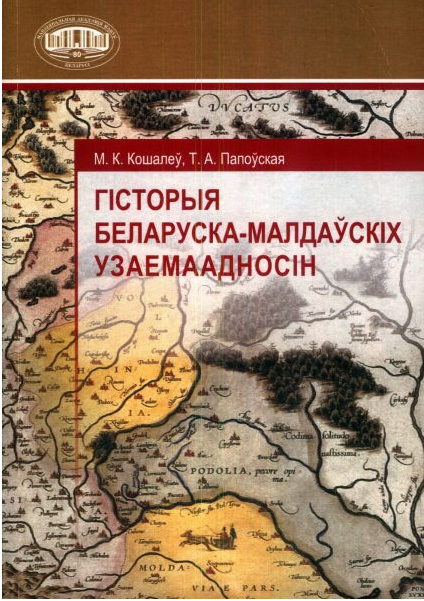 Koshalev M.K., Papouskaya T.A. History of Belarusian-Moldovan Relations. – Minsk: Belarusian Science, 2009, – 187 p.
The reviewed publication is the final text of a study of Belarusian-Moldovan relations carried out within the framework of the state comprehensive research program for 2006-2010.
Although the book is presented as the result of research, it is not research in the generally accepted sense of the word. It is a rather brief encyclopedic overview of the history of Belarusian-Moldovan relations, as well as the history of Moldova and an account of the Belarusian diaspora in Moldova, with biographies of Moldovan figures of science and culture of Belarusian origin and a detailed list of political, economic, and cultural events that have at least some connection to Belarusian-Moldovan relations. At the same time, the scholarly style of the publication is not always maintained and quite often shifts into journalistic and even literary prose.
Already in the first introductory chapter, the poverty of the sources on which the study is based is striking. All sources on the history and present of Moldova are exclusively Russian-language, apparently because literature in Romanian was unavailable to the authors. This, undoubtedly, sharply reduces the value of the study itself. Literature in other foreign languages also proved inaccessible to the authors: the book contains only isolated references to publications in English and Polish. Sources on economic and cultural ties are mostly dated to the Soviet period.
In the reviewed book, several tendencies are clearly visible in the description of the early period: an almost complete identification of the Grand Duchy of Lithuania with Belarusian statehood and an interpretation of historical events through the prism of Grand Lithuanian national interests; a justification of the expansion of the Grand Duchy of Lithuania into the northern Black Sea region as the liberation of the inhabitants of these lands from Tatar rule (while the consequences for the population of the seized territories of moving from one dependency to another are not analyzed at all); and a contrast between the “peaceful and good-neighborly policy” of the Grand Duchy of Lithuania in the region and the hostile anti-Moldovan policy of the Polish Crown.
Throughout the book, the authors try hard to avoid assessing the political realities in Belarus and Moldova that affected interstate relations. They cautiously note that “the divergence in Belarus’s and Moldova’s choices of foreign-policy vectors and priorities often determines differences in approaches to a number of issues”.
In Belarusian-Moldovan relations during the period of independence, Koshalev and Papouskaya identify two major periods: from 1991 to 2003 and from 2003 to the present. They characterize the first period as a time when Moldova supported Belarus in foreign policy, while the second began after Moldova set a course toward European integration, after which relations between the two countries cooled. Again, the authors do not explain the reasons for this foreign-policy turn by Moldova.
The book by M. Koshalev and T. Papouskaya contains rich and interesting factual material on Belarusian-Moldovan relations in all spheres of life, from ancient times to the present day. It will certainly interest readers who wish to become acquainted with the history of Moldova and gain initial knowledge of bilateral relations between Belarus and Moldova. But this book is not a scholarly study and does not meet the criteria required of one. Both in content and in style, it resembles an encyclopedic reference work, at times diluted with journalistic reflections and poetic imagery. Still less is the publication under review a complete and exhaustive source of information on the entire spectrum of Belarusian-Moldovan relations. Rather, it is a first attempt to outline a research direction that is relatively new for Belarusian historical scholarship.
Review prepared by: The Political Sphere Institute