
Publications · 26 May 2011
A Study of Belarusian Nationalism
Warning: Undefined array key "file" in /home/u475055259/domains/palityka.org/public_html/wp-includes/media.php on line 1788
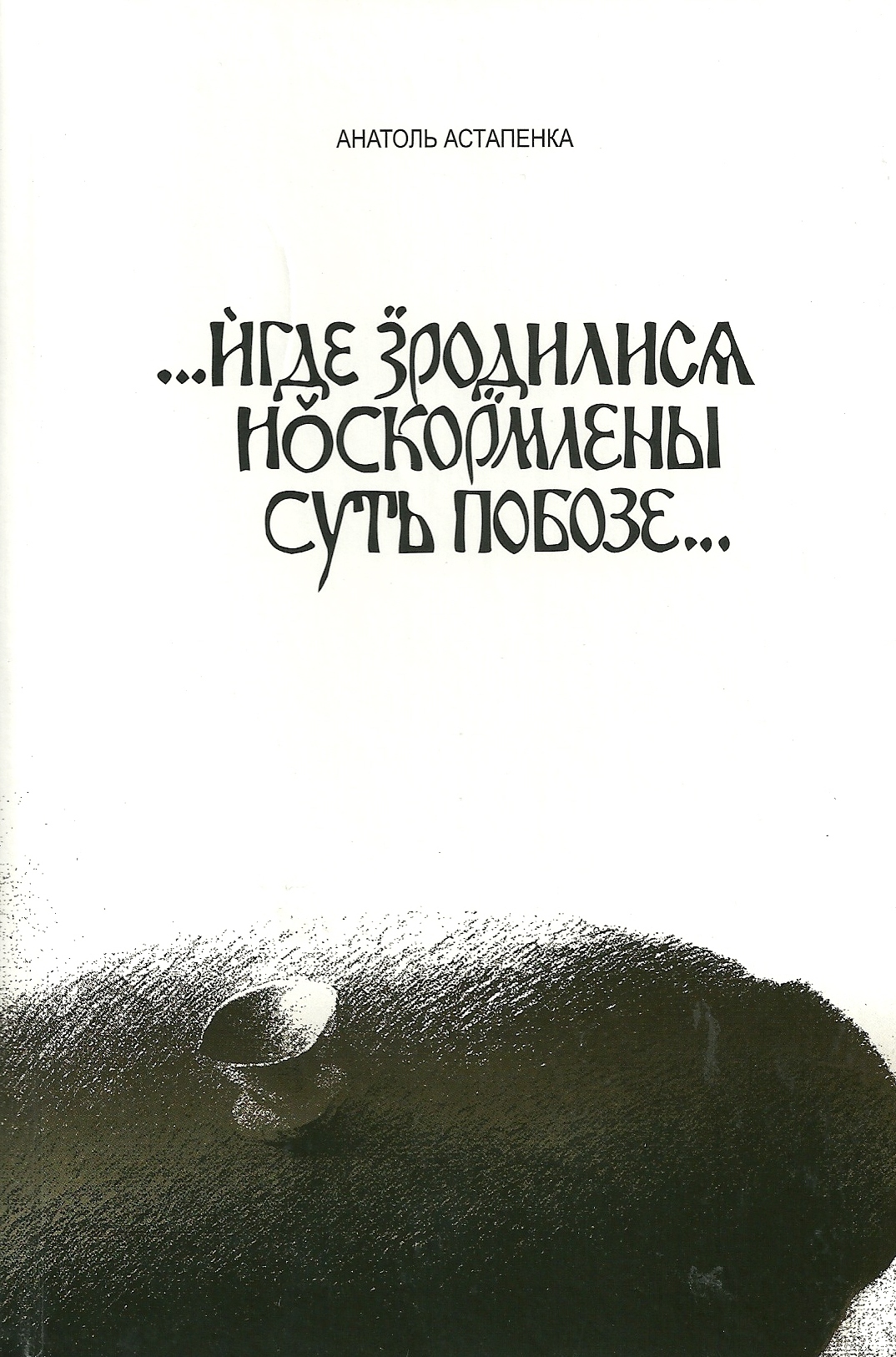
Astapenka A. Where They Were Born and Nurtured by God. A Study of Belarusian Nationalism / Anatol Astapenka. – Saint Petersburg: “Nevsky Prostor”, 2010. – 734 pp.
The review was prepared by the historian, political scientist and researcher at the Political Sphere Institute for Political Studies Ales Shamiakin.
_______________________________________________________________________________________
In his book, Anatol Astapenka attempts to examine Belarusian nationalism in all its dimensions — through the prism of history, philosophy, politics, and even ethnology, anthropology, linguistics and other disciplines. As often happens, such ambitious tasks cannot be properly resolved within a single work. The book contains a genuinely large body of information from entirely different spheres, from the beginnings of Belarusian political parties in the 1990s to the historical specificities of the Belarusian language. And all of this is placed under the roof of the “concept of Belarusian nationalism”.
As the author himself notes, the book is written in different genres: it combines scholarly research, essay writing and memoir. Such a mixture of genres does not improve the quality of the book, because the value of the scholarly part is reduced by the journalistic character of other sections and vice versa. For example, the first and fifth chapters, which claim to be scholarly, contain very few references to the literature and sources used.
In the “scholarly” first chapter, the author uses such an exotic category as the “race of Eastern Slavs” with specific anthropomorphic differences (p. 33). In addition, the author applies to political formations on the territory of Rus’ the term “the state of Kievan Rus’”, which is rather questionable from a scholarly point of view, if only because there is not a single historical document in which such a state is mentioned. The term “Kievan Rus’” is artificial and is practically not used in contemporary scholarship. True, if one takes into account that this “scholarly” chapter has been influenced by the journalistic style dominant in the book and is in fact more an essay than scholarly research in the full sense of the word, then these questions disappear naturally.
The second, journalistic chapter contains rather fantastic hypotheses, for example that the Virgin Mary came from the Old Rus’ nationality, and that Jesus was not Jewish but possibly Belarusian (p. 66). In principle, such reflections and hypotheses may be interesting and acceptable for a literary essay, but such “fantastic” episodes can hardly be perceived normally next to fragments that claim scholarly status within one and the same book. It is precisely for this reason that the attempt to unite such different genres under one cover lowers the value of the work under review.
The most significant and noticeable characteristic of Anatol Astapenka’s work is its Belarus-centredness, and this is to some extent an interesting advantage. The author is not “ashamed” to call the Grand Duchy of Lithuania a Belarusian state and openly declares that the time has come to write the history of Belarus without looking back at its neighbours. The book also contains the author’s interpretation of the historical path of the Belarusian nation, the philosophical narratives of Belarusian nationalism, and the formation of the national idea in literary creativity. Special attention is paid to incorporating medieval literary monuments from our lands into the treasury of national culture, combined with polemics against certain Belarusian intellectuals.
At the same time, some episodes of Belarusian history and the formation of the Belarusian national idea are presented by the author in a rather tendentious way. Being a sincere supporter of Orthodoxy, the author consistently devalues the Uniate layer of the Belarusian past and also diminishes the significance of the national liberation uprising of 1863–1864 and the figure of Kastus Kalinouski for the Belarusian revival. The author’s “forgiveness” of Kalinouski for the “Orthodox schism” (p. 137) looks quite strange.
Of particular interest and value is the description of political events of which the author was both a witness and a participant. Anatol Astapenka, first as co-chair of the National Democratic Party of Belarus and later as chair of the Belarusian National Party, recounts interesting events from the political life of Belarus in the 1990s — the time when party-building and the formation of the national-democratic current in Belarusian politics were taking place.
Despite the shortcomings noted above, this work will be of interest to a very wide range of readers, because it allows one to become acquainted with many concepts of contemporary and at the same time “traditional” Belarusian nationalism. At the same time, the author insists that Belarusian nationalism in his version is an idea necessary for society, aimed at creation rather than destruction.