
Publications · 30 May 2011
In the Fog of Foreign Policy
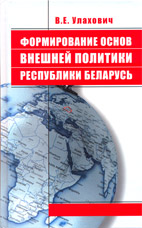 V.E. Ulakhovich. The Formation of the Foundations of the Foreign Policy of the Republic of Belarus (1991-2005). Minsk: Harvest, 2010. – 352 p.
Review prepared by political scientist and political commentator for the weekly “Nasha Niva” Siarhei Bohdan.
______________________________________________________________________________________
The director of the BSU Center for International Studies, Uladzimir Ulakhovich, has made the first attempt to summarize the results of Belarusian foreign policy during the years of independence. The book that resulted from this effort looks ambiguous. On the second page of the volume, published by the Minsk publishing house Harvest, the names of the reviewers stand next to the imprint “Recommended for publication by the Foreign Policy Department of the Administration of the President of the Republic of Belarus.” The reader is left to guess whether he is holding a scholarly publication or, after all, the official course on the history of the Belarusian government’s international activity.
It is impossible to answer this unequivocally. There are few details that contradict the official line, only mentions of opposition politicians that are rather too neutral for official discourse. At the same time, there are many more objections to the publication as a scholarly work. The text is difficult to read, and I was unable to find either a conceptual framework or any narrative lines. The material is organized around a line that can provisionally be called “the march of Belarusian diplomacy and foreign policy across the planet, its successes and minor difficulties.” The author himself believes that “the monograph is written not in an interpretive key, but in a style more characteristic of fundamentalist historians, who place real events and facts, rather than commentaries on them, at the center of consideration” (p. 6). Yet even a simple orderly chronicle of Belarus’s international ties is absent from the book.
The book begins with a discussion of theoretical foundations and historiography. Unfortunately, the author did not risk going beyond repeating the most general knowledge on this subject. For example, a conceptual approach in foreign policy is expressed by “an assessment of the situation, an adequate reflection of national interests, the selection of means for advancing them, and the development of a strategy” (p. 16). There is nothing to dispute here, but there is also little benefit in such repetition. Then follows a rather traditional list of works by Belarusian scholars on the main and adjacent topics: national identity, the national historical doctrine. Ulakhovich acknowledges the existence of several “non-state” publications, which are cautiously called “discussion-oriented” (p. 21). But the problem lies elsewhere. Having announced his intention to study Belarus’s foreign policy in 1991-2005, the author suddenly begins in the first chapter to examine publications of a much broader scope, from the Principality of Polatsk to the Soviet period. Less than eight pages are devoted to the actual description, not analysis, of studies of the period of the independent republic.
The review of foreign studies on the topic looks even worse; the absence of Polish publications and the very marginal attention paid to Russian authors immediately stand out.
Ulakhovich formulates the goals of his own research as follows: “to try to examine the main elements of the process of formation and development of the country’s foreign policy, its diplomatic history in the first fifteen years of existence (…) to identify specific foreign-policy principles of a conceptual nature that took shape during this historical period” (p. 5). According to Ulakhavich, this topic “projects an interdisciplinary approach and, in addition to a historical view, requires theoretical analysis” (p. 54). Therefore, the following “particular methods” are used: “analysis, comparison, generalization, systematization, forecasting”, while “the systemic method was the principal one” (p. 54). In fact, this is all that can be understood about the research methodology from the text.
Neither scholarship nor ideology
One of the fundamental problems of the publication under review is that the factual material it contains is of very uneven caliber. At times whole pages are devoted to describing attempts to develop foreign-policy concepts, and projects that were never adopted are examined; at other times a cardinal turn of Belarusian diplomacy toward developing countries from 1997 onward is discussed only in passing, over a couple of pages.
Important facts are mixed with banalities and information devoid of content, such as accounts of yet another press conference by foreign ministers. Next to the mention of Minister Sienko’s important visit stands an anecdotal description, since it is torn out of context, of his question to his German colleague: “Is there a place for Belarusian neutrality in the new Europe?” (pp. 122-123). This looks like a naive question to a teacher rather than a conversation between two ministers. Incidentally, Ulakhovich generally does not dwell on the people who made the country’s foreign policy. Even ministers appear on the pages of the book only as marginal characters; somewhat more attention is paid to the current minister, Martynov, but still not much. Changes of ministers are mentioned as minor events, unlike “round tables” or exhibitions.
Even a superficial review of the sources makes their composition surprising. Only 8 of the 519 sources appeared after 2006, and even those 8 sources that I identified were mostly not studies but documents or informational publications. The final number is impressive, but a look at the contents is mercilessly disappointing: many of the publications are short articles; I could not explain this selection of newspaper and journal articles by anything other than chance; many substantial publications included in the list are mentioned only in passing and only once.
In a manner typical of post-Soviet “state” scholarship, the book is devoid of conflict, and any mentions of contradictions in Belarusian foreign policy are absent. While reading, one periodically has the impression of leafing through a digest of foreign-ministry reports and dispatches. Indeed, only the Ministry of Foreign Affairs could pretend that Minister Antonovich’s words, namely that Belarus’s cooperation with NATO was nevertheless developing, testify to the development of relations with the West against the background of Belarus’s complete blockade by Western countries after the 1996 referendum.
The text has other problems as well: visits and statements are quoted fragmentarily; comparisons of the foreign-policy concepts of several countries are limited to ceremonial quotations from official documents; statistical figures are often given without indicating the period to which they refer. Statistics are almost never compared across years. Even the periodization is pale (p. 47): 1991-1994, the “period of international recognition”; 1994-2000, the “period of development of foreign policy on the basis of the principles of sovereignty and multi-vectorism”; and 2000-2005, the “period of completion of the formation of the elements that constitute the foundations of foreign policy.” Formation, further formation, and completion of formation. What, interestingly, should the next period be called?
Against the background of a listing of routine facts and the literal retelling of the content of not the most important presidential decrees, one isolated but powerful passage immediately stands out. It turns out that “by the beginning of the 21st century, despite difficulties and problems, the foreign policy of sovereign Belarus had to a significant degree been realized both from the point of view of its progressive-theoretical function (a substantial body of theoretical materials of a long-term character had been developed), and from the point of view of its planning-analytical function (programmatic planning documents of sectoral and general character had been developed and adopted), and its organizational-managerial function (a sufficiently effective foreign-policy mechanism had been formed)” (p. 179).
***
What, then, is useful about Ulakhovich’s book? First of all, its bold formulation of the task of making sense of the experience of foreign relations of independent Belarus. Ulakhovich himself has almost failed to accomplish this task, but the challenge has been issued.
The sad fact is that today we know neither what has been done and is being done within the country’s foreign-policy course, nor the degree of success of this course, nor the grounds on which it was defined. Official information is buried in archives, open information in newspaper files, and Belarusian diplomacy is deprived of a history.