
Publications · 13 June 2011
Konstancja Skirmuntt and the Political Thought of Lithuania and Belarus
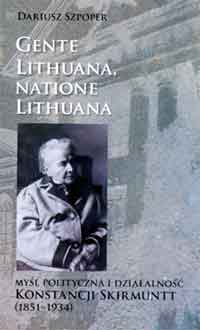
Dariusz Szpoper (2009). Gente Lithuana, natione Lithuana. Myśl polityczna i działalność Konstancji Skirmuntt (1851–1934). Arche. Gdańsk. 487 pp.
Review by Andrzej Pukszto, Ph.D., Associate Professor at the Department of Political Science, Vytautas Magnus University in Kaunas, Republic of Lithuania.
______________________________________________________________________________________
The literary historian and professor of the Jagiellonian University Tadeusz Bujnicki, twenty years ago, called the former lands of the Grand Duchy of Lithuania a “buried continent” (zasypanym kontynentem). By this he emphasized the need for comprehensive studies of the unique heritage of this corner of Europe by scholars from Lithuania, Poland, Belarus, and Ukraine.
In Polish research circles in the early 1990s, numerous initiatives emerged that were aimed at studying Polish, Polish-Lithuanian, and Polish-Belarusian heritage beyond the borders of present-day Poland. Unfortunately, few of those projects continue to this day. On the other hand, new initiatives are emerging, also highly valuable, whose contribution to the development of historical scholarship is becoming increasingly visible.
At the University of Gdańsk, for several years the development of political thought on the territory of Lithuania and Belarus in the nineteenth and early twentieth centuries has been actively studied by the legal historian Dariusz Szpoper.
Over the past ten years, in addition to the monograph discussed here, other works have appeared from his pen (Szpoper, 1999; 2003). It should be noted that Dariusz Szpoper turned to a little-known figure, discovered many new archival documents, and thereby reminded us of very “dust-covered” pages in the political and public life of the Polish-Lithuanian-Belarusian borderland of the late nineteenth and early twentieth centuries. The very title of the book, if one takes into account the Polish-language background of its heroine, makes one reflect that the author is presenting us with an unusual activist, one difficult to fit into the context of today’s history textbooks.
The author of the monograph presents the unusually wide-ranging public, political, and literary activity of Konstancja Skirmuntt in five chapters: “Paths of Life. A Biographical Sketch against the Background of the Epoch,” “The Tradition of the Grand Duchy of Lithuania and the Birth of Ethnic Lithuania,” “Attempts at Compromise and the Modernization of Public Life in the Northwestern Governorates,” “In the Realities of the Rebirth of Poland,” and “Together with the Catholic Church.” It is not known why no chapter devoted to the Belarusian question appeared. Fortunately, this question was not left entirely outside the author’s attention, and the landowner from Pinsk’s attitude toward the Belarusian revival can be traced on individual pages of the book.
From the first pages of the book, Dariusz Szpoper encourages the reader, even one well acquainted with the history of the national revival of Lithuanians and Belarusians, to reflect on the depth and complexity of the processes through which these peoples’ modern national consciousness was formed. The author of the monograph on Konstancja Skirmuntt uniquely presents the period in which modern nation-states were created, the “tightness” of these state organisms, and the active search by a group of intellectuals, the “last citizens” of the Grand Duchy of Lithuania, for new supranational formulas 100–150 years ago.
Konstancja spent and wrote most of her life in Pinsk (for more than ten years she was confined to a wheelchair). The atmosphere of this landowning world is brought very precisely (in places even too extensively) closer to us by the author of Gente Lithuania, natione Lithuania. The heroine of Dariusz Szpoper’s book, however, did not stand aside from the main events and political processes. She was a figure with whom people debated and argued, and whose ideas influenced the views of representatives of different social strata. Her regular correspondence with Eliza Orzeszkowa, with the leaders of the Lithuanian revival movement Jonas Basanavičius and prelate Adomas Dambrauskas-Jakštas, attests to the publicist’s activity.
Since the times of tsarist Russia, she boldly expressed her views in the pages of the St. Petersburg publication «Kraj», the Vilnius publications «Kurier Litewski» and «Gazeta Codzienna», as well as in the pro-Lithuanian newspaper «Litwa». She did not avoid polemics with the Warsaw Kurier Polski and other publications either. Historiography researchers have assessed the role of Konstancja Skirmuntt’s history textbooks in the formation of Lithuanian consciousness. The textbooks are written in a highly romantic style that may even seem amusing to today’s reader, but this does not diminish their popularity a hundred or more years ago.
Konstancja Skirmuntt’s position once again reminds us of the vitality of the idea of the Grand Duchy of Lithuania and the deep tradition of the Commonwealth of the Two Nations at the beginning of the last century. The worldview of the book’s heroine was only partly formed on the basis of romanticism about the glorious history of the Litvins and Poles. Above all, it was based on a particular understanding of state-building processes in the Belarusian-Lithuanian-Polish borderland and on a conviction in the civilizational mission of the Union of Kreva and the Union of Lublin, as well as in the supra-religious and even political role of the Catholic Church in Eastern Europe.
Although Konstancja Skirmuntt did not know the Lithuanian language, she considered herself Lithuanian, guided by the principle that the philological criterion should never be the main or one of the basic rules for determining national identity. Dariusz Szpoper gives a good account of the atmosphere of Polish-Lithuanian disputes over language in Lithuania’s public life and of the writer’s engagement in these difficult debates (it should be noted with regret that the author was unable to turn to the Lithuanian-language press).
And although the author has already answered many questions concerning the actions of the conservative milieu in «Sukcesorach Wielkiego Księstwa Litewskiego», it nevertheless seems that a systematic comparison of Konstancja Skirmuntt’s position with the actions of other pro-Lithuanian representatives of the landowning class, Bolesław Jałowiecki, Stefania Jabłońska, or Antoni Zawisza, will be unavoidable. Not to mention Stanisław Narutowicz and Michał Römer, who unfortunately appear only minimally on the pages of the book. Although in a letter to Jonas Basanavičius Konstancja Skirmuntt called herself “the last of the Mohicans,” in her feelings, in her Lithuanian-Polish duality, she was far from the only person who found no place for herself either among Polish or among Lithuanian political formations.
In this connection, one might also recall the “Old Litvin” Józef Piłsudski and his dilemmas in shaping the domestic and foreign policy of reborn Poland, or the undisputed leader of the Vilnius Lithuanians, Mykolas Biržiška (taking into account his noble roots). This would have significantly helped explain the unusual phenomenon of “gente Lithuanus, natione Lithuanus.” In this way the author might also have avoided burdening the reader with frequent and “dense” (without paragraph breaks) quotations of two or three pages, even though they come from highly valuable documents and unknown archival materials.
Despite some critical remarks, it must be acknowledged unequivocally that with his book Dariusz Szpoper has returned from oblivion a unique figure to whose intellectual legacy we will turn increasingly often.
The book by Dariusz Szpoper can be sincerely recommended, especially to researchers of Lithuanian, Polish, and Belarusian political thought of the late nineteenth and early twentieth centuries. It undoubtedly also contributes much that is new to the history of the landowners of the former Grand Duchy, a social group whose merits were systematically silenced in the Soviet period throughout Eastern Europe. The book once again refutes the thesis, still often encountered and already elevated to the category of myth in the interwar period, that landowners on the territory of present-day Lithuania, Belarus, or Ukraine were strongly pro-Polish in their positions and categorically and consistently opposed the national revival of the peoples among whom they lived.
Szpoper, D. Pomiędzy caratem a snem o Rzeczypospolitej. Myśl polityczna i działalność konserwatystów polskich w guberniach zachodnich Cesarstwa Rosyjskiego w latach 1855–1862. Gdańsk, 2003.
Szpoper, D. Sukcesorzy Wielkiego Księstwa. Myśl polityczna i działalność konserwatystów polskich na ziemiach litewsko-białoruskich w latach 1904–1939. Gdańsk, 1999.
For the full version of the review, see: Andrzej Pukszto. Gente Lithuana, natione Lithuana // Political Sphere No. 14 (1) 2010