
Publications · 23 June 2011
Youth: a Study of Faith
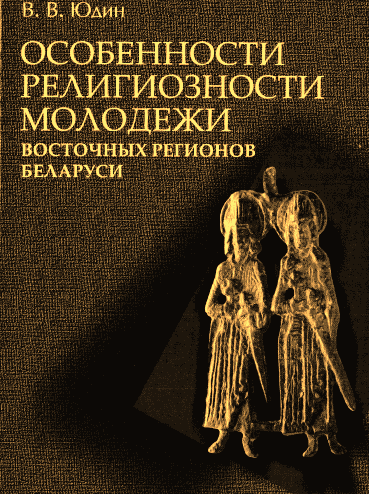 Yudin, V. V. (2009) Features of the Religiosity of Youth in the Eastern Regions of Belarus. Minsk: Publishing Centre of BSU. 150 pp.
The review was prepared by political scientist, senior lecturer at the Department of Theory and History of Law of the Belarusian Institute of Law, and director of the Ecumena Centre Natallia Vasilevich.
_______________________________________________________________________________________
Viktar Yudin’s book addresses various aspects of youth religiosity, though not youth as a whole, but primarily students and, above all, in the Mahiliou region. In this sense, the publication develops his earlier work (Yudin, 2006). The study is based on methodological approaches developed by L. Novikova, who identifies three indicators of religiosity: (1) belief in God; (2) confessional self-identification; (3) religious behaviour. The data are obtained through questionnaires. U. Abushenka follows the same approach, so it can be said that this is a traditional approach in Belarusian sociology.
As for the first point, four possible positions are distinguished in response to the question “What is your attitude toward religion?”: 1) belief in God (bearers of religious consciousness), which, according to Yudin, accounts for 67.9%; 2) belief in supernatural forces (bearers of quasi-religious consciousness), 13.5%; 3) atheists (bearers of extra-religious consciousness), 6.9%; 4) the absence of both belief and unbelief (bearers of non-religious consciousness), 11.6% (p. 9).
With regard to confessional self-identification, the author shows how substantially the data change when open-ended questions are used. For example, the level of self-identification as “Orthodox” may differ by a factor of two: with an open-ended question in 2003, the share of Orthodox respondents was 40.1%, while with a semi-closed question in 2004 on the same sample it was 79.8 %. At the same time, the “no answer” option accounted for 41.2% and 0.5%, respectively (p. 12).
The third characteristic of religiosity identified by the author is cultic behaviour, the quality of which is determined through attendance at worship services and through the “level of churching” (that is, participation in such sacraments as confession and communion). In the reviewed publication, however, the author avoids detailed differentiation and turns to simple indicators, while also introducing the concept of connection with a religious community, which, according to the data obtained, is almost zero.
The author’s idea of studying the role played by various social institutions in the reproduction of religiosity is undoubtedly interesting. Here Yudin relies on the research of Ya. Babosau (1993–1994). That research produced the following results: for 34.5%, the family exerted influence; 35.2% did not experience family influence; other significant factors were: 7.9% a close friend, 9.2% acquaintances, and 6.2% a priest. The data obtained by Yudin show that the greatest influence on young people in the region in question is exerted by the family, and that this influence, in percentage terms, rose from 37% to 56.2% between 2002 and 2009. The influence of religious literature fell from 10.6% to 6.4%, and that of a difficult life situation from 30.3% to 25.5% (p. 76). Within the family, the role of religious socialization is performed first of all by mothers, grandmothers, and grandfathers; the presence of religious cult objects in the family, especially icons, also has a strong influence, with 84% of believers noting their presence.
Various trust indices show an extremely high level of trust in the Orthodox Church. The figures obtained by Yudin, however, make it possible to question such results. Respondents assessed the influence of the church at 9.1%. The author tries to examine this discrepancy and identify the factors that produced it, but the discussion of the problem is more essayistic than systematically scholarly.
Another criterion that Yudin mentions, but to which he gives little attention in the methodological section, is dogmatic literacy, or rather illiteracy. In the author’s view, dogmatic illiteracy among young people is very significant. He connects this with the fact that young people, especially those who identify themselves as Orthodox, practically do not receive socialization and education through religious institutions: the community or religious literature.
A separate chapter is devoted to a comparative analysis of the religiosity of Orthodox students at MSU with Orthodox and Catholic students at GrSU. In terms of the level of religiosity, the ratios of bearers of different types of consciousness are practically identical in both eastern and western Belarus; significant differences appear, however, in confessional identification. In the author’s view, an important role here is played by the fact that an ethnic principle is used in confessional identification, when Belarusians and Russians record themselves as Orthodox, Poles as Catholics, and so on.
The researcher dwells specifically on confessional affiliation when analysing the significance of dogmas and concludes that Catholic youth (GrSU) believe more in Christian dogmas than in non-Christian ones. Orthodox youth, by contrast, believe less in Christian dogmas than in non-Christian ones, while regional differences between groups from different regions are minimal. This indicates significant differences between confessions in religious worldview, but, unfortunately, the author does not investigate them in any way.
Catholics and Orthodox Christians also differ in terms of religious behaviour. Thus, 42% of Catholics (GrSU) attend worship services once a week, and 26.3% once a month, whereas among Orthodox Christians these indicators are several times lower. Here a significant regional difference also emerges: 5% of Orthodox students (GrSU) attend services once a week, and 7.5% once a month, while practically none of the Orthodox youth at MSU attend services weekly, and only 5.1% attend once a month (pp. 104–105).
The book also presents rather vaguely the views of believing and non-believing youth on the violation of rights; moreover, what is examined is not human rights as such, but rather “lawful interests” in labour relations, trade, medical care, public administration, social services, education, and the social sphere.
The least clear section is the one devoted to the realization of rights in the sphere of religion. It occupies only two pages and is not a study, but a brief description of examples of state financial support for Orthodoxy, including in the Mahiliou region, as well as information about compulsory voluntary work days and the financing of the Orthodox Church by enterprises. Nor does the author omit mention of duty-free vodka traded by the Orthodox Church; only in this lyrical digression, in addition to vodka, oil also appears. This short section refers to an expert survey, but it clearly lacks an expert assessment.
Field studies and lyrical digressions are placed in the appendices and constitute the most engaging reading. In the first appendix, young people from Mahiliou draw their image of God; in the second, various stories about the evil eye and fortune-telling are included, resembling an ethnological collection of contemporary folklore or the last pages of newspapers such as “Crosswords, Scanwords, the Incredible”. A similar lyrical digression, though justified by sociological methodology, appears in the main text in the section devoted to the symbolic expression of religiosity, when respondents are asked to give their associations with such symbols as the cross, the star, and the crescent.
Yudin’s study contains interesting and useful information, but it also has many flaws. First of all, the problems are connected with an imprecise description of the methodology of the sociological surveys. It is not always clear which region is being studied, which social group is used for the sample in the questionnaire, or whether the indicated data are part of a single questionnaire or of different studies.
Conceptually, the study is eclectic. The different aspects of religiosity to which the author draws attention do not form a single system, but remain separate elaborations of one or another topic, including topics of different genres. Therefore, the conclusions that can be drawn from the information obtained are partial and particular, rather than creating a comprehensive vision of the stated theme.
The most developed material is the section in which certain aspects of the religiosity of students at MSU (Orthodox) and students at GrSU (Orthodox and Catholic) are compared.
Overall, it can be stated that, despite the flaws noted above, Yudin’s book may serve as useful research material.