
Publications · 6 March 2013
Frescoes of Belarusian and European History
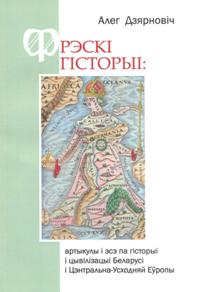 Aleh Dziarnovich, “Frescoes of History: Articles and Essays on the History and Civilization of Belarus and Central-Eastern Europe.” Minsk, RIVSh, 2011
The review was prepared by Aliaksandr Filipau
Aleh Dziarnovich’s book “Frescoes of History” leaves a very positive, but at the same time ambivalent, impression. On the one hand, the publication positions itself as scholarly and outwardly meets the requirements for such works: it has reviewers, the necessary scholarly reference apparatus (an index of names, geographical and ethnic names, etc.), and the text is accompanied by numerous references to relevant sources and studies. On the other hand, the full title of the book itself is rather journalistic in character: “Frescoes of History: Articles and Essays on the History and Civilization of Belarus and Central-Eastern Europe.”
Structurally, the book is a set of rather diverse articles and essays devoted mainly to the history and culture of Belarus (the Grand Duchy of Lithuania, the Polish-Lithuanian Commonwealth) in the thirteenth to eighteenth centuries, although it also includes subjects connected with other periods and countries.
All the essays are divided into five blocks. In the first (“State”), the author examines the problem of the place of Mindaugas’s coronation through the prism of historiography, then traces the evolution of the titulature of the Grand Duke of Lithuania, and, at the end of the section, studies the name of the “Rzeczpospolita” and the use of the word “republic” in the context of the political tradition of that period. The block “Tradition” analyzes the reasons for the emergence of different names for the “Battle of Grunwald”; the concept of “antiquity” and “tradition” in the Grand Duchy of Lithuania; and also introduces two new sources into scholarly circulation: “A Collection of the Names of Polish Princes and Kings” and “Antoni Kasakouski’s Preface to the Transliterated Lithuanian Metrica.” “Trials” and “Conversation” describe famine, epidemics, diseases, climate change on the territory of Belarus in the sixteenth and seventeenth centuries, as well as certain aspects of everyday communication, mainly in pre-revolutionary Belarus.
The last block, “Dialogue,” is the most eclectic. It examines questions concerning the formation of the Grand Duchy of Lithuania in German historiography (mainly through the prism of the polemic between German authors and V. Pashuta), the activities of Bona Sforza, and Jacques Margeret’s mission to England. It introduces into scholarly circulation a letter of guarantee from the field hetman of the Grand Duchy of Lithuania, Prince K. Radziwiłł, to Jacques Margeret concerning compensation for the expenses of his journey to the court of the English king James I.
The publication represents a special phenomenon in Belarusian historiography. First of all, one should note the variety of topics addressed in the book and the broad source base in different languages. The author deserves credit: few historians would have ventured to prepare such a book, and probably even fewer would have been able to carry out their plan successfully. There can be no doubt that A. Dziarnovich has succeeded. Reliance on sources and the careful selection of the problems under consideration allow the author to draw well-argued conclusions, and where the work is descriptive in character, to present a detailed and vivid picture of events and phenomena.
The appeal to various examples from world history, as well as to a range of disciplines, makes it possible to present many phenomena of national history in a new form, one that is not typical of Belarusian historiography.
At the same time, like any publication marked by a strongly pronounced authorial approach, the book has, in my view, certain problematic points. I would like to emphasize that some of these shortcomings are debatable in character and rather reflect agreement or disagreement with the author’s concept of presenting and organizing the material.
First of all, one should note the genre heterogeneity. Despite the formal structure (five blocks, each of which brings together several subjects), there is no general line or overarching idea. In essence, all the subjects can be divided into two groups: a) historiographical and archaeographical ones; b) subjects that largely resemble historical anecdotes “about everything.” It is precisely because of this mixture of completely diverse works, moreover dispersed across different blocks, that the book acquires a scholarly-journalistic character. This clearly makes it considerably more difficult to define the target audience: is it professional historians, or, as annotations usually put it, “all those interested in history”?
With regard to the first group of subjects (historiographical and archaeographical in character), the professionalism should again be noted. The book addresses relevant issues in the history of Belarus, introduces new historical sources into scholarly circulation, and provides a detailed historiographical overview on some questions. The author uses numerous sources in Latin, Polish, German, and other languages. At the same time, although in the preface the author reproached Professor Heorhi Halenchanka for his “positivist fidelity to sources,” it seems that under certain circumstances this reproach could be addressed to Aleh Dziarnovich himself.
An example is the analysis of the titulature of the monarch of the Grand Duchy of Lithuania. Despite the enormous work carried out by the author, it can be stated that, overall, it amounts to a selection of the necessary information from various documents. As a result, we have a set of various titles by which the monarch of the Grand Duchy of Lithuania is referred to in different sources over a relatively short period of time, but the legal status denoted by these titles and the political circumstances behind the use of one title or another remain outside the scope of attention. Apparently, this is precisely why the author draws not a conclusion, but an “attempt at a conclusion.”
It seems that the difficult situation in which Aleh Dziarnovich found himself when analyzing this question is connected with the mixing of four (!) cultural-political and linguistic traditions: medieval Latin, German, Old Ruthenian, and Byzantine, without any hint of constructing a basic system of assessment. The situation is further complicated by the fact that the author examines one and the same title in three “hypostases”: “descriptive,” “nominal,” and “official-legal” (p. 62), but nowhere provides criteria by which such a division is made.
In addition, the claim that the Byzantine equivalent of the title “grand duke” is precisely “archon” is highly doubtful. Byzantine sources often used the term archons for the leaders of the armies of “barbarian” peoples who attacked them (see, for example, Constantine Porphyrogenitus, “De Administrando Imperio”). In addition, Byzantine texts contain the phrase “great, significant archon,” the precise interpretation of which is of considerable scholarly interest (for more detail, see Filippov A. A. “Senior Emirs” in Egypt: Their Social Status in the Mid-Thirteenth Century // Vostok – Oriens. 2009. No. 3. Pp. 136–140.).
The dichotomy that the author draws between “Slavic” Navahrudak and “Lithuanian” Kernavė as the place of Mindaugas’s coronation, which, in A. Dziarnovich’s view, emerges at the end of the sixteenth century (p. 13), is also debatable. This conclusion does not follow from the cited sources, nor from the socio-political situation of the time, and, it would seem, should be carefully substantiated. Skepticism toward this conclusion is reinforced by the fact that on p. 54 an appeal to the “Ruthenian” tradition is declared to be a symbol of the defense of paganism (in this case by Kęstutis).
Questions may also be raised about the section “Antiquity in the Grand Duchy of Lithuania: From the Inviolability of Traditions to Social Transformations.” Thus, one can dispute the comparison between Byzantine law and customary law in the lands of Rus’ (p. 82). After all, Byzantium had codified law already under Justinian I, and it was this law that formed the basis of the empire’s legal system. References to codified legislation and to customary law are far from being the same thing.
When analyzing “Antoni Kasakouski’s Preface to the Transliterated Lithuanian Metrica,” the author proposes turning to the biography of the Kasakouski brothers in order to assess its political context (p. 101). The problem, however, is that the “Preface…” was written in 1777–1780, while only the activities of the brothers in the 1780s and 1790s are described; in other words, it is unclear what influence this turbulent period of their biography had on a text written earlier.
Perhaps the most serious remark concerns the principles of citing various sources. A. Dziarnovich uses two methods: 1) translation into Belarusian with the original text provided (usually in footnotes); 2) the original text without any translation. While the first option is optimal, the second looks strange for a publication intended not only for a narrow circle of specialists. The book contains fairly large untranslated fragments in Polish (in its seventeenth-century variant), German (p. 118 and elsewhere), and Latin (p. 113, p. 117, and elsewhere). It is especially regrettable that the source introduced into scholarly circulation, “A Collection of the Names of Polish Princes and Kings,” remains untranslated.
Such high demands on readers—namely, the ability to read fluently in Latin and in non-modern variants of Polish and German—contrast sharply with subjects that have the character of historical anecdotes. These subjects were apparently conceived by the author in the spirit of the French Annales school, but the first thing that stands out is the obvious lack of Belarusian material for writing a scholarly work in this tradition. A substantial part of the section has a very remote relation to Belarus: a description of ergotism, the history of the creation of LSD, reflections on the benefits and harms of coffee, an opus on the assimilation of milk…. The fashion for the Annales can lead to strange conclusions, such as the claim that the seventeenth-century Vitebsk voivode Jan Chrapowicki, who for thirty years recorded the weather in his diary, among other things, did so because he “understood the importance of weather for his citizens and felt that his personal notes (about the weather – A. F.), which seem private, could still play an important role for posterity” (p. 141).
There are also certain inaccuracies in the text. Thus, it is unclear why the author transliterates the Yemeni city of (al-)Mocha as al-Moga, since neither the Arabic, nor the English, nor the Russian version of the reading provides grounds for this. The statement on p. 157 that Russian society’s real acquaintance with coffee occurred only after the war of 1812 is doubtful. Historical sources from that period contain enough evidence of coffee consumption in Russia. Moreover, one of the grounds for the war was Napoleon’s accusation that Russia wanted to buy coffee and sugar from France “cheaply.” Given that France had lost Haiti, its main source of sugar and coffee, Napoleon’s irritation at Russian demands is understandable. The use of the term “kuru” to designate a disease in seventeenth-century Belarus is not very appropriate (p. 128). Kuru is a very specific form of spongiform encephalopathy found among the Papuans of Papua New Guinea.
In conclusion, despite the remarks made, the reviewer would like once again to emphasize the high level of the publication and to express the hope that readers will continue to have the opportunity to acquaint themselves with Aleh Dziarnovich’s interesting works.