
Publications · 20 March 2013
Family and Women through the Eyes of the Belarusian Academy of Sciences
 The review was prepared within the framework of the joint project “Book Review” of the Political Sphere Institute and the Centre for European Studies in Minsk.
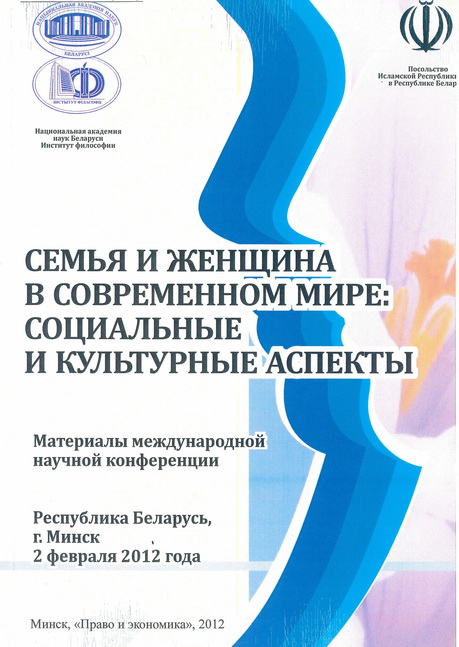
Family and Woman in the Contemporary World: Social and Cultural Aspects. Proceedings of the international scholarly conference, Minsk, 2 February 2012. Minsk: “Pravo i Ekonomika”, 2012. – 491 p.
The review was prepared by Tatsiana Shchurko.
In February 2012, the Academy of Sciences of Belarus hosted the international scholarly conference “Family and Woman in the Contemporary World,” which resulted in a collection of proceedings under the same title. The conference was a particularly interesting event for a number of reasons.
First, since 1996 gender policy has been actively introduced in our country, but in the scholarly space there have been rather few events that would make it possible to reflect, both theoretically and practically, on the processes taking place in this sphere, on the position of women in society, and on the specificity of the local context. In 2012, the conference “Family and Woman in the Contemporary World” became such an event. It was held at the Academy of Sciences with full support from many official structures.
Second, the specificity of this conference lies in the fact that it was organized with the support and active participation of the Embassy of the Islamic Republic of Iran. Such an unexpected partnership prompts certain reflections, given that many researchers note a strengthening of traditionalist tendencies in the position of women in Iran [1]. In addition, the articles by researchers and scholars from Iran included in the collection are oriented toward the reproduction and support of these traditional values and clear prescriptions regarding gender roles. It is worth noting that the position of these authors also found support among Belarusian participants in the conference. Thus, at the plenary session, Nadezhda Ermakova (chair of the Belarusian Union of Women and of the National Bank of the Republic of Belarus) spoke on behalf of all Belarusian women http://n-europe.eu/article/2012/02/17/nauka_koran_i_zhenshchina: “We, the women of Belarus, have not yet come to the point of basing our laws on principles of morality and spirituality. Not only women, but men as well. In this respect we have something to learn from Iran. We, the women of Belarus, parliamentarians, will take Iran’s experience into account in our legislative work.” Accordingly, the publication of the conference proceedings is of definite interest as a symptom and reflection of the official view of the position of women in Belarusian society, and it cannot remain unnoticed by gender researchers.
The collection includes a very large number of materials: 253 articles, many of which are only brief theses. However, the collection also contains more developed articles based on empirical research data.
If we pay attention to the substantive content of the collection, three thematic blocks can be provisionally identified: the problematics of the family, the “mission” of women, and the position of women in different spheres (work, politics, education). Analysis of the articles themselves makes it possible to argue that, for the most part, they reproduce the sex-role approach as the basis of gender policy in our country. This approach emphasizes differences between the sexes, appealing in the spirit of biological determinism to some supposedly natural predestination of men and women.
A typical example is the following quotation: “In advocating a critical attitude toward gender stereotypes, we do not call for the elimination of differences between men and women. It is important that both should not lose adequate sexual and gender self-identification and, at the same time, should be oriented toward equal participation in making and implementing responsible social decisions” (A. L. Aizenshtadt, p. 341). However, the gender approach is based on the conviction that biological differences are not determinative for the formation of the psychological and social characteristics of women and men, since the decisive role in the formation of gender differences is played not by biological sex but by the social and cultural meanings that society attributes to anatomical differences. Yet such an understanding of the gender approach practically does not appear on the pages of the collection and can be found only in a couple of articles. Moreover, many researchers [2] note that the sex-role approach reinforces the existence of discrimination against women in society and also levels out the diversity of personal manifestations, limiting people to a given set of rigid prescriptions. Such an approach does not promote the development of tolerance, flexibility, or equal relations regardless of sex.
How, then, does the sex-role approach manifest itself in the reviewed collection?
First, the idea of “femininity” as a certain predetermined essence, fundamentally different from the paired category of “masculinity,” is actively defended in it. For example, the theoretical articles are preceded by the welcoming address of A. R. Tsyganov, deputy chair of the Presidium of the National Academy of Sciences of Belarus, who defined the role of women in society as follows: “It is to be the bearer of the female life-creating and life-affirming principle in the contemporary complex, contradictory, competitive world, which in its essential characteristics is most often perceived as ‘male’” (p. 9).
References of this kind to a certain “mission” of women, to their “true purpose,” permeate the entire collection. At the same time, many authors raise the question of women’s position in politics and the labor sphere. Accordingly, the contract of the “working mother” [3] still dominates in the discourses and representations of officials and the scholarly community. This means, on the one hand, that the role of women in the professional sphere is recognized and they are used as a labor resource; however, on the other hand, attention is focused on the importance of the roles of mother and housewife. Quite naturally, gender policy is invoked to create conditions for combining these roles rather than for the purposes of criticizing and analyzing the predetermination of women’s choices and their limitation to only a few options.
Second, the collection is oriented toward promoting such values as the traditional family with a clear gender division of roles and motherhood as the principal purpose of women. Accordingly, a large number of articles dealing with the study of the current state of the institution of the family and the preparation of the younger generation for creating a family rely precisely on these values. Family education is meant to form a value-based attitude toward the family and the upbringing of children. This includes, in particular, the formation of those qualities of men and women that are most valuable for performing the roles of mother and father. At the same time, the semantic meanings of these roles appear as fundamentally different. And all of this is supplemented by religious rhetoric: the need to orient oneself toward “Christian values/traditions.”
Contemporary transformations of family models, the emergence of new forms of family, and the legalization of same-sex relations in Europe are perceived as unambiguously negative phenomena. Accordingly, it is no accident that the collection includes articles by Iranian researchers who sharply criticize same-sex relations: “Some Western people, ignoring all existing human values and divine commandments, enter into relations with persons of the same sex in order to satisfy animal thirst. Society, too, instead of fighting such deviations, grants them legal status … as a result of anti-family tendencies, the West is witnessing a gradual transition from the creation of a healthy family consisting of a man, a woman, and their children to other forms of coexistence, representing all kinds of deviations from the norm” (M. Gholamghasemi, p. 48). In this connection, the question arises: what experience is Belarus going to borrow from Iran, and what relation do all these reflections have to gender policy?
Third, many authors of the collection legitimize the orientation toward traditional values by speculating with the concepts of morality and ethics, norm and pathology. Such articles resemble the construction of moral panics, since they focus exclusively on crisis processes. This can be illustrated by the following quotations:
“Enlightenment is steadily growing, while the moral principle in society is gradually disappearing, and with it the self-activity of the individual also disappears” (A. I. Levko, p. 17).
“… the destruction of the traditional family is such a change in the history of a people that over time it will lead to its complete destruction” (O. I. Utkevich, p. 30).
“The loss of the moral integrity of the person, chastity, is the source of alienation of the person in society and of his or her further degradation” (I. I. Tarkan, p. 186).
Some authors assess the processes of women’s emancipation and feminism especially negatively, assigning to them a certain share of the “blame” for crisis phenomena in the family-demographic sphere (for example, A. I. Loiko, B. M. Lepeshko).
Finally, fourth, it should be noted that the collection ignores and excludes a number of topics that are also important for understanding the position of women in society and the processes of family transformation. There are practically no articles dealing with the study of sexuality, corporeality, questions of social guarantees and social policy, or different models of family (for example, queer families). The model of family presented at the conference is quite conservative and does not include other existing types of families. Accordingly, all other models except the registered heterosexual family are excluded, silenced, and ignored, which is a discriminatory practice toward everyone who does not fit into the normative matrix.
In conclusion, it can be noted that the aim of this collection is rather to appeal to traditional gender roles than to deconstruct the patriarchal gender order and gender norms that underlie discrimination against women in society. The very appearance of the collection is a natural consequence of the shortage of gender researchers in the country, as well as of a complete misunderstanding of what gender studies are.
Nevertheless, a number of articles should be noted that may be of some interest for gender studies. These texts cover such topics as studies of young people’s representations of the family (V. A. Klimenko, E. S. Babosova, T. V. Verzhybok, E. V. Osipova, I. V. Lashuk, S. A. Morozova), the “everyday life” of the family (O. V. Ageiko, O. V. Burko), problems of domestic violence (L. V. Filinskaya et al., E. A. Murashko), “women’s” history and women in history (A. A. Onishchenko, L. I. Novikov, V. N. Rakachev and Ya. V. Rakacheva, T. A. Shchurko, V. V. Sokolchik, I. M. Shumskaya, O. N. Kirilova, O. O. Smolina), women’s health (P. V. Dik), discrimination and the position of women in the labor sphere (L. V. Akhremchik, E. V. Taranova, N. N. Sechko, L. G. Titarenko, T. P. Berezovskaya), as well as the problematization of the construction of femininity, the role of feminist ideas and gender studies/policy (I. I. Ivanova, S. V. Lapina, E. V. Kriuchkova, I. R. Chikalova). Articles concerning the position of women in rural areas (I. V. Lavrinovskaya, M. A. Balbutskaya) also deserve attention.
Notes
[1] Hoodfar, Homa. The Women`s Movement in Iran: Women at the Crossroads of Secularization and Islamization. WLUML, The Women`s Movement Series No.1, Winter 1999. 46p. http://www.wluml.org/sites/wluml.org/files/import/english/pubs/pdf/misc/women-movement-iran-eng.pdf
Mehran, Golnar. The Female Educational Experience in Iran: a paradox of tradition and modernity // Middle Eastern Women on the Move. Openings for and the Constraints on Women’s Political Participation in the Middle East. Washington, D.C.: Woodrow Wilson International Center for Scholars, 2003. P.69-73. http://74.121.194.235/sites/default/files/MEP_women.pdf#page=133
Mohammadi, Majid. Iranian Women and the Civil Rights Movement in Iran: Feminism Interacted // Journal of International Women‟s Studies. Vol.9 (№1). November 2007. P.1-21. http://www.bridgew.edu/SoAS/jiws/Nov07/IranianWomen.pdf
Moghadam, Valentine M. Iran: From Islamization to Islamic Feminism and Beyond? // Moghadam, Valentine M. Moderninizing women: gender and social change in the Middle East. 2nd ed. Lynne Rienner Publishers Inc., 2003. P.193-225. http://books.google.by/books?id=hOVjBzQrdxkC&printsec=frontcover&hl=ru#v=onepage&q&f=false
Tohidi, Nayereh. Modernity, Islamization and women in Iran // Gender and National Identity / Edited by Valentine M. Moghadam. Helsinki, Finland: Zed Books Ltd.,1994. P.110-147. http://dcr.csusb.edu/dny/395/articles/tohidi%20-%20women%20in%20iran.pdf
[2] Штылева Л.В. Фактор пола в образовании: гендерный подход и анализ. М.: ПЭР СЭ, 2008.
Ярская-Смирнова Е. Гендерная социализация в системе образования: скрытый учебный план // Женщина. Образование. Демократия. Материалы 2-ой международной междисциплинарной научно-практической конференции (3-4 декабря 1999г.). Мн.: ООО «ЭНВИЛА-М», 2000. С.27-32.
[3] Айвазова С. Г. Русские женщины в лабиринте равноправия. М.: ЗАО «Редакционно-издательский комплекс Русанова», 1998.
Здравомыслова Е. А., Темкина А. А. Государственное конструирование гендера в советском обществе // Журнал исследований социальной политики. Том 1, № 3/4, 2003.