
Publications · 16 May 2013
Białoruskie Zeszyty Historyczne
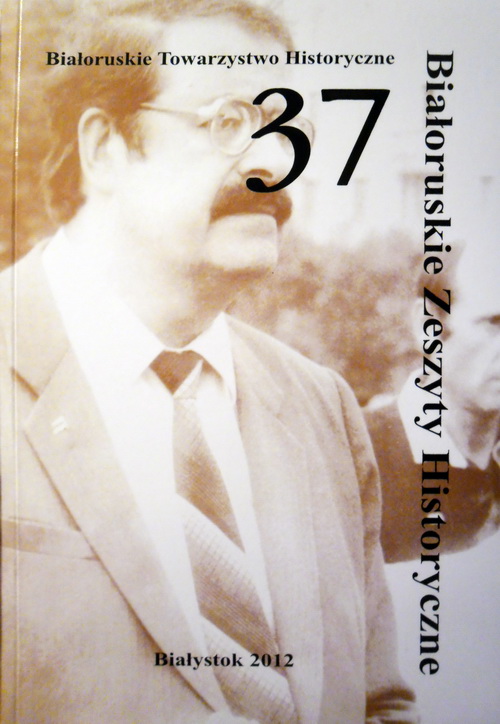 The review was prepared within the joint “Book Review” project of the Political Sphere Institute “Political Sphere” and the Center for European Studies in Minsk.
Białoruskie Zeszyty Historyczne. No. 37. – 2012. Białystok, 2012.
Review prepared by Aliaksandr Paharely.
“BZH” (“Belarusian Historical Notebooks”) is the journal of the Belarusian Historical Society, published twice a year, and for a long time it has served as a platform for a fruitful exchange of views among researchers on both sides of the Belarusian-Polish border. Articles, reports/communications, and sources are the main formats of materials published in the journal. Editor-in-chief Eugeniusz Mironowicz seeks to maintain the journal’s high standards; it has always been distinguished by the novelty of its themes and by original approaches to subjects already familiar to the scholarly community.
In the new issue, Aleh Latyshonak, professor at the University of Białystok and chair of the Belarusian Historical Society, examines the historiography of the early medieval Principality of Hrodna. Drawing attention to the paradoxical lack of interest among Belarusian historians, above all those from Hrodna itself, in this problem, he analyzes the achievements of Russian historiography, which has worked on this topic far more productively. According to the author, this can be explained by concepts of Belarusian history that emphasized a smooth transition from the Polatsk period to the Navahrudak period, in which Navahrudak was assigned the role of initiator in the creation of the Grand Duchy of Lithuania. There was no place for the Principality of Hrodna in this scheme. Such a view is characteristic of the works of Mikola Yermalovich. Although Yermalovich’s proposed localization of Lithuania was rejected by Belarusian historians, as was his denial of the existence of the Principality of Hrodna on the Neman, this did not lead to a reassessment of the latter’s role in Belarusian history. The question of its territorial boundaries also remains a “blank spot.” The St. Petersburg school stands out for its significant contribution to the study of the Principality of Hrodna. A young researcher from this school, Aleksei Kibin, has done much to study the history of the principality. He himself comes from the Neman region.
Several articles are devoted to topics in cultural history. Mariola Jarczykowa of the University of Silesia in Katowice analyzes the art of rhetoric at the court of the Biržai Radziwiłłs. Helena Głogowska from Białystok and Anatol Trafimchyk from Minsk address the problems of West Belarusian literary work and its connection with the social and cultural context. In the first case, this is done by comparing the reaction of poets from Western Belarus to the Treaty of Riga with that of their contemporaries in the BSSR; in the second, through the prism of the biography of Father Jan Siemaszkiewicz.
The problem of industrial development in the Belarusian lands of the Russian Empire in the late nineteenth and early twentieth centuries is addressed by Volha Sabaleuskaya from Hrodna, who analyzes the case of enterprise development in the colony of Niezbudka-Michalowa in Hrodna Governorate, ironically called a “Klondike.” In the reports section, the article is supplemented by Ina Sorkina of Hrodna University with an assessment of the source base for this problem. Volha Sabaleuskaya has introduced into circulation a new and very interesting layer of materials. The novelty of the topic and of the sources used nevertheless does not change the fact that the rather limited industrialization in the western part of Hrodna Governorate could have been placed in a comparative context, set against the Łódź region, the Donets Basin, and Riga. Against such a background it would have been possible to reveal the specificity of industrial development and of the environmental problems that were only beginning to concern the authorities and the public, as the researcher notes. One should speak not so much about the backwardness of industrial development as return once again to the general question of why, in the nineteenth century, industrialization in the Belarusian lands took place outside cities, unlike in neighboring regions.
Researcher Alena Trubchyk of the Belarusian State Agrarian Technical University in Minsk devotes her material to the educational policy of the Polish Civil Administration of the Eastern Lands during the Soviet-Polish War of 1919-1920. Representatives of this structure sought to create not only Polish schools, but Belarusian ones as well. These initiatives, however, developed under very difficult circumstances. On the basis of a careful study of archival documents, the author shows that the work of the Polish administration in the field of education was strongly dependent on the uncertainty and absence of an overall vision of future prospects characteristic of wartime. The persons appointed as inspectors for each of the three districts, Vilnius, Brest, and Minsk, were in effect intermediaries between the central and local educational authorities. No less important is the fact that the author shows the role of political and personal loyalty, which were the main criteria in the work of the administration’s bureaucratic apparatus and its educational sphere, resulting in the absence of any lasting outcomes in its activity.
The consequences of the Polish-Soviet War are also the subject of reports by Ales Smalenchuk of the Polish Academy of Sciences’ Institute of Slavic Studies in Warsaw and Andrei Krotau of Francysk Skaryna Homiel State University. Ales Smalenchuk focuses on the analysis of Edward Woyniłłowicz’s texts, his memoirs and an article on the borders of Poland in 1771 and 1920, in connection with the reaction of the krajowcy to the Treaty of Riga. Woyniłłowicz characterized these agreements as a “fourth partition.” The memoirs were strongly influenced by the later position of the landowner-krajowiec in the late 1920s, which is clearly visible in an analysis of the fragments that touch on this topic. The researcher concludes that there was a distance between the views of the krajowcy ideologists and the views of landowner-bearers of this tradition, since the latter changed their views in accordance with the historical conjuncture.
Andrei Krotau uses primarily printed publications from the period 1918-1920 in order to explain the emergence of one component of the negative image of Poles among Belarusians. It is true that the author uses Polish publications, which rather reflect the attitude of Poles toward Belarusians. It is not entirely clear whether the experience of the Soviet-Polish War has any influence on the formation of views of Poland and Poles among Belarusians in different regions of the country today, something the author does not mention.
In the same reports section, there is also a piece by Professor Antoni Mironowicz of the University of Białystok on Mastaŭliany. Drawing on archival sources, the author traces changes in the owners of this estate, whose tenants from approximately the early 1830s were the Kalinoŭskis.
Eugeniusz Mironowicz reflects on one of the most controversial pages in the history of Belarusian state formation, and one that remains relatively poorly studied today: attempts to create an independent Belarusian state in alliance with the Third Reich in 1941-1942. The disappointment of Belarusians in the sincerity of German aims already in the summer of 1941, together with mutual distrust, created an atmosphere in which Belarusian activists in effect tried unsuccessfully to take steps toward the formation of civil and military structures that would become the foundations of a future state. By the end of 1942, the policy of limited German support for Belarusian aspirations had moved into an entirely opposite phase, the most tragic manifestation of which was the arrest and murder of Father Hadleuski, the author of the concept of preparing the creation of Belarusian statehood.
The topic of the most recent history of Belarus opens with an article by Henadz Semianchuk of Hrodna University, Andrei Miatselski of the Institute of History of the National Academy of Sciences of Belarus, and Lavon Kaliadzinski of Maksim Tank Belarusian State Pedagogical University, devoted to the seventieth anniversary of the birth and the sad twentieth anniversary of the death of the archaeologist, writer, and public figure Professor Mikhas Tkachev. The article presents his figure in many dimensions and across all areas of his activity. Jarosław Syrnyk, an employee of the Wrocław branch of the Institute of National Remembrance, seeks to refute the persistent view of the Belarusian minority in Poland during the “Solidarity” movement as a wholly conservative and loyal support base for the communist regime. It is more appropriate to speak of internal polarization within the Belarusian community of Poland. While a very significant part of Belarusians viewed the program of “Solidarity” through the prism of its national-Polish and Catholic rhetoric, seeing it as a threat to themselves, another part actively joined the structures of the all-Polish trade union. The hierarchy of the Orthodox Church also took a conservative position and cooperated with the communist security services. The not always well-formulated postulates in “Solidarity” materials were received ambiguously by Poland’s national minorities, including Belarusians.
The largest article in the issue, by political scientist Arkadiusz Czwolek from Toruń, analyzes the main factors in the defeat of the Belarusian opposition in the 2006 presidential election and examines the pre- and post-election situation, based mainly on Belarusian texts that appeared between 2005 and 2008. Most of the opposition’s actions, in the author’s view, were counterproductive. They did not lead to the consolidation of democratic forces, but after the presidential election produced an aggravation of existing contradictions within the democratic opposition. The political scientist from Toruń draws attention to the context of the 2006 election as an attempt to repeat, under Belarusian conditions, the scenario of Ukraine’s “Orange” Revolution. The low level of popularity of Aliaksandr Milinkevich distinguished him from Viktor Yushchenko’s high indicators. Whereas the latter received support from Yuliia Tymoshenko, Milinkevich competed with Aliaksandr Kazulin. According to Czwolek, the program of the single candidate of the democratic forces did not correspond to his views. A major mistake was also the low level of cooperation between the democratic forces and pro-democratic NGOs and trade unions. The Belarusian opposition did not have the support of even any segment of the nomenklatura or the security services. The same applies to contacts with business circles. It would be a mistake to think that Aliaksandr Lukashenka would have embarked on negotiations with the opposition or accepted international mediation in any form. The opposition demanded not new elections, but a recount of the votes. The deeper reasons lie in the fact that, according to the Polish scholar, the Belarusian opposition did not undergo the transformation experienced by the Ukrainian opposition between 2001 and 2004. The Polish political scientist does not pay attention to a whole range of other factors that distinguished not only the Belarusian opposition from the Ukrainian one, but also the very context of the formation and functioning of the political regime in Belarus, which had a significant impact on the electoral and post-electoral cycle in Belarus in 2006.
Father Józef Makarczyk from Hrodna devotes his essay to the revival of the Roman Catholic Church in Belarus over the past two decades. Although the article contains very little analysis of the dynamics of the Church’s development, and the author’s approach can hardly be called new, this is compensated for by statistical data and historical excursions. In the sources section, an inventory of the town of Sapotskin from 1704 is published for the first time, prepared for publication by Andrei Vashkevich and Vital Halubovich.
The reviews section considers monographs by Dzianis Liseichykau, Vital Kryvuts, and others. Swedish researcher Per Rudling has published his response to the memoirs of Barys Rahula, which appeared in Canada back in 2005.
Overall, the new issue once again justifies the journal’s high reputation and fills a number of “blank spots”; and, very importantly, it invites other researchers, not only from Belarus and Poland, to join the discussion.