
Publications · 22 May 2013
Belcult Without Style: Diagnoses from Maksim Zhbankov
 This review was prepared as part of the joint “Book Review” project of the Political Sphere Institute and the Center for European Studies in Minsk.
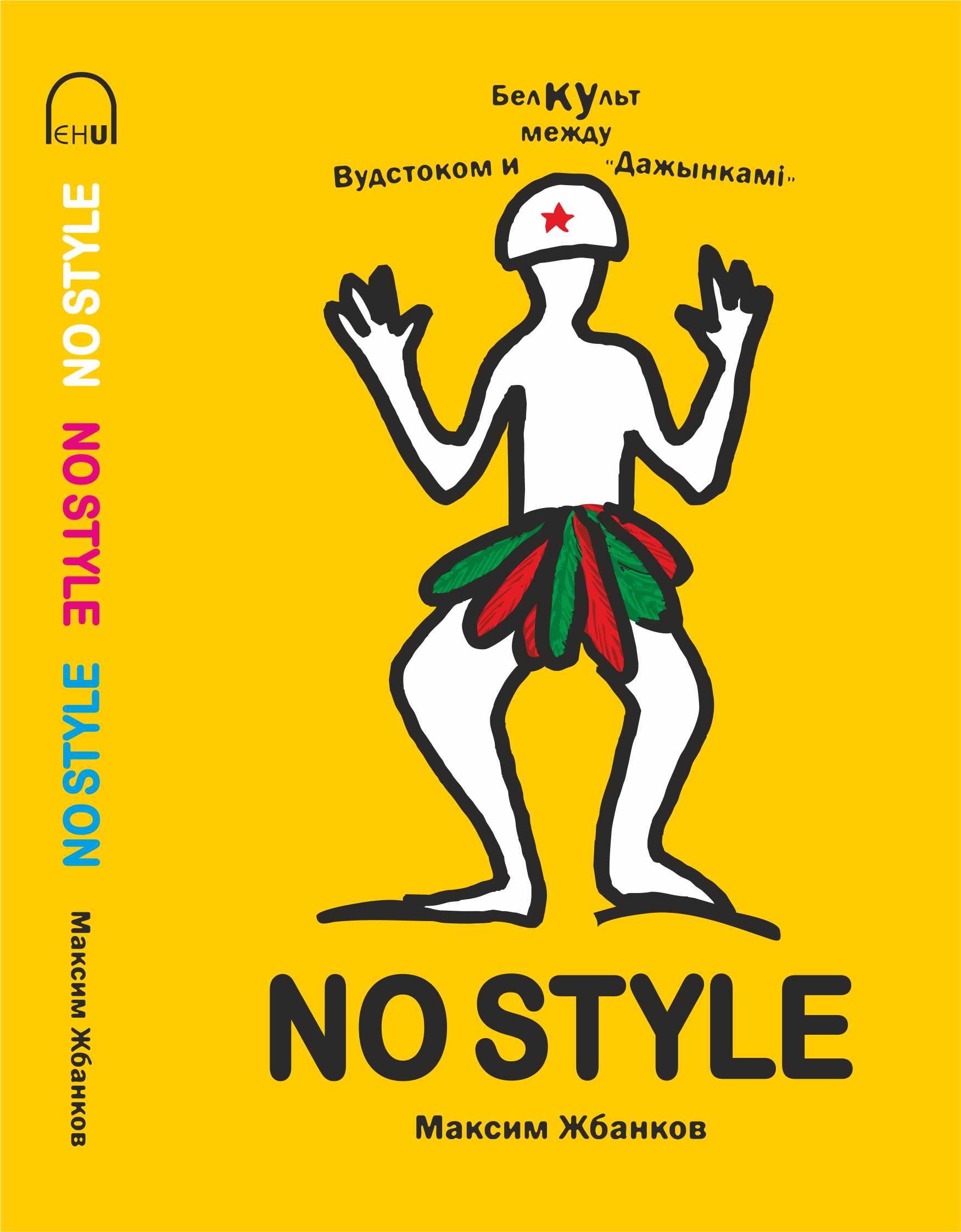
Zhbankov M. NO STYLE. Belcult between Woodstock and “Dazhynki”. – Vilnius: EHU, 2013. – 268 pp.
The review was prepared by Halina Rusetskaya.
Maksim Zhbankov’s book No Style. Belcult between Woodstock and Dazhynki breathes life into what might seem beyond resuscitation: the culture of trash. The culture of trash, or the trash of culture, is Maksim’s harsh and fair definition of belcult over the last decade.
“…with a glance back at Nabokov: I turned around to see whether Nabokov had turned around to see whether I had turned around.”
H.R.
“We are not bad people, we just come from hell” (from Steve McQueen’s film Shame)
“We were forced; we are doing this only for the money! Only for the money!” (Russian-speaking dancers in a Turkish restaurant)
Maksim Zhbankov’s book No Style. Belcult between Woodstock and Dazhynki breathes life into what might seem beyond resuscitation: the culture of trash. The culture of trash, or the trash of culture, is Maksim’s harsh and fair definition of belcult over the last decade.
A little theory. The magic notebook
The book consists of texts dated to different years of the past decade. There are several connecting threads. One is this: we live in zero time, and therefore it is worth ceasing to pine for authenticity, just as it is worth ceasing to strain ourselves inventing an avant-garde. If everything has already happened in postmodernism, then in Belarus it has happened even if it has not.
Another thread, with which I do not entirely agree: all partisan cultural strategies (what other kind could there be in Belarus?), regardless of the level of their ambition, miss the mark in their attempt to reflect or somehow relate to the “real state of things”. Without going into details, let us merely note that no real state of things exists. It does not exist outside culture. And something suggests that the author knows this.
The book is concerned more with the art milieu, with art or its imitation, than with culture in the broad sense of the word. From distant student days, one phrase has remained in my mind: “there are more than two hundred definitions of culture”. Even if there are two thousand, the point is that culture, as non-nature, permeates the human being through and through, regardless of one’s distance from the art milieu. A human being is alienated into culture as soon as they are born. A human being born here is alienated, among other things, into belcult.
And now I will write a few words about Freud’s magic notebook. The occasion is Maksim’s reflections on the specific features of authorial utterance in a culture that is always already covered with the writing of predecessors and contemporaries. Maksim writes about authorial inscriptions over others’ inscriptions, which should be disregarded if there is no clean sheet at hand. In Freud’s “magic notebook” (the metaphor of the “father of psychoanalysis” himself, clarifying the work of the psychic apparatus), inscriptions are made on the upper layer of a paper sheet that covers a wax tablet. What is written, pressed into the wax, appears through this sheet by means of a stylus.
Stylus, from the Greek stylos, is precisely the name of the pointed stick used for writing in the magic notebook. Earlier inscriptions, appearing through the surface, seem to reach toward what is only about to be written. It is also important for the founder of psychoanalysis that in one and the same technical device, the magic notebook, two mutually contradictory functions are successfully combined: one can both preserve what has been written and use a completely clean sheet.
For Maksim Zhbankov, cultural artifacts of Belarusian production are interesting and significant in the same way that, for Sigmund Freud, the contents of the unconscious are significant: as traces of earlier perceptions-inscriptions. The question of the heuristic possibilities of new writing remains excitingly open both for the creator of psychoanalysis and for our author.
It is worth saying separately something about the sociodynamics of our culture. The author writes that the once regular cyclical movement of cultural production, from elite culture through popularization to mass culture, no longer works today. It does not work in Belarus either. But it fails to work in its own way: dash-dot, gap, dash-dot, gap, gap, something somehow somewhere, conservation, gap… Yet the last thing I would want is to devalue what has been done. The book devotes enough attention to individual authors and projects; the reader can even fill in certain gaps in their own knowledge of what has happened here over the past decade.
“Mimic or die!” The culture of borrowing and self-repetition
Cultural second-hand is ineradicable. First, because any art product or art event sooner or later becomes an artifact. This is a supranational phenomenon. Second, the situation of frozen transitivity, the Belarusian case, once again actualizes the “rag-and-bone man’s strategy”, to use Maksim Zhbankov’s term. The alignment of the main forces remains obvious: pro-state pornography and, as an alternative, underground struggle. Third, Russian-produced pop culture is “successfully” inscribed into the Belarusian cultural landscape. A wonderful choice: orientation toward the neighbor, albeit selectively.
Mimic. One must mimic trends. The trend is compulsion to patriotism. From two sides: the aggressive and garish state-commissioned version, and the nationalist version appealing to origins. Experiments are prohibited at the level of the superego. Therefore, the author of “Belcult” can live without bel-art, and this, unfortunately, is mutual. Bel-art lives without an audience. As one form of overcoming the audience’s alienation from the “artist”, Maksim Zhbankov proposes that the latter turn attention to everyday life, stepping out of narrow professional niches. “Become a wrapper. Become a banner. Turn into an album cover. And then one day the viewer will come to you. Perhaps.”
Die. In his other texts, the temperamental author demands a rock-and-roll overdose and laments the endless failure to push things to the end. The nearest rise and departure, in time and space, of Alexander Bashlachev and Viktor Tsoi marked the end of the age of heroes (“live fast, die young”). After that, among the neighbors, the market and marketing began, with all the aggravating circumstances.
To die or to sell oneself: this dilemma is not for us. We cannot manage to die heroically, and trade is not going well. “The place where Samsara coincided with Nirvana” (Ihar Babkou), “The Belarusian Anomaly” (Uladzimir Furs), “The Code of Absence” (Valiantsin Akudovich), “I Will Die Here” (Aliaksandr Kulinkovich). Between life and death. And no criticism is needed. When/if a market appears, and an art market as well, perhaps these signifiers will lose their meaning, and we will lose our attachment to them.
The heroes of bel-art brought onto the pages of the book are alive and real: those who carry out their own projects in relation to the local cultural second-hand. Navinki, Ruslan Vashkevich, Artur Klinau, Silver Wedding: the list is incomplete. Their projects correspond to reality to the extent that they shape it.
In assembling Dogma
One of the characters in Isaac Babel’s works used to say: “Stop making scandals at your writing desk and stammering in public!” There is something similar in Maksim Zhbankov as well: “…our schemes know nothing about reality, and reality knows nothing about our schemes.” And also: “The eternal curse of the theorist is to be held hostage by conceptual matrices in a non-conceptual world.”
But the so-called reality outside the window does not even have this: conceptual matrices. That reality outside the window, without our speculative theoretical constructions, is highly problematic. Therefore there is no need to be sad that intellectuals have drifted too far from “reality” and that, as a result, “life passes by with a playful gait”. Everything is exactly the opposite. As with Soviet and post-Soviet rock, with theorizing here it is a matter of not pushing hard enough, not of overdose. Philosophy dies barely having been born; psychoanalysis is supposedly not in demand; and art is deeply in debt. How familiar all this is. And “targeted fire at one’s own” has not been cancelled either. Partly because matrices differ even among “one’s own”, while a common “reality” for everyone does not exist.
At the same time, I agree with the claim that “culture lives not in a set of concepts, but in the gaps of speech”. That is, the production of new meanings and forms is possible in the interstices of what has already been said. But one must speak, and preferably at length. So it is worth theorizing and conceptualizing according to the measure of one’s strength and access to the world library, until Alzheimer’s, with its clouded gaze, knocks at the door.
In the gaps of speech, Nothing [1] appears. In the maturing of Belarusian art house, Nothing takes on the form of social and everyday infernalism.
Maksim Zhbankov’s dream is Radio I (Radio He). From metaphor to “reality”: Belarusian radio, the kind found in the kitchen of Soviet apartments, has not changed in the last forty years. “The parental home, the beginning of beginnings…” “A tired wedge flies, flies across the sky…” And generations of radio hosts have already changed more than once. This is difficult to explain, despite knowing the structural and systemic reasons for such a state of affairs and despite the invariably arising aching feeling of touching the origins. “Contemporary” radio waves are not for the faint-hearted either: they call this rant “radio”. But one can believe in Maksim Zhbankov’s Radio I. In terms of stylistics.
This short text is not a review, but a compliment to the author who voiced the possibility of “establishing a roll call from the trenches” of the partisans of bel-art. Is this possibility doomed, according to old Belarusian tradition, to failure? Or, why dramatize so much, to fading away on takeoff, surrounded by the various noises of belcult?
“It is impossible to eliminate the noise environment, but one can make oneself a Jedi of junk,” the author writes. Pessimistic allusions: “Friend, leave me a smoke.” And in response, silence. Yesterday he lost faith in noise.
Partisans around Nothing. “Artist on the run.” Cultural junk. No style… An attempt to create a Belarusian Dogma.
Thanks to the author of Belcult for an engaging read. The book is too good to praise emphatically. But this is worth quoting: “We all do not hear one another. More precisely, each of us listens to our own thing. The basic moment of aesthetic communication, the experience of emotional consonance, is leaving our dance-around-art. The excited recognition of oneself in another. The direct work of feeling, which requires no crutches of interpretation.”
Notes:
[1] Akudovich V. The Book About Nothing. Minsk, “Lohvinau”, 2012.