
Publications · 26 July 2013
“Theatrical Art”: a second layer of ruins?
 This review was prepared as part of the joint “Book Review” project of the Political Sphere Institute and the Center for European Studies in Minsk.
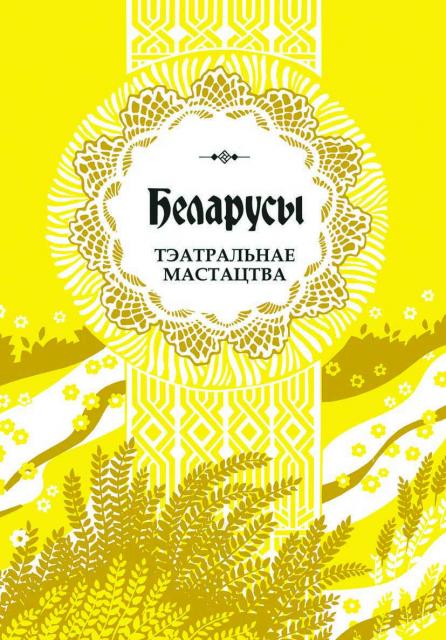
Belarusians / National Academy of Sciences of Belarus, K. Krapiva Institute of Art Studies, Ethnography and Folklore; [authorial collective: R. B. Smolski [and others]; scientific editor A. I. Lakotka]. — Minsk: Belarus. navuka, 2012. — [Vol.] 13: Theatrical Art — 758 pp.
Review prepared by Tatiana Artsimovich.
The book “Theatrical Art” in the series “Belarusians” is the first general scholarly publication after the collapse of the Soviet Union devoted to the history of Belarusian theatre, whose official description was first produced in Soviet times and therefore contained many pages that were “crossed out” or interpreted in accordance with the dominant ideology.
According to the introductory remarks by Professor and art historian R. Smolski, the researchers rely on the official “History of Belarusian Theatre” in 3 volumes (4 books), published in Minsk in 1983–1987, and the “Theatre Encyclopedia” (Minsk, 2002–2003). It is clear that the “History of Belarusian Theatre”, published back in Soviet times, was censored in many respects. For example, it does not mention Yanka Kupala’s play “The Locals”, banned until the late 1980s; the figure of F. Aliakhnovich is interpreted negatively (in the book he appears as a traitor who “served the occupiers” / p. 10). Nor are the reasons disclosed, for example, for the dismissals in various Soviet periods of the chief directors of BDT-1 (now the Yanka Kupala National Academic Drama Theatre), E. Mirovich or L. Litvinov, and others. The “Theatre Encyclopedia” already includes entries on F. Aliakhnovich, the theatrical debates of the 1920s, and mentions of repressions against theatre figures.
But alongside the official works there were also others. Thus, in 1924 in Vilnius, the playwright, director, and theatre figure F. Aliakhnovich published the monograph “Belarusian Theatre”, which in the Soviet period, because of the repressions against its author, was “forgotten” (fragments were printed already in independent Belarus in journals and in Aliakhnovich’s collected works). Another “forgotten” book (unfortunately, it never saw the light of day) is the monograph “Belarusian Theatre” by the literary scholar and art historian U. Siadura, who was also repressed in the 1930s but emigrated to the United States in the 1950s.
Yet the books mentioned above remain unanalyzed to this day. It is understandable that theatre studies in Belarus as a scholarly field took shape in the Soviet period, and the main research was done precisely then. Nevertheless, it seems important also to cite, or at least to mention, these books, which, unfortunately, the authors of “Theatrical Art” do not do (only one fragment from Aliakhnovich’s book is quoted, describing a Belarusian evening).
History without context
The chronological boundaries of “Theatrical Art” cover the entire history of Belarusian theatre: from its very beginnings (origins) to the present day (the book mentions events up to 2010). The sections devoted to the period before the beginning of the nineteenth century mostly retell the contents of the corresponding sections of the “History of Belarusian Theatre” (ritual games, skomorokhs, batleika, folk and magnate theatres). The period in which professional Belarusian theatre itself was formed receives a different interpretation (the activities and significance of the figures of V. Dunin-Martsinkevich, I. Buinitski, F. Zhdanovich). Unlike the earlier Soviet publication, the main optics become an emphasis on the national and an assertion of the distinctiveness of Belarusian culture. Thanks to this, a separate article is devoted to Belarusian-language performances, in which the national idea is presented as the main theme.
Naturally, an attempt is made to reconsider the events of Soviet times. But while emphasizing the importance of the 1920s for the formation of national professional theatre (the main theatres were formed: BDT-1, BDT-2, BDT-3; a circle of Belarusian playwrights appeared, and so on), the authors of the publication try to pass gently over the 1930s, which were harsh for Belarusian culture.
Repressions against theatre figures are mentioned, but rather in passing (the fact is described, but not analyzed). And yet it seems that precisely these pages should receive as much attention as possible today.
The ignoring of historical context and its role is characteristic of the entire book. This is all the more surprising after R. Smolski’s very promising “Introduction”, in which he writes about a new methodology, a new understanding of tradition, and the use of a method at the intersection of disciplines, all supposedly characteristic of this publication (pp. 5–7). In the end, however, this proved to be, to a certain extent, a formal declaration, while the statements of some authors in principle contradict the strategy announced in the preface.
For example, Smolski writes about the atmosphere of “universal fear” that prevailed in the 1930s and “did not contribute to liberated artistic creativity”. And without experiments “it is very difficult for art to move forward and be enriched with new ideas” (p. 16). Professor S. Laushuk, however, in the section “Belarusian Dramaturgy of the First Half of the Twentieth Century”, while noting that “indeed, repressions knocked U. Halubok, M. Zaretski, V. Shashalevich” and others “out of the creative process and out of life”, disagrees with those researchers who try to emphasize historical context, because “creative searches continued in the second half of the 1930s as well”; for example, the playwright Kandrat Krapiva flourished (p. 167). In the context of contemporary discussions about the need to rethink the Soviet past, such statements in a 2012 publication seem strange.
On the contemporary period, fragmentarily
The most interesting section from the point of view of new information is “Belarusian Theatre in the Second Half of the Twentieth and the Beginning of the Twenty-First Century”, which, in addition to the traditional parts devoted to the activities of the main Belarusian theatres (the Yanka Kupala National Academic Drama Theatre, the Yakub Kolas National Academic Drama Theatre, the Theatre for Young Audiences), includes articles on scenographic art at the turn of the twentieth and twenty-first centuries, Belarusian-language performances, and even music in dramatic productions.
A separate chapter is devoted to the history of the experimental studio movement of the 1980s–1990s (“Theatre Studios of Belarus in the 1980s–90s”, by V. M. Yarmalinskaya). Until now there have been only two small monographs that attempted to describe this phenomenon. Unfortunately, V. M. Yarmalinskaya’s article also does not go beyond descriptions of studios and individual performances. It does not articulate the fact that the experiments of this period were effectively forgotten, and that this had a negative impact on the renewal of the theatrical aesthetics of Belarusian theatre. The InZhest Theatre of V. Inazemtsev, effectively the only collective that has survived to our time, is not mentioned at all. Even if “InZhest” is defined as a plastic theatre, contemporary theatre studies no longer make rigid divisions between dramatic, puppet, or plastic directions. Therefore it is still unclear why “InZhest” is absent, or why the activities of the Belarusian Puppet Theatre, where in recent years many interesting experiments have been carried out, including scenographic ones, are not mentioned.
The logic of the section “New Theatres of Belarus in the Twentieth and Twenty-First Centuries” (authors T. Ya. Harobchanka, V. S. Ivanouski) is also unclear. The section seems to be devoted to young theatre collectives: it describes the activity of the “Dze-Ya?” theatre (after M. Trukhan’s death, this became the New Drama Theatre), the emergence of the “Free Stage”, which in 2000 became the Republican Theatre of Belarusian Drama, and the opening of the Center for Belarusian Drama under it. It also considers the activity of regional theatres in Maladzechna, Mazyr, Slonim, and Pinsk. Several pages in the article are devoted to individual figures. At the same time, it does not mention, for example, the Minsk Youth Theatre, which in the late 1990s and early 2000s paid considerable attention precisely to intellectual drama; the Belarusian Free Theatre, without which it is impossible to imagine the contemporary Belarusian theatrical space; or the activity of other independent associations: Theatre “Kampaniya”, U. Ushakov’s Free Art Theatre, and others.
Such a fragmentary approach and selectivity with regard to phenomena and figures (the authors provide no justification) also remain incomprehensible.
Is the contemporary period “faceless”?
The article by S. Laushuk, “Contemporary Belarusian Dramaturgy”, raises the most questions; it consists of two parts. The first is devoted to the dramaturgy of the second half of the twentieth century (1945–1980), which seems inappropriate: according to this structure, the starting point of contemporary drama is 1945? Yet in the second chapter the author explains that, formally, the beginning of the development of new dramaturgy should still be placed at the turn of the century, while everything preceding it should be viewed as its preconditions.
There are even more such contradictions further on. Although in the chapter “Belarusian Dramaturgy of the First Half of the Twentieth Century” the author denies the importance of historical context, when discussing contemporary drama he constantly emphasizes the connection of theatrical processes with the socio-political situation in the country during perestroika and independent Belarus. Unlike most other articles, in which the descriptive method predominates, in this section the author spends more than ten pages trying to interpret and analyze processes that were and are taking place in contemporary drama. But the course of his reasoning assumes a very strange character, resembling the method of criticism of the 1930s.
Thus, the author criticizes the “so-called comprehensive experiment” that unfolded in Belarusian theatres in the late 1980s and was aimed not only at improving management. But theatres gained the opportunity to form their repertoire independently, and the first thing that directors turned to were formerly banned or “imported” plays. In Laushuk’s view, this was an absolute mistake (p. 334). He quotes another theatre scholar, V. Naumenka, on the absolute failure of the experiment, which brought more harm than benefit to Belarusian theatre. “Unimpressive” experiments by “so-called advanced directors … drove the adequately oriented public to white heat” (p. 338).
S. Laushuk is also concerned that the “total revision of the spiritual achievements of the Soviet period” led to “attacks on the method of socialist realism” (p. 339), and that portraying events of Soviet history (the revolution, working life, etc. / p. 339) in a positive light became bad form. All this led playwrights to encroach upon “the sacredness of our people’s feat” during the Great Patriotic War (p. 340). On the one hand, the author acknowledges that the truth of war can be multifaceted — through the eyes of a general, a field commander, and so on. On the other hand, he contradicts himself when he criticizes materials in official and “oppositional” (as the author himself calls them) media that attempted to look differently at the activity of the Home Army, for example, or to take certain steps toward the “de-heroization” of the partisans.
As for the new wave of Belarusian drama of the early 2000s, the author marks it out (“a wave of new creators arrived”) and even lists names: V. Hapieyeva, A. Kureichyk, A. Karelin, M. Rudkouski, P. Pryazhko, and others. But he immediately adds the caveat that there are no outstanding artistic phenomena among them, because mentally and nationally they are faceless (p. 345). “It is very difficult to attribute them to Belarusian dramaturgy,” S. Laushuk states, “and the Russians do not need them either…”. And he writes this, among others, about playwrights such as Pryazhko or Rudkouski, whose plays have already been translated into several European languages and are performed in numerous foreign theatres.
It is also interesting to understand the logic according to which the author nevertheless singles out a certain circle of plays as worthy of attention.
For example, in the case of Pryazhko, he notes “When the War Ends”, a work that, in S. Laushuk’s opinion, is accidental for the playwright and was noticed by no one except the Republican Theatre of Belarusian Drama. At the same time, there is no mention at all of the plays “Life Is a Success” or “The Evil Girl”, which received special prizes at the Golden Mask International Theatre Festival in Moscow.
Yet while ignoring the phenomena of new Belarusian drama that are already making themselves heard on the international theatre stage, the author is convinced that A. Dudaraŭ or A. Petrashkevich, for example, remain significant figures (the question is: for whom?). And also, very modestly, at the end of the section, the author devotes almost a page to describing his own plays, productions of which were staged in Maladzechna, Vitebsk, Mahiliou, and Hrodna, which, evidently in the author’s opinion, allows these works to be included in this section alongside the other names.
Thus, despite the positive aspects of the book — attention to the national, an attempt to outline precisely the distinctive pages of the history of Belarusian theatre, an overview of the activities of theatre studios, the return of names banned in Soviet times — as a scholarly publication the book raises many questions.
The “new method” announced in the “Introduction” remains unclear. On the contrary, the method by which events are interpreted seems all too familiar: descriptiveness predominates, facts are distorted (for example, about the lack of demand for young playwrights), individual contemporary figures are mentioned only formally (the activity of Valery Mazynski, who in 2005 unofficially became persona non grata), or certain phenomena and names are absent altogether. For example, there is no mention of the dramaturgy of Mikolai Khalezin, who was one of the first Belarusian authors to be shortlisted in Russian competitions in the early 2000s. Nor is there any mention of the activity of the Belarusian Free Theatre.
In addition to this, the constant emphasis on spiritual values and moral education as the tasks of theatre, as well as the clichéd comparison of theatre to a temple that “it is very important… to finish building” (p. 339), completely negates the claim to a new methodology. It is interesting, in general, how exactly researchers intend to finish building, when they themselves are creating a second layer of ruins?