
Publications · 4 October 2013
“By Now”: and everything here is strange to the Western eye…
 This review was prepared within the framework of the joint “Book Review” project of the Political Sphere Institute and the Center for European Studies in Minsk.
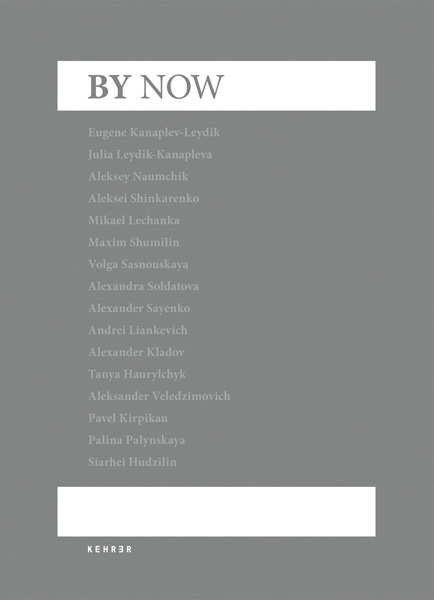
ed. Matthias Harder. BY Now. – Berlin: Kehrer Verlag Heidelberg. – 2013.- p. 144.
Review prepared by Sviatlana Paliashchuk.
“In the Western imagination, there is no country between Poland and Russia. For many, finding Belarus on a map will be too difficult a task,” begins the book Belarus: The Last European Dictatorship, published by Yale University Press in… 2011. This admission by Andrew Wilson is disconcerting and painful. One might think: here we are, Belarusians, right next door, bordering three European Union countries! Yet anyone among us who has travelled and answered the question “Where are you from?” knows what reaction an honest answer provokes.
They do not see us, they do not hear us, they know nothing about us. Although from time to time, in the Western geopolitical imagination, there are guesses that some such place must exist somewhere. And now a Belarus Airways plane is carrying Brad Pitt away from zombie-occupied Jerusalem in the film World War Z; the third episode of the first season of Sherlock begins in the gloomy place called Minsk, Belarus; in The Manchurian Candidate (2004), the company Manchurian Global, which conducts experiments on humans, reveals itself during the Belorussian War; and one episode of South Park discusses the “problem” of farmers from Belarus. No, of course, we have not yet grown into vivid images of pop culture, but a certain “groping” for the territory is clearly taking place. They are beginning to look for us and trying to define us, while we are still looking for ourselves…
I remember that while studying in Poland I felt the pressure of the image of Belarus created by the local media. Belarus is a dictatorship. People who live in this country have been unlucky. They deserve sympathy because they are deprived of the right to enjoy basic democratic freedoms. And young people have been especially unlucky: they are doomed to waste their best years and prospects, and therefore must either make a revolution or certainly leave the country. A young Belarusian who does not dream of emigration causes bewilderment. “So where will you go?” my friends worried when I was returning home. “What awaits you there? You will end up working in some village shop…” The thought that in Belarus one can live, breathe, love, create, enjoy the luxury of communicating with close people, rejoice in the beauty of nature, work, and make plans for the future somehow does not fit the image of dictatorial tyranny.
This thin line, where we are still ready, or no longer ready, to accept the complexity, diversity, and, most importantly, the dynamics of the image of the Other, is precisely the line that separates definition from stereotype. “The stereotype reduces, essentializes, naturalizes and fixes difference,” wrote Stuart Hall. The stereotype establishes a symbolic order by drawing a boundary between “norm” and “deviation,” “proper” and “condemned,” “understandable” and “strange.” Practices of labelling become especially active in situations marked by inequality of power, since a dominant position justifies the freedom to name. Michel Foucault wrote about the link between power and knowledge. Pierre Bourdieu wrote about symbolic power as the power to describe, define, construct reality, impose a particular vision, and establish an epistemological order, warning that in the field of cultural production the manifestations of symbolic power are camouflaged by claims of objectivity, disinterest, sincerity, and even self-sacrifice. But this power is present all the same. It is present even now, as you read my interpretations.
Why another “first book”?
The book-album By Now, edited by Matthias Harder, was published by the Berlin-based Kehrer Verlag Heidelberg only a couple of months ago. Already in the first paragraph of the introduction, the reason why this new publication may attract interest is stated: before us is “the first book that presents young photography” of Belarus.
It is already time to write a separate book about the discursive status of the word “first” in the local context. The slow formation of the field of cultural production and the underdeveloped mechanisms of consecration and legitimation tempt many to play the game of self-naming. Here and there, self-proclaimed “first” websites, journals, festivals, and exhibitions appear. All of this could only be welcomed, if the “first” were not being so blatantly overused. The game ceases to be amusing when the one who gains access to power easily nullifies everything that had been achieved and developed earlier by others.
After all, why should the “first” art project have greater significance than a non-first one? This is not sport, but our national culture. Is it important here to break a record, hastily “stake out a place,” and experience one’s “15 minutes of fame”? Or is it important to achieve understanding and move to a new level of reflection?
What will remain in memory? What will remain in history? Will the “first book on young photography” in Belarus be able to create some kind of foundation, a point of support? Will it be able to offer such a perspective that afterward we will no longer look in the same way? Will it reveal to us something we did not know? Will it push us toward insight? Will it become the kind of book we will often take down from the shelf to leaf through again and again, in a year, in two years, in five years? How many references to this book will there be in reviews, surveys, research articles, monographs, and creative projects? Let us try to step beyond the level of initial reactions and ask deeper questions of the books that fall into our hands.
Problematic aspects of the Berlin introduction
The list of personal achievements of the book’s editor Matthias Harder is impressive. He defended a dissertation on photography, works as chief curator of the Helmut Newton Foundation in Berlin, is the author of numerous articles, and has compiled a dozen albums devoted to individual photographers. I assume that behind each such monograph stood a full-fledged study. Yet the book By Now stands apart from this background and looks like a peculiar adventure: too global a concept, too short a timeframe, too little funding, and too new a topic for Matthias.
Publications with ambitious titles usually sell well, but a cautious author will immediately hasten to indicate the precise focus and boundaries of the study, so as to direct readers’ expectations properly and remove a fair number of questions that any reviewer will inevitably ask. Unfortunately, we do not get any of this from Harder, who, while working on this project, for some reason suddenly lost academic caution and that very critical scrutiny whose absence he so readily attributed to Belarusians themselves.
I would recommend using the introductory article to By Now as an excellent case study for a course in postcolonial studies: every statement and every assumption here is simply too symptomatic. Thus, it very quickly became clear that the curator had not conducted any research on Belarusian art and photography, and in this sense the word “first” was not merely a marketing trick. Having leafed through the catalogue Fotografie aus Minsk (1994), the same catalogue in which Valery Lobko wrote his version of the history of Belarusian photography, Matthias Harder declared that this was the only existing publication in the world about Belarusian photography. I admit it is not entirely clear how one could miss, for example, at least these books and catalogues published in the West:
– Walker, Ursitti & McGinniss. (1991). Photo manifesto: contemporary photography in the USSR. New York: Stewart, Tabori & Chang : Distributed in the U.S. by Workman Pub.
– Eskola, T. (1988). Toisinnäkijät: Uusi valokuva neuvostoliitossa. Helsinki: SN-kirjat.
– Moderna museet (Stockholm, Sweden), & Ludwig Muzeum (Budapest, Hungary). (1999). – After the wall: art and culture in post-Communist Europe. Stockholm: Moderna Museet.
– Noorderlicht (Foundation), & Fries Museum (Leeuwarden, Netherlands). (2008). Behind walls: Eastern Europe before and beyond 1989. Groningen: Stichting Aurora Borealis.
– Macek, V., Stredoeurópsky dom fotografie, & Eyes on Monat der Fotografie Wien. (2010). The history of European photography, 1900-1938. Bratislava: Central European House of Photography.
– Bewegte Welt – erzählte Zeit: 1989 – 2009 ; zeitgenössische Fotografie und Videokunst aus Russland, der Ukraine, Belarus, Georgien, Kasachstan, Kirgisistan, Usbekistan und Deutschland; = Turbulent world – telling time. (2009). [s.l: Goethe-Institut.
– Kuizinas, K., Fomina, J., & Siuolaikinio meno centras. (2010). Opening the door?: Belarusian art today. Vilnius: Siuolaikinio meno centras.
Not to mention that, in order to understand contemporary Belarusian photography, it would probably have made sense to become acquainted with current creative and research projects inside Belarus. But the role of discoverer, which Harder so confidently assigned to himself, allowed him to make even such loud statements: “There are virtually no art dealers or art critics in Belorussia. There are also no survey publications on contemporary art and photography that would make it possible to advance serious research on the topic. All that exists is the thin exhibition catalogue ‘Photography from Minsk,’ in which the German Institute for International Relations (IFA) presented 6 photographers in Berlin in 1994… That is precisely why it is so important that the IFA galleries in Berlin and Stuttgart are now going to show the By Now project.”
And even the delicate work of the translator, who carefully replaced Belorussia with “Belarus” and “there are no” with “there is a lack of,” could not smooth out the sharp edges. Almost 20 years have passed, and Belarusian photography is being invented in Germany once again. At the end of his remarkable revelation, Harder decides to name the only Belarusian photographers visible from Berlin: Ihar Savchenko, Artur Klinau, and Andrei Liankevich…
Why was the voice of an editor from Belarus so important?
Andrei Liankevich’s relation to the By Now project cannot be explained in a few words. His name is not indicated on the book’s cover, although it is mentioned in all annotations and press releases, and on Amazon.com Andrei appears among the co-authors. We all know that Andrei initiated the project and became its manager; it was he who ran the competition, gathered the participants, worked and continues to work with local media, makes announcements and gives interviews, organizes presentations and meetings.
Liankevich also became one of the photographers whose works passed the competition and were printed in the book. A photograph from Andrei’s project opens the book By Now itself. But Andrei’s conceptual leadership did not grow into its final and perhaps most important materialization: his own introductory article, which could have balanced the view of the Berlin curator and allowed us to learn what Andrei himself, as an insider, thinks about this project.
Media interviews will be forgotten and lost, but the absence of Andrei’s voice in the book itself is a significant omission. The reader will not learn why Belarusian photographer and curator Liankevich undertook this project. Why did he consider it, and why does he still consider it, important? What difficulties did he face? What future does he see for this book? What does he think about the authors who were selected or rejected? Why does he find their works interesting? Does he think this book has a future in Belarus? Does he agree with Harder’s interpretations? Alas, at the decisive moment Andrei somehow stepped back, handing the editor all power and responsibility for the final product.
And in the final product Matthias Harder draws an altogether gloomy image of Belarus: here people do not look each other in the eye because they are demoralized and depressed; shops do not sell fresh literature and it is impossible to order it; hotels are so bad that Harder is forced to stay in a private apartment; there are bad laws that force a tourist to obtain an expensive visa and buy two insurance policies; on the road from the airport one encounters strange mounds that have “some” relation to the Second World War; Minsk’s architecture recalls a communist utopia, while the central buildings were constructed by German prisoners; here there is a single independent gallery in the entire country, and all creativity remains under state control, and so on. Harder never stops being surprised by how “strange,” “paradoxical,” and “surreal” everything here seems to the Western eye… Even if one realizes how important it is for young Belarusian photographers to be published in such a book, it becomes curious whether they understand the ideological context into which the project curator places them.
The photographic part of By Now: other stories
Of all the photographic representations of contemporary Belarus, my sympathies are perhaps on the side of the recent project Stand By (2012). Its elegant and viable concept is captivating and disarming. The Sputnik Photos team worked together on the project for a year, preparing seven fully developed original photo stories. We see authorial, subjective, and responsible positions; we see research, searching, successes and mistakes. At the same time, none of the compilers or participants of this collection (including the Belarusian ones) claimed the authority to offer a certain centering and uniquely legitimate interpretation of what is happening in Belarus.
In comparison with the Polish book Stand By , the German By Now loses out because of its unclear concept, confusing procedure for selecting authors, highly debatable editorial position, and because under one common heading it brings together old projects that were made with entirely different aims. For example, some photographers submitted their student works, prepared under the guidance of teachers as reporting assignments. It is hardly possible to speak here of authors’ independence; rather, these young people are only at the beginning of their search for an authorial style and their own themes. Nevertheless, in the mosaic of By Now one can see several names symptomatic of the processes taking place today in the Belarusian photographic milieu.
Thus, in the genre and stylistic eclecticism of the By Now selection, reportage projects on social themes stand out (“Private Lukashenka” by Siarhei Hudzilin and “Trolleybus Bureau” by Aliaksandr Saenka). Behind these two authors there is a tendency we have been observing for three years since the Belarus Press Photo contest was established. The contest showed that between the impressive façade and the gloomy back alley there exists a vast and very interesting space of Belarusian everyday life, where the political manifests itself in softer and often creative forms. Today, perhaps the most important thing about the Belarus Press Photo contest is its uninterrupted work, thanks to which a body of truly alternative images has been built up, and a circle of authors systematically working to chronicle the Belarusian present has become visible. Most of these authors are young photographers, among them the annual winners S. Hudzilin and A. Saenka.
Photographers connected to the Minsk Center of Photography can be singled out as a separate team: Aliaksei Naumchyk, Aliaksandr Veledzimovich, Tatsiana Havrylchyk, and Aliaksei Shynkarenka. The center itself was founded six years ago by Aliaksei Shynkarenka, who declared the teaching of authorial photography as its aim. For this reason, the programme included classes in the history of photography, the basics of visual literacy, and project work, which is hardly something one would see in simple photography courses. Around 400 people have passed through the school, again mostly young people, this time interested not so much in reportage as in art and documentary photography.
“We need to be realistic,” Shynkarenka said in one interview. “It is difficult for us now to reach the general concept of a European level, because this work requires the comprehensive development and interaction of all cultural, economic, and political formations of our society. But we are not going to underestimate ourselves. In the conditions in which we find ourselves, we are creating a very good product.” Shynkarenka’s own Polaroid project, selected for the book By Now, is already well known thanks to its successful participation in the exhibition Opening the door? Belarusian art today, organized in 2010 by the Lithuanian Contemporary Art Centre. T. Havrylchyk’s project about residents of Minsk psychoneurological boarding homes became a prizewinner in the documentary photography contest “Archive of Time” (2009), organized by the Minsk Center of Photography.
The presence of the European Humanities University is undoubtedly significant. A quarter of the By Now authors indicated their affiliation with this institution. It is interesting that neither EHU programmes as a whole nor individual courses are aimed at training photographers. Photography classes are offered to students only in several specialties and only as one of many tools (alongside film, radio, television, and other media) that students can use for their creative and professional purposes. Yet the orientation of courses toward project work, close acquaintance with tendencies in contemporary art and photography, familiarity with current cultural problems, and the incredibly creative environment of the university itself produce original and competitive student projects. In 2012, the Ў Gallery showed a separate exhibition of photographic works by EHU students. After their debut, two authors, Volha Sasnouskaya and Pavel Kirpikov, successfully passed the competition for participation in the book By Now.
Since space limitations do not allow discussion of all photographers, I would like, in concluding the review, to draw attention to one more author. It was especially pleasant to discover in the book a previously unknown to me series, “City Holidays,” by Aliaksandra Soldatova. It is difficult to attach Aliaksandra to any institution; the author works rather autonomously, and recently Aliaksandra has moved toward interesting experiments with adapting the aesthetics of detachment, or deadpan, as Charlotte Cotton called it, to local material. In these cold, distanced, almost sterile photographs, we can feel something of Gursky or Gronsky. Aliaksandra’s series on Belarusian bus stops, made in the same aesthetic, was shown this year at the photography festival in Krakow.
I would not like to sum up or have the last word. As always, I hope that the book will receive more reviews that will delight us with new ideas, new points of view, and original interpretations. I sincerely want to believe that the book By Now will become a good start for young photographers and will serve them well in promoting their personal portfolios.
But most of all I want to hope that after the publication of By Now there will be a little fewer people for whom Belarus looks like a blank spot on the map of Europe. Now that there is already a “first book,” people (at least in the photographic milieu) no longer have the right not to know about us. And I also want to hope that the next publication on Belarusian photography will not be the first, and will be no less significant because of that.