
Publications · 7 November 2013
“Why Lukashenka?”: Andrew Wilson writes about the “last dictatorship” in Europe
 The review was prepared as part of the joint “Book Review” project of the Political Sphere Institute and the Centre for European Studies in Minsk.
Wilson, Andrew (2011). Belarus. The Last Dictatorship in Europe. New Haven and London: Yale University Press, XII+304 pp.
Review prepared by Sviatlana Paliashchuk.
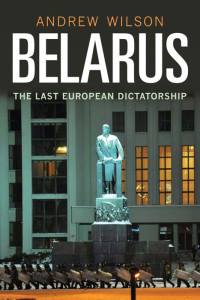
While we are trying to decide which version of the Belarusian language to speak, which history to reproduce, which academic standards to follow, and whose forecasts to trust, monographs appear that make the tangled Belarusian situation “comprehensible” for English-speaking readers. Seeing Andrew Wilson’s book Belarus: The Last Dictatorship in Europe in the bookstore of Central European University in Budapest was unexpected. I did not know that such a publication existed. It was impossible not to buy it: 300 pages of scholarly text by a British expert, under a cover with a frightening photograph by Drachev showing the dispersal of an opposition rally after the elections of 19 December 2010.
Being neither a historian nor a political scientist, I experienced a strange mixture of academic curiosity and the anxiety of a subject placed in a subordinate position. What is it like to be objectified, described, studied, systematized? What is interesting here is not even so much the facts as their interpretations, conceptualizations, the language itself, the terminology. There was a fear of once again seeing humiliating labels and stereotypes, sweeping generalizations, but there was also hope. What if Wilson could offer some original way of describing our situation, retell our experience in a new way, externalize our problems by suggesting a productive path for reconstructing ourselves, and perform a kind of psychotherapeutic task?
Without claiming to engage in scholarly debate and leaving to professionals the task of carrying out a detailed examination of the facts and conclusions accumulated in the book, I wanted to understand what Wilson’s study might offer to a broad circle of Belarusian readers. And given that a translation of the book is hardly to be expected in the foreseeable future, is there any chance that Wilson’s ideas might find a place in our own understanding of ourselves and our country? Or will the interpretations prove so foreign that they will be difficult to accept?
First of all, it must be said that Wilson’s book can serve as a good example of research as such. The author managed to collect many interviews, but these became only a small part of the materials. The book contains around a thousand (!) references, which looks impressive, especially against the background of how some Belarusian scholars manage to write monographs without mentioning any sources at all… Among the authors most frequently cited by Wilson are Hienadz Sahanovich, Aleh Latyshonak, Zakhar Shybeka, Yury Turonak, Valery Bulgakov, Pavel Tereshkovich, Andrei Dynko, as well as the books Lukashenko. A Political Biography by A. Feduta, The Firing Squad by O. Alkayev, The Temptation of Power by V. Kebich, and Belarus at the Crossroads by P. Kravchenko. Of separate interest are the English-language monographs on Belarus cited by Wilson, of which, as it turns out, there are also quite a few, for example:
Bekus, N. (2010). Struggle Over Identity: The Official and the Alternative “Belarusianness.” Central European University Press.
Korosteleva, E., Lawson, C., & Marsh, R. (2004). Contemporary Belarus: Between Democracy and Dictatorship. Taylor & Francis.
Snyder, T. (2003). The Reconstruction of Nations: Poland, Ukraine, Lithuania, Belarus, 1569-1999. Yale University Press.
Urban, M. E. (1989). An Algebra of Soviet Power: Elite Circulation in the Belorussian Republic 1966-86. Cambridge University Press.
Vakar, N. P. (1956). Belorussia: The Making of a Nation, a Case Study. Harvard University Press.
Zaprudnik, J. (1993). Belarus: at a crossroads in history. Boulder: Westview Press.
The storehouse of Belarusian studies is regularly replenished with new publications, but Belarus does not cease to remain terra incognita. Wilson begins his book with a frank admission: “In the Western imagination, there is no country between Poland and Russia. For many, it would be too difficult a task to find Belarus on a map.” This dire situation does not, however, prompt the author to write The Very Short Introduction to Belarus. Nor does he try to offer a “final answer” to the question of what Belarus is and who Belarusians are. Wilson begins with a more restrained formulation of the problem: there is a stereotype that Belarus is a country without history; what can be said in response?
The entire first half of the book is devoted to refuting this stereotype. Belarusian history is set out in stages: the Principality of Polotsk (the chapter “Polotsk”), the Grand Duchy of Lithuania (“Lithuania”), the Polish-Lithuanian Commonwealth (“Ruthenia” and “Uniate Territory”), the Northwestern Krai of the Russian Empire (“Belarus Begins”), the Belarusian People’s Republic and the Belarusian SSR (“Belarus Begins Again: The Traumatic Twentieth Century”).
Wilson’s design may seem strange: why retell the history of a country if encyclopedias exist for such overview purposes? Yet the author was hardly interested in a simple summary of facts. What came to the fore was the desire to show the complexity and confusion both of the events themselves and of their interpretations by Belarusian, Russian, and Lithuanian researchers. “Belarus may look incomprehensible, but it has interesting stories, provided, of course, that they are told properly” (xi). The scrupulous description of historical vicissitudes, the attempts to find logic and build causal links, sometimes seem to tire even the author himself: “This is mess, frankly” (15), Wilson jokes. Incidentally, the author’s jokes and irony noticeably enliven the book: “The name Usiaslau is quite suitable today for a brand of vodka: Usiaslau’s magical powers allowed him to fly, and vodka is believed to have a similar effect” (6).
The second task Wilson set himself was to present the history of Belarus as a series of aborted starts in nation-building. His previous study, devoted to Ukraine, allowed the author from time to time to draw parallels between the two countries. The comparisons, however, were not in Belarus’s favor. “Weak,” “unable,” “handicapped,” “failure” — this is the vocabulary that constantly accompanies the presentation of the local narrative. “The Russian Pushkin was a good writer. The Ukrainian Shevchenko was a good poet […]. But Belarusians did not have that. There was no Belarusian Shevchenko…” (87). Belarusians proved to be “eminently digestible” (60), Wilson comments on the ease with which various forces and ideologies subordinated the country’s territory and people’s minds. “National identities, in whatever form, came late to Belarus” (62). “Belarusians were too honest” (87) to invent for themselves a strong and competitive national myth.
Wilson, however, is in no hurry to explain the reasons for this helplessness. In his review of the book, Aliaksandr Paharely described Wilson’s approach as primarily descriptive, and there are certainly grounds for this. Wilson really does not rush to satisfy readers eager to receive exhaustive explanations. There are no such explanations in the book. In recounting the course of events, Wilson only occasionally pauses: for example, by devoting a paragraph to reflections on what would have happened to Belarus if, after the Second World War, it had continued its life with Vilnius as its capital (106). Or by trying, over three pages, to list the facts that might answer the question of why “the national movement was so weak” in nineteenth-century Belarus (85–87). The conclusions to the chapters and the interpretations of the facts remain surprisingly sparse.
But sometimes bringing together facts alone can be perceived as a form of interpretation. For example, one often hears about how Nasha Niva played a key role in the formation of Belarusian national identity. In Wilson we read: “By 1911 there were two Belarusian-language periodicals in Vilnius, but the city’s polyglot inhabitants could also choose from thirty-five publications in Polish, twenty in Lithuanian, seven in Russian, and five in Yiddish” (85); Nasha Niva, meanwhile, had a print run of 4,500 copies. Or elsewhere the author lists simple facts concerning the building blocks of the national movement: the first Belarusian dictionary was published only in 1906, Kupala published his poem “Muzhyk” in 1905, the first collection of Kolas’s poems appeared in 1908, and the first normalization of Belarusian grammar was carried out by Branislau Tarashkevich in 1918. All this was meant, in particular, to explain why Belarusian schools did not play a significant role until the first half of the twentieth century.
Wilson devotes considerable attention to the Second World War, repeatedly emphasizing the destructive consequences these events had for Belarus. “By the end of the war, half the population of Belarus had either been killed or displaced. This happened to no other European country” (110), he quotes Timothy Snyder. “No European country suffered so much” (110). Yet the explanation of Belarus’s postwar history occupies only a couple of pages. “The war was a turning-point social event. The Holocaust, migration, and enormous social change cleared the cities of Jews and Poles, and for the first time Belarusians began to dominate urban life” (117). Wilson describes the BSSR as the most loyal of all Soviet republics.
The second part of the book, entitled “Independent Belarus,” is almost entirely devoted to the figure of Aliaksandr Lukashenka (apart from the first chapter), which cannot but cause some disappointment among readers who would like to learn about broader themes related to culture, society, and history. In terms of content, there is hardly anything here that can surprise you if you have already read, for example, the political biography of Lukashenka written by Aliaksandr Feduta, the source most frequently cited in Wilson’s book. “Why Lukashenka?” — this is the title Wilson gives to the concluding chapter. He formulates his research questions quite clearly. Why did history lead Belarus to Lukashenka? “Was this an accident? Or is Lukashenka broadly typical of Belarus’s history and political culture? How paradoxical is it that the ‘last dictator’ also became the first successful Belarusian nation-builder?” (xi).
Independent Belarus also has many stories awaiting a skillful narrator. One of the ideas Wilson seeks to convey is that dictatorship should not be considered synonymous with stasis; it is a living process in which the dictator appears as a survivor, someone constantly fighting for survival. Wilson opens his account of Lukashenka’s entry into politics with one of the most vivid characterizations of the future dictator — a quotation from A. Feduta’s book that Lukashenka craves power like a sixteen-year-old teenager craves sex with a woman (148). What follows is a description of gripping political maneuvers in which the president “plays,” “flirts,” “experiments,” “schemes,” “balances,” “skillfully uses opportunities,” and “shows sensitivity.”
Wilson explains in detail Lukashenka’s rise to power, as well as the events of each election: the current balance of forces, the characteristics of opposition candidates, and Lukashenka’s tactics. He calls Lukashenka a serial election-stealer, showing how deftly election results are falsified and how virtuously and dirtily “political technologies” are used to retain power. The book should dispel the last doubts of those who refused to believe that the data of the Central Election Commission are fiction.
However, the entire theater of manipulation is staged against the backdrop of an unpleasant truth: the majority of the population supports Lukashenka. Wilson cites BISS and IISEPS data from February and September 2010, according to which 44 percent of Belarusians believe that the concentration of power in Lukashenka’s hands is good for the country, while Lukashenka’s approval rating still remains around 39 percent, with strong support in rural areas, among older people, and among the less educated (256–257).
Wilson calls Belarusian society of the independence period creole, thereby emphasizing the multiplicity, borderland character, and hybridity of reproduced cultural practices and national identity. Interesting, for example, are the facts he gathers about the Belarusian language. Wilson describes three versions — “tarashkevitsa,” “narkamawka,” and “trasianka” — and at the same time receives reproaches from reviewers for simplifying the situation: “Belarusian Latin script” is not mentioned, nor is the fact that all versions simultaneously exist as legitimate. Wilson compares national survey data from 1999 and 2009, demonstrating “an obvious paradox: over the years, more people identify themselves as ‘Belarusians’ than speak Belarusian” (123). According to the 2009 census, Belarusians who used Belarusian at home amounted to 21.8 percent, while 60.8 percent named Belarusian as their native language.
State ideology is equally creole: “Everything was ‘Belarusian’: the ‘Belarusian model of development,’ the ‘Belarusian path,’ the ‘Belarusian economic model,’ and so on. Lukashenka launched the slogan ‘For Belarus!’ during the 2004 parliamentary elections. It was patriotic but vague: a beautiful empty box into which he could put whatever he wanted” (2003). National projects are striking in their “radical eclecticism”: here one finds nostalgia for the Soviet, Pan-Russianism, Minsk as the Fourth Rome, Belarusians as the purest Slavs, Belarus as the defender of Slavic civilization against the West, Belarus as a conqueror of space, Belarus as a new Silicon Valley, Belarus as a center of nuclear energy, as the most athletic country…
Finally, Wilson portrays Lukashenka himself as the same kind of creole, an “interesting combination of things,” a pot pourri, and he largely links this to his political appeal to the population. Lukashenka knows how to address a local audience; he knows how to be close and understandable to the population and thereby outplays any opposition proposal oriented toward a homogeneous, intellectual, aristocratic, linguistically and historically pure national identity. “For better or worse, modern Belarus is forming its identity under Lukashenka, partly because of his long tenure in power since 1994 and partly because of his construction of an eclectic identity that is closer to the average Belarusian than the purist project of the opposition” (139).
“If Lukashenka had not come along and spoiled everything, Belarus might have muddled through the 1990s like Ukraine or Moldova — not exactly a success story, but not exactly a catastrophe either,” Wilson reflects (141). His forecasts for the future of Belarus can hardly be called optimistic: “Lukashenka will not last forever” — this is Wilson’s parting answer.