
Publications · 23 January 2014
From the Times of the Grand Duchy of Lithuania to the Second World War: New Historical Studies
 This review was prepared within the joint “Book Review” project of the Political Sphere Institute “Political Sphere” and the Centre for European Studies in Minsk.
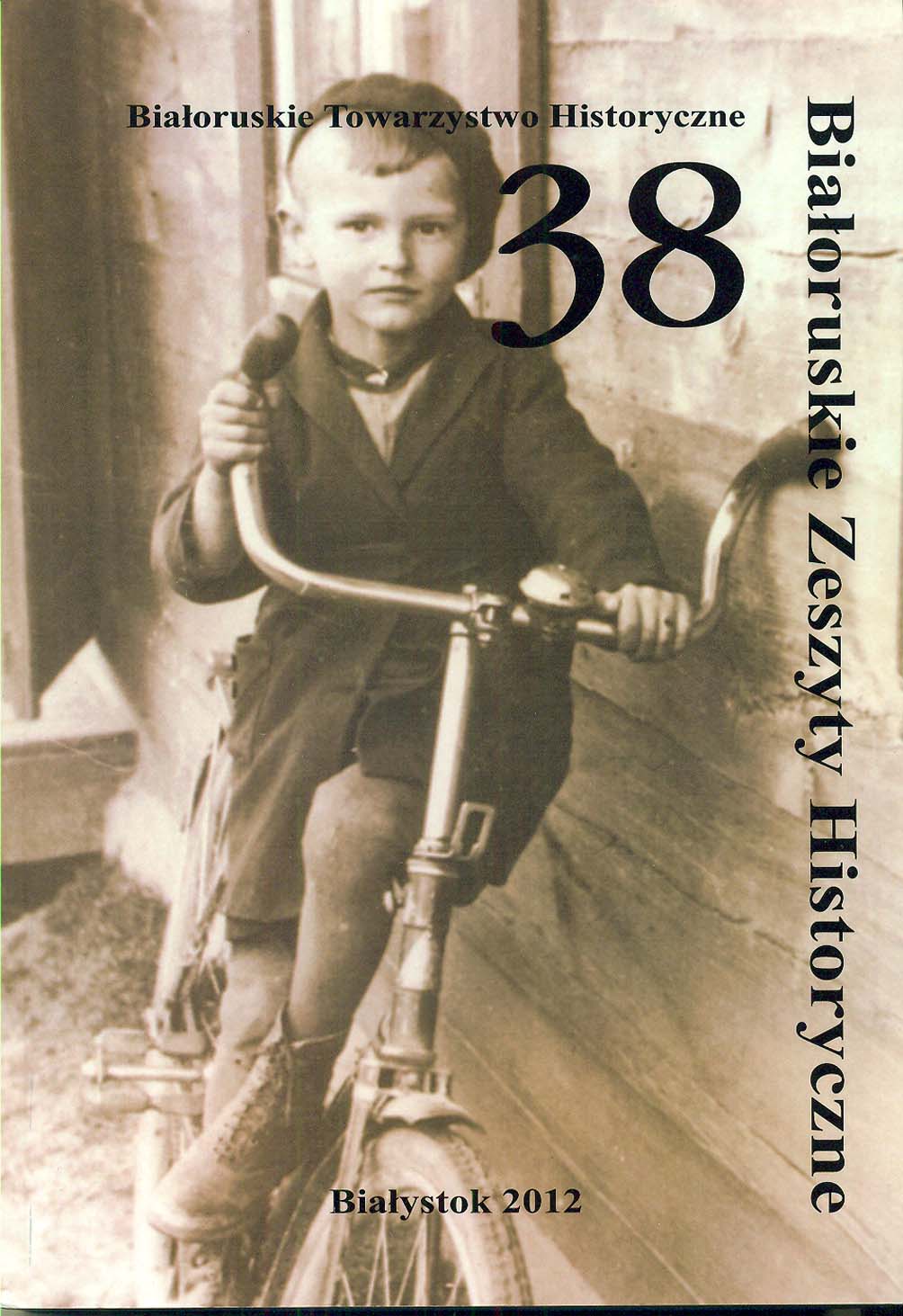
Białoruskie Zeszyty Historyczne. No. 38. ‒ 2012. Białystok, 2012.
Review prepared by Andrei Vashkevich.
The latest issue of the journal, published by the Belarusian Historical Society, is devoted to traditional research areas that interest scholars of the Belarusian-Polish borderland and, more broadly, the whole history of Belarus. These include genealogical research, articles on ethno-confessional issues, and studies of the history of the Belarusian national liberation movement. It should be noted that the journal continues to be an important discussion platform where historians of very different views, as well as literary scholars and philologists, can have their say.
The issue opens with a large, almost forty-page article by the Hrodna researcher Natallia Slizh on the family of the treasurer of the Grand Duchy of Lithuania, Ivan Hornastai. The article is a kind of documentary chronicle of one of the influential families of the Grand Duchy, written on the basis of little-known documents preserved in the Potocki archive in Warsaw. N. Slizh not only describes in detail Ivan Hornastai’s influence on the ordering of the state’s finances, but also characterizes in detail the complex of documents from the Hornastai archive. Particularly interesting family documents are published by the author. Among other documents, attention is drawn to the unique programme for his own funeral composed by Ivan Hornastai himself, as well as the calculation of funeral expenses.
The well-known Białystok researcher of magnate families of the Grand Duchy of Lithuania, Marzena Liedke, devotes her article to the demographic indicators of the Ogiński family in the seventeenth and eighteenth centuries. After analysing data on marriages, births, and deaths among members of this famous family, the author concludes that Ogiński men lived on average about 58 years, considerably longer than other magnates of the Grand Duchy.
Articles by Piotr Chomik and Antoni Mironowicz are devoted to the religious life of Belarus in the sixteenth and seventeenth centuries. P. Chomik studies the history of the Ascension Monastery in Minsk, while Antoni Mironowicz examines in detail the educational and charitable activity of the Mahiliou Brotherhood. The publications of the Mahiliou brotherhood printing house enjoyed great popularity and deserved authority in the Orthodox world, and its charitable work was highly diverse.
Vital Harmatny, a researcher of Belarusian agrarian history, published a study on land consolidation in the Western Belarusian lands in 1921–1939. The author emphasizes that eliminating strip farming was a matter of principle for the interwar Polish authorities. Strip farming was a clear feudal remnant; it hindered normal agricultural development, while rural poverty created fertile ground for the activities of the Communist Party of Western Belarus. For this reason Western Belarusian communists often opposed consolidation. The author concludes that peasants generally supported the idea of creating individual farmsteads, although moving to such a farm did not always unambiguously mean greater prosperity for the owner.
In the article “The German ‘Europeanization’ of Belarus (1941–1944)”, Eugeniusz Mironowicz develops the topic of German-Belarusian relations during the Second World War, raised by him in the previous issue of the journal. As the author stresses, the occupiers’ main task was to supply the front and ensure security in the frontline zone; to do this it was necessary to “pacify” the local population. This could be achieved either through propaganda and by tempting Belarusians with the prospect of their own statehood, or by force, through brutal pacifications. “Since the destruction of the population of Belarus was part of the long-term plans of the Third Reich authorities, police and military actions prevailed in current policy in the occupied country,” concludes E. Mironowicz.
Urszula Gołubowska, using rich factual material, shows the evolution of the national identity of the Orthodox population of contemporary Poland, mainly the Białystok region. The author states that the position of the autocephalous Orthodox Church in Poland does not help preserve the Belarusian language and, accordingly, strengthen the national identity of the Belarusian population. Białystok Belarusians are rapidly evolving from the categories of “Orthodox” or “Russians” toward “Orthodox Poles”, while the Belarusian language remains mainly in family communication. Young people perceive it only as the “language of the grandfathers”.
Studies by Jarosław Dumanowski from Toruń and Mariola Jarczykowa from Katowice are devoted to the original topic of the culinary traditions of the Polish-Lithuanian Commonwealth and their connections with belles lettres.
In the interesting essay “Fires in Polesian Villages”, historian Anatol Trafimchyk describes what a tragedy the element of fire was for the inhabitants of Western Belarus. The author analyses not only the material but also the social aspect of fires, when arson against someone else’s property could be a means of ordinary revenge, social protest, and political struggle. Both oral-historical and archival materials are richly represented in the article.
The sources section publishes the memoirs of Eugeniusz Iwaniec about Mieračoŭščyna and Kosava in the interwar years, and statistical materials of the Polish Autocephalous Orthodox Church for 1966 prepared by Witold Bobryk.
Among the reviews printed in the issue, the polemical response by historian Siarhei Yorsh to Yury Hrybouski’s book “Pogoń between the White Eagle, the Swastika and the Red Star. The Belarusian Independence Movement in 1939–1956” (Grzybowski, 2011), published in Polish in Warsaw in 2011, attracts the most attention. This review continues an old polemic that flared up between the authors after the publication in Lviv in 2006 of the book “Belarusian Resistance” by Siarhei Yorsh and Siarzhuk Horbik (Yorsh, Horbik, 2006), and is perhaps the most interesting polemical material in the issue. S. Yorsh emphasizes numerous mistakes in the surnames and names of Belarusian figures present in Yu. Hrybouski’s book, and also draws attention to several other factual inaccuracies.
The existence of these mistakes, as well as certain contradictions in Yu. Hrybouski’s statements, for example regarding Father V. Hadleuski’s views on cooperation with the Germans, is obvious. Yet it seems that they may be forgiven to a conscientious author who has worked through thousands of pages of archival material. S. Yorsh, however, gives his review the character of an exposé, which is not appropriate when writing a response to a scholarly publication. In any case, the polemic reflected in this review once again proves that truth is born in disputes and that both the author of the book and the reviewer should be more careful in assessing both Belarusian heroes of the past and our contemporaries.
Literature mentioned in the review
1. Jerzy Grzybowski (2011). Pogoń między Orłem Białym, Swastyką i Gwiazdą Czerwoną. Białoruski rucj niepodleglościowa w latach 1939-1956. Warszawa: Bel Studio.
2. Siarhei Yorsh, Siarzhuk Horbik (2006). Belarusian Resistance. Lviv.