
Publications · 17 November 2014
A Collection of Articles as an Indicator of the Quality of an Academic Community’s Work: A Positive Example
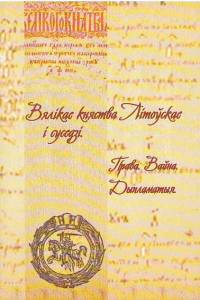 The Grand Duchy of Lithuania and Its Neighbours: Law. War. Diplomacy (2012). Edited by S. F. Sokal and A. M. Yanushkevich. Minsk: BIP – Institute of Legal Studies, 370 pp., 8 leaves of illustrations.
Review prepared by historian Aliaksandr Kazakou
This collection of scholarly works, devoted to various aspects of the history of the Grand Duchy of Lithuania and its relations with neighbouring states, emerged as the result of two academic conferences. They were organised by BIP – the Institute of Legal Studies – and the Polish Institute in Minsk. Their main initiator was Andrei Yanushkevich, well known in academic circles as a capable organiser of high-level events of this kind. The conferences he organises are always distinguished by the participation of major specialists both from Belarus and abroad, and, accordingly, by the high quality of the papers presented.
The first of the two conferences, “Legal Practice in the Grand Duchy of Lithuania”, took place on 13-14 October 2010 and focused on issues of law-enforcement practice. The second, held on 14-15 September 2011, was timed to the 450th anniversary of the transfer of the lands of the Livonian Order under the joint rule of the Grand Duchy of Lithuania and Poland. It was entitled “The Baltic Triangle”, a title meant to symbolise the three main participants in the struggle in the Baltic region in the second half of the sixteenth and seventeenth centuries: the Polish-Lithuanian Commonwealth, Sweden and Muscovy.
On the basis of their conference presentations, the participants prepared not abstracts but full articles. There was no limit on the length of publications, so many authors submitted substantial studies. Seventeen texts were included in 370 pages. They were divided into three blocks under the headings “Law”, “War” and “Diplomacy”.
The section on legal history opens with a text by Andrzej Zakrzewski, professor at the University of Warsaw, in which the author surveys the relationship between legal theory and legal practice in the Grand Duchy of Lithuania in the sixteenth to eighteenth centuries. Another well-known Polish historian, Professor Andrzej Rachuba, contributed an article on the functioning of law in the conditions of the armed struggle between the republicans and the Sapiehas and their allies in the late seventeenth and early eighteenth centuries. Andrei Matsuk examines in detail a rare case in the legal practice of the Grand Duchy of Lithuania: the execution of a nobleman, using the example of Mikhail Valadkovich in 1760. Valiantsin Holubeu characterises the role of the rural community in village legal proceedings in Belarus in the sixteenth to eighteenth centuries.
Natallia Slizh turns to the legal aspect of dowry and dowry-record practices in the Grand Duchy of Lithuania. Aliaksei Shalanda’s study is devoted to the functioning and composition of the Grodno castle court during the time of Stephen Báthory. It is worth noting that the last two articles are especially substantial in length. The legal section also includes a text by the Ukrainian researcher Andrii Blanutsa on the economic policy of confrontation between Lithuanian and Muscovite rulers on the “borderland” frontier in the late fifteenth and first third of the sixteenth century.
The military block consists of six articles. The first, by the St Petersburg researcher Aleksei Lobin, is devoted to new documents from the former archive of the Teutonic Order concerning the campaign of 1514 and the Battle of Orsha. The Polish military historian Przemysław Gawron examines in detail disputes within the command of the Lithuanian-Polish army in Livonia in 1600-1602. Dzmitry Vitsko addresses the issue of mustering the levée en masse of the Grand Duchy of Lithuania in 1702, during the conflict between the republicans and the Sapiehas.
The remaining three articles concern the Northern War of 1700-1721. Mikola Volkau characterises the role of Nesvizh Castle as a defensive point during this conflict. The work of Igor Gostev, a researcher from Arkhangelsk, is devoted to the strengthening of Russia’s northern borders and the victory of the Russian fleet near Arkhangelsk in 1701. Mariusz Sawicki from Poland assesses the diary of Karol Stanisław Radziwiłł as a source on the history of military events in 1700-1713 in the Grand Duchy of Lithuania.
Among the authors of the “Diplomacy” section we again find Aliaksei Shalanda, with an article on the ideological justification of the rights of the Grand Duchy of Lithuania to Livonia in the sixteenth century. Kyrylo Karliuk’s study is devoted to the visual practice of legitimising royal power through the equestrian portrait in the dynastic conflict of the Vasas in the first half of the seventeenth century. Robert Kołodziej of Wrocław turns to the process of ratifying the “Eternal Peace” of 1686 between the Commonwealth and Russia, while Urszula Kosińska of Warsaw analyses certain aspects of Saxon-Polish-Russian relations in the 1720s, using as her main source the report of the Saxon ambassador in St Petersburg, Jean Le Fort.
The approach to producing “post-conference” publications in which authors submit articles for publication rather than abstracts or “conference materials” has once again proved justified. The result is a collection of scholarly works that deserves the attention of specialists in the legal, military and political history of the Grand Duchy of Lithuania. The only shortcoming is that not all participants prepared publications based on their papers, so the reader cannot form a complete picture of the conference. However, the solid group of authors and the quality of the works make the collection needed. We can be sure that it will not suffer the fate of a “mass grave of articles”, as, unfortunately, so often happens with publications of this kind in Belarusian scholarship.