
Publications · 16 January 2015
Toponymy and the History of the City
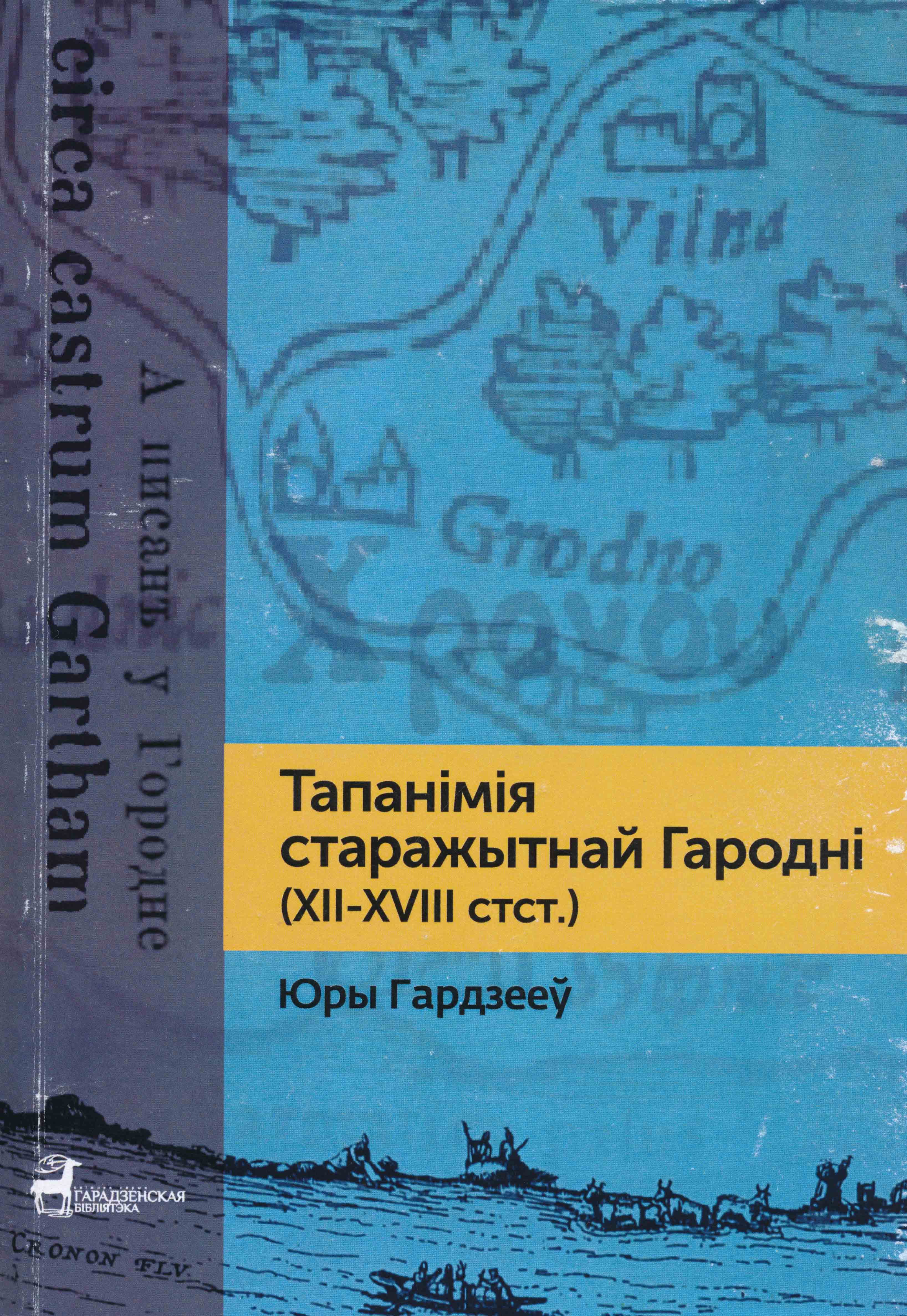 Hardziejeu, Yury (2013). The Toponymy of Ancient Hrodna (12th–18th Centuries). Hrodna: Haradzienskaja Biblijateka, 190 pp.
Review prepared by Andrei Vashkevich.
“Horadnia or Harodnia?” is a famous and much-debated question, one in which more than one generation of Belarusian philologists and writers has taken part. The situation is unique in its own way, since both names claim a monopoly position in the revivalist toponymicon of the 1990s, unlike, for example, Miensk, which claims to replace the Russified-Polonized Minsk. Historians, for the most part, deliberately do not take part in this debate, rightly regarding it as largely abstract; yet when it comes to the history of urban names, they do have something to say.
The book “The Toponymy of Ancient Hrodna (12th–18th Centuries)” is, to a certain extent, a “by-product” of Yury Hardziejeu’s work as a researcher of Hrodna’s social topography. Yet this is precisely what gives the book its special flavour: it was written not by a professional philologist, but first and foremost by a historian who encounters urban names in documents and can reconstruct the chronology of the use and evolution of a given toponym. In this sense, the work continues a trend, clearly visible in recent years, toward the study of names by professional historians (Bely, 2000; Rogalev, 2011).
The book consists of five chapters. The first discusses the origin of the proper name of the city on the Nioman. The author offers a broad overview of possible versions of the name’s origin, but the most valuable part of the chapter is his study of the evolution of the name Goroden–Gorodno. Y. Hardziejeu concludes that the original chronicle name of the city was Goroden, to which the name Gorodno was nevertheless added very quickly. The toponym Goroden still appears even in documents from the first half of the seventeenth century. The modern form Grodno–Hrodna is first encountered not in Polish or Russian sources, but in Latin-language documents of the fourteenth century.
The second chapter is devoted to the origin and history of the hydronym Nioman. This hydronym cannot be counted entirely among urban toponyms, but it is simply impossible to imagine Hrodna without the Nioman, especially since the name of this river links us very closely to the European Latin tradition. One need only recall the famous engraving by Adelhauser and Zündt, where alongside the entirely modern name of the city, Grodno, the ancient name of the river, Cronon, is also given.
The third chapter is a very thorough examination of the history of Hrodna’s hodonyms (street names) and agoronyms (squares and markets). In the fourth chapter, the author broadens the mosaic of his study of Hrodna toponymy to include the names of churches and monasteries, city boundaries, plots or allotments of land, and other toponyms. In a situation of the almost total dominance of Soviet toponymy in the historic centre, and of a largely transformed urban space (after the last war, not only old street names disappeared, but physically the streets themselves as well), reading these chapters makes it clear how necessary the return of historical names is for the revival of forgotten meanings in the space of the historic centre. Here the issue is not only old street names, but also the names of urban localities: the Perasouka ditch, the Kanapielka tract, Kurhan, whose revival may take place not only through decisions of the city administration, but also through the efforts of Hrodna residents themselves, by opening shops, cafés, and galleries bearing such names in these places.
In the fifth chapter, as the author himself puts it, “an attempt is made to illuminate certain linguistic and value-related aspects of the evolution of the urbanonymicon” (p. 9). Here Y. Hardziejeu notes some features of the evolution of urban toponymy that are common to all Belarusian cities, as well as some specific to Hrodna. For example, street names tended toward a certain spontaneous systematization: choronyms (Padol) or urbanonyms (Kurhan) gradually became street names (Padolnaja or Kurhannaja). The first deliberate ideological interventions into urban space took place after the uprising of 1863, when the city authorities first eliminated streets bearing the names of Catholic monasteries and, at the beginning of the twentieth century, began to assign ideologized names (Suvorovskaya, Muravyovskaya, and others). We continue to exist in this space, saturated with Soviet and imperial ideology, even today.
The scholarly character of the book is both its strength and its weakness. We have already discussed the strong side; the weak side is the enormous number of scholarly terms, not only in the text but also in the titles of subsections, which will clearly frighten away some readers. Let us cite only a few examples from chapter five, “The Urbanonym as a Linguistic Unit and a Historical-Cultural Monument”: “Transonymization,” “The Axiological Dimension of the Urbanonymicon,” “The Binary Opposition of Urbanonyms”… In short, at times one gets the impression that one is reading not a book about urban names, but a textbook. Readers are, it is true, offered a glossary of special terms, but it is far from complete.
It would clearly have been possible to find some alternative, more popular formulations for these titles, and the already mentioned book by Ales Bely is a very good example of this. Adding a little accessibility to complex historical explanations is always a worthwhile task. In 2007, when the title of the very first book in the “Haradzienskaja Biblijateka” series was being discussed, many people had to persuade Yury Hardziejeu that the title of his excellent book should be shortened on the cover to “Magdeburg Hrodna.” As for the book under review, one can only hope that Hrodna’s creative figures, such as Ihar Kuzminich, already quite well known for his Belarusian audio fairy tales, will use Hardziejeu’s book as material for their own artistic works.
Incidentally, soon after its publication, Yury Hardziejeu’s book received an excellent continuation: he himself edited the second issue of the “Haradzienski Hadavik,” almost entirely devoted to the history of Hrodna’s toponymy (Haradzienski Hadavik, 2013). The most interesting articles in the yearbook are devoted to attempts to revive the urban toponymy that was almost completely destroyed in the times of the Russian Empire and especially the USSR, when only Zamkavaja, Mastavaja, and Padolnaja remained of the dozens of historical street names of old Hrodna.
In the early 1990s, Hrodna activists, among them Yury Hardziejeu, managed, through an incredible struggle with the nomenklatura, to return several historical street names to the city. Thus, for example, Engels, Kashavoy, Krupskaya, and Passionarija (!) streets disappeared from the map of Hrodna, giving way to Haradnichanskaja, Vialikaja Trajeckaja, Stefan Batory, and Kaliuchynskaja. But this was literally a drop in the ocean, since already at the end of the “revival” era, representatives of the old nomenklatura, having regained their strength, still did not allow Sacyjalistychnaja Street to be renamed Vitaut the Great Street, nor Urycki Street to regain its historical name Zalatarskaja.
Since then, the city has changed mayors about a dozen times, but the principle of not renaming streets, introduced in the mid-1990s supposedly because of financial and administrative difficulties, is observed almost sacredly. And the streets and lanes of the Middle Ages, all these Zalatarskija, Reznickija, Kurhannija, Bryhickija, Banifraterskija, Padvalnija, and Rabiajouskija, are still waiting for their time. As for the essential, main question asked by readers — “Horadnia or Harodnia?” — Yury Hardziejeu was never able to give an unequivocal answer, remaining here as well a true scholar. “Earlier the stress was not indicated, and therefore now it is extremely difficult, indeed impossible, to understand how it was originally pronounced: Horodzen, Horodna, Haradno, or Harodnia,” the author of “Toponymy…” explained at the presentation of his book.
Literature mentioned in the review
- Bely, Ales (2000). Chronicle of White Rus’. Miensk.
- Rogalev, A. F. (2011). Names of the Fatherland (Toponymy of Belarus). 2nd ed. Homiel: Bark.
- Haradzienski Hadavik (2013). II. Hrodna, 144 pp.