
Publications · 31 March 2015
A Long-Awaited and Timely Book
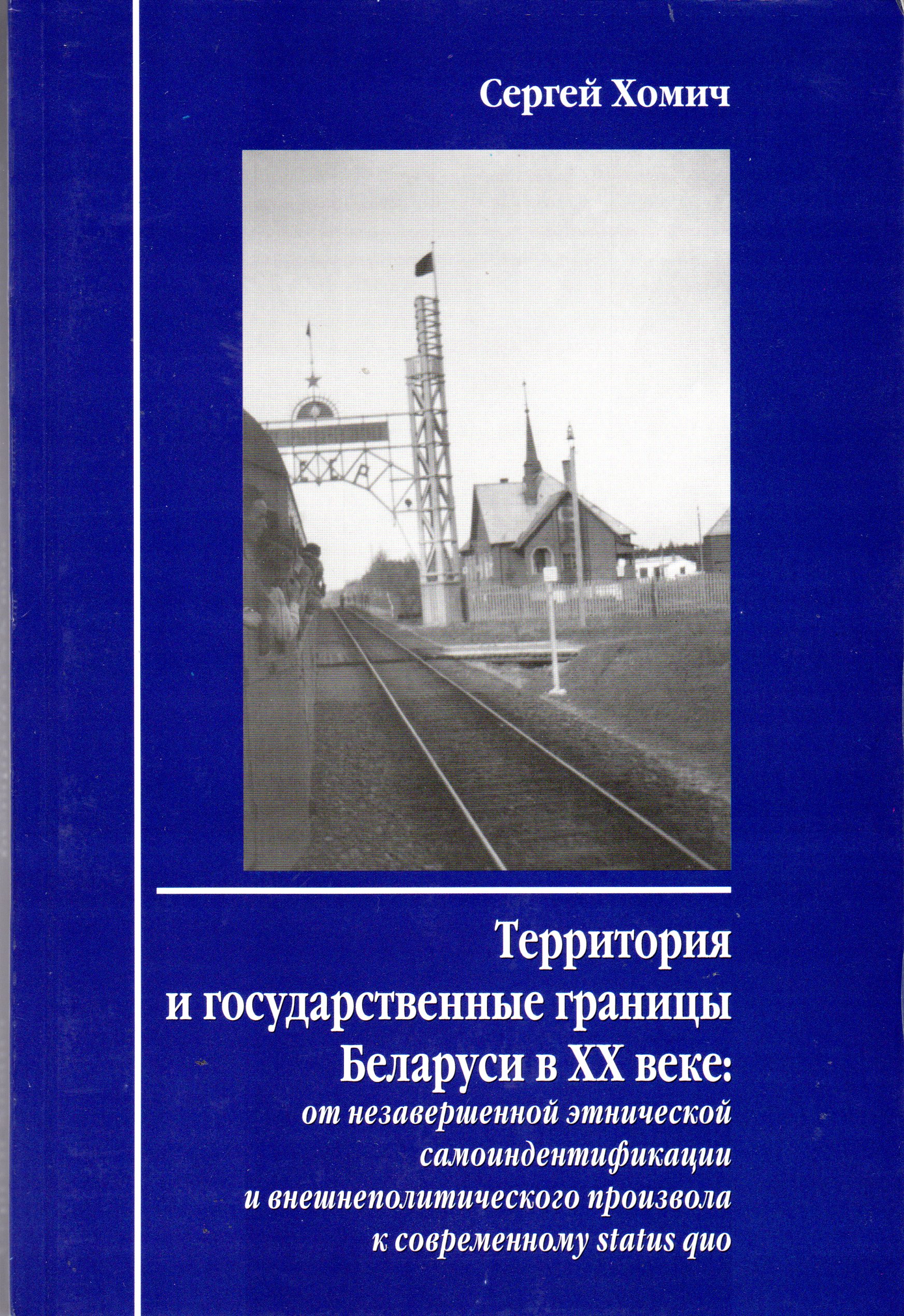 Khomich, Sergei (2011). Territory and State Borders of Belarus in the Twentieth Century: From Unfinished Ethnic Self-Identification and Foreign-Policy Arbitrariness to the Contemporary Status Quo. Minsk: “Ekonompress”, 416 pp.
Review prepared by Aliaksandr Paharely.
Many publications have been devoted to the topic of Belarusian state borders, but before the appearance of Sergei Khomich’s book there had been no synthetic works that covered a substantial range of problems related to the issues of Belarus’s borders and territory. The book may be called long-awaited, since after two decades of independence the need had matured for an understanding of the nature of state borders and of the regularities of the processes that led to their changes. Belarusian readers have finally received a publication that analyzes the vicissitudes of the formation of Belarus’s state territory not only throughout the twentieth century, but also examines the origins of these problems in the late nineteenth and early twentieth centuries, during the formation of the Belarusian national movement.
The Belarusian historian has in fact brought to a logical conclusion his many years of research into the problems of Belarus’s borders and territory in the twentieth century. His earlier publications had already been important stages in the study of this topical field (Khomich, 2000; Khomich, 2007).
The monograph consists of seven chapters, of which the fourth is the largest. It is devoted to the expansion of the territory of the BSSR in the interwar period. It is written on the basis of a large quantity of new materials. S. Khomich used a significant body of documents from archives in Russia, Lithuania, and Belarus which, before him, had either been introduced into scholarly circulation in Belarusian studies of the issue only to a minor extent or had not been used at all (pp. 17-18).
The researcher points to the gradual evolution of Soviet international-legal concepts and definitions of state territory and borders (p. 5). He shows that over time these definitions moved closer to those used outside the USSR, once the latter accepted the rules of existence in the postwar international system through treaties and participation in international organizations.
The book notes the non-coincidence of ethnic and political borders despite the similarity of these concepts. They are not, however, identical, and in the case of Belarus this is quite clearly apparent (pp. 6, 26). Khomich formulates Belarus’s national interests in the process of the formation of its territory and borders in the first half of the twentieth century as the aspiration for as many territories inhabited by ethnic Belarusians as possible to find themselves within the borders of the Belarusian state. He does this with an important reservation concerning economic and social factors. Nevertheless, the role of ethnography and ethnographic knowledge in defining borders and national interests is clearly present in the researcher’s monograph (Hirsch, 2005: 149-155).
On the one hand, throughout the book Khomich seeks to construct a narrative that would simultaneously emphasize the negative aspects of the Soviet system and policy regarding Belarus’s borders and territory, while also not ignoring the fact that it was precisely the Soviet period and the creation of the Soviet model of statehood that served as the main factors in the formation of Belarus’s territory and borders in the twentieth century. The latter nevertheless stands outside unequivocal assessments of the character of the political regimes that existed in Belarus during the past century, and still more outside any moral judgments about their role and place, on the other. Such an approach may be called pragmatic.
One can agree with the author when he writes that Belarusian national interests were not a priority for the leadership of the USSR. They could be sacrificed for the sake of solving particular foreign-policy tasks. In general, Moscow could act as if “the BSSR did not exist” (pp. 302-303).
It is worth pausing briefly on the problem of the articulation of interests and the question of agency when discussing the territory and borders of the Soviet Belarusian state. In our view, one cannot speak here of the role of local politics, the interests of the Belarusian population, or the significance of what might be called local “party elites” or certain regional groups within such elites (Sahlins, 1989). Belarus’s borders and territory in the twentieth century, and changes in them, were linked to changes within the Soviet project and were to a lesser extent conditioned by compromise with local circumstances.
All the more so because the Soviet period was characterized by a view of external borders as isolating lines that excluded any contacts by Soviet citizens not sanctioned by party-state structures with relatives or other persons and organizations outside the USSR, even in the countries of “people’s democracy.” In the Soviet case, as existing studies also show, a clear connection can be traced between the regime’s politics and ideology, the character of borders, and attitudes toward them (Chandler, 1998: 3-41).
Sergei Khomich provides many quite convincing examples of what happened when Belarusian national interests coincided with Moscow’s calculations, with the calculations of the Soviet leadership, and when they did not. It was precisely additional territory, in the eyes of the Bolsheviks, that could give Soviet Belarus the possibility of being considered a full-fledged state that could be used in Moscow’s interests as an additional trump card, as happened, for example, during negotiations with Poland. The head of the Soviet delegation at these negotiations in Minsk and Riga, Adolf Joffe, asserted that if the BSSR were returned Homel and Mahileu, which had been annexed by Russia in 1919, then “[from Belarus] something more resembling a state would result” (Borzęcki, 2008: 186).
One should agree with the author that the NEP played no role in the return of the eastern Belarusian territories. The main role belonged to Soviet nationalities policy (pp. 213-214). Following Terry Martin, Khomich distinguishes the “soft” and “hard” lines of the Soviet leadership in the national question (pp. 216-217). The author analyzes in detail and with care the competitive struggle of various influence groups around the eastern Belarusian territories. The ability to use the Soviet discourses of political programs and campaigns helped party-political elites enter struggles over resources and positions, the results of which were always far from predetermined (Hirsch, 2005).
The period of the 1920s may be considered an exception to the situation in which the local party-political elite could articulate and implement Belarusian national interests in relation to the territorial question, which distinguished this period from the later one.
Foreign-policy calculation and propaganda effect were motivating factors in the return to the Soviet Belarusian state of territories that only a few years earlier had been annexed into Russia. Without the use of such arguments it would have been more difficult for the Belarusian Bolsheviks to prove the necessity of territorial changes in favor of the BSSR (pp. 250-254, 256).
Alongside the term “return” in relation to the territories that became part of the BSSR, Khomich also uses such terms as “expansion” and “inclusion,” “resolution of the territorial question,” which gives the narrative a more emphatically neutral character. At the same time, Khomich states that after the inclusion of territories into the BSSR in the second half of the 1920s, the leadership of the BSSR did not consider the territorial question exhausted (p. 282). The inconsistency of the Bolshevik leadership in this matter undermined Soviet influence among Belarusians beyond the borders of the USSR.
The episode involving the transfer to Sovietized Lithuania of districts where the Lithuanian population lived compactly, as well as Druskininkai, shows that Moscow continued to be guided exclusively by the demands of propaganda and by the demonstration that decisions in the USSR on such important questions as the borders of the union republics and the transfer of territories from one such republic to another were supposedly carried out by consensus and compromise. In reality, however, the transfer of these territories from the BSSR to the Lithuanian SSR was carried out on the formal “proposal” of the BSSR leadership, which itself had been appointed according to Moscow’s assignment. These people could be transferred by order from Moscow to another place of work (pp. 323, 318-319).
External Soviet borders differed in their meaning and status from borders between Soviet republics. Attitudes toward these two different types of borders were different (p. 346). The Soviet leadership viewed the borders between union republics as conditional phenomena (p. 325). But even taking this into account, the borders with the countries of the so-called “socialist camp” were still regarded as strategically important, as elements of isolation from the countries of the West.
The topic of complicated relations with Poland and the problem of the border with it in general occupies, naturally, a significant place in the monograph. The author, for example, points to delays by the Polish side in the definition and demarcation of the Belarusian sector of the Polish-Soviet border (pp. 185-188). It should be noted that in contemporary Western literature this issue is still not treated with the necessary degree of criticism (Borzęcki, 2008: 246-249).
Relations with Poland remained complicated even after the latter’s Sovietization. When in 1949, 1950, and 1955 Belarusian territories were transferred to the Polish People’s Republic, within the framework of what was officially called a “border correction” (pp. 334-336, 339), the leadership of the BSSR could only record the requests of the population in the process of preparing and carrying out the “corrections” and the facts of territorial reduction. There was no political-legal mechanism for interaction between central and republican authorities regarding changes to the borders of the republics (pp. 335-336).
The postwar period also saw the completion of the formation of the territory of contemporary Belarus, when a number of villages from the Smolensk region of the RSFSR were transferred to the BSSR in 1964. The leitmotif of this transfer act was Khrushchev’s concept of the rapid advent of communism and the merging of all nationalities into a single Soviet people (pp. 352-353). The process of territorial construction in the USSR was considered complete at that time.
Still, the legal aspect of borders in the Soviet period was not entirely unchanging or unregulated. Soviet legislation, including the 1982 law on the border, recognized that international treaties together with decisions of the highest Soviet authorities determined border issues. The signing of the Helsinki Final Act on 1 August 1975 meant recognition of the inviolability of borders in postwar Europe. This important international-legal document contributed to the establishment of the state borders of all post-Soviet republics (p. 354). In this way, according to the author, the inviolability and stability of borders in the post-Soviet world was achieved.
However, the inviolability of borders could be called into question in the final years of the USSR. Territory could be treated as a kind of political “Trojan horse.” One representative of the Soviet party-political elite of the BSSR, the First Secretary of the Hrodna Regional Committee of the CPB, Uladzimir Siamionau, put forward in March 1990 a demand that Lithuania return Belarusian territories that had become part of the country in 1939-40 in the event of its withdrawal from the USSR (pp. 358-362).
Siamionau acted not on his own initiative and not from the standpoint of Belarus’s national interests, but precisely from that of the “Moscow center” (Jowitt, 1987). For the “center” was embodied not only by Gorbachev. At that moment there existed other, far more conservative groups, on whose field this representative of the no less conservative party-political elite of the BSSR was playing.
All these examples, the introduction of new factual material, and the analysis of important problems in the formation of state borders and territory testify in favor of the fact that the Belarusian historian’s book is a high-level study, even despite some minor errors in geographical names and dates. The latter should probably not be attributed to the author.
The significance of Sergei Khomich’s monograph is difficult to overestimate. This book is critically important for understanding the processes and regularities of the emergence of contemporary Belarusian statehood, its territorial contours and borders. Familiarity with this work is obligatory for those who seriously study the history and politics of Belarus in the past century.
Literature mentioned in the review
- Khomich, Siarhei (2000). “The Main Stages in the Formation of the Territory of the BSSR (1918-1926)”, Belarusian Historical Review, Vol. 7, Issue 2 (13): 351-364.
- Khomich, Siarhei (2007). “The Formation of the Belarusian-Russian Border in the Twentieth Century”, 61-72, in Elżbieta Smółkowa (ed.). Pogranicza Bialorusi w perspektywie interdyscyplinarnej. Warszawa: DiG.
- Borzęcki, Jerzy (2008). The Soviet-Polish Peace of 1921 and the Creation of Interwar Europe. New Haven and London: Yale University Press.
- Chandler, Andrea (1998). Institutions of Isolation. Border Controls in the Soviet Union and Its Successor States, 1917-1993. Montreal & Kingston-London-Buffalo: McGill-Queen’s University Press.
- Hirsch, Francine (2005). Empire of Nations. Ethnographic Knowledge & the Making of the Soviet Union. Ithaca and London: Cornell University Press.
- Jowitt, Ken (1987). “Moscow ‘Centre’”, East European Politics and Societies, Vol. I, № 3: 296-348.
- Sahlins, Peter (1989). Boundaries: The Making of France and Spain in the Pyrenees. Berkeley-Los Angeles-London: University of California Press.