
Publications · 18 June 2015
Catholic Clergy: A Path toward Belarus
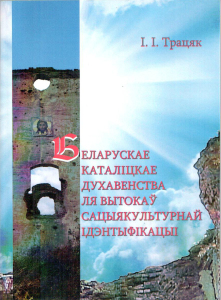 Tratsiak, I. I. (2013). Belarusian Catholic Clergy at the Origins of Sociocultural Identification. Hrodna: Hrodna State University, 267 pp.
The review was prepared by Father Andrei Krot
The monograph by Ivan Ivanavich Tratsiak, Candidate of Cultural Studies and Associate Professor at Yanka Kupala Hrodna State University, Belarusian Catholic Clergy at the Origins of Sociocultural Identification, was published by the university press in 2013. In the introduction to the monograph, the author notes that the changes that have taken place in the political and state life of Belarus since 1991 have allowed religion to occupy a more significant place in public life. According to I. Tratsiak, the growth in popularity of religious institutions and Christian denominations was facilitated by the policy of the government of the Republic of Belarus and by the Law “On Freedom of Conscience and Religious Organizations,” which became a stimulus for the study and interpretation of the history of individual denominations (p. 3).
The scholar notes that, until now, religious and educational processes and the cultural and national activities of the clergy had remained outside the framework of fundamental scholarly research, while such a phenomenon as the Belarusian clergy and the processes of Belarusianization, both in the Catholic and Orthodox Churches, had been entirely ignored. I. I. Tratsiak’s monograph is intended to fill this gap.
The author defines the aim of the study as follows: “To study and interpret the origins of self-knowledge and national identification among the Belarusian Catholic clergy in the sociocultural process during the period of the formation of national ideologies in the modern era” (p. 4). The researcher defines the chronological framework as the nineteenth century and the first quarter of the twentieth century, although he deliberately does not specify it more precisely. He explains the blurred boundaries by noting that all sociocultural processes are the result of preceding ones, and that it is impossible to understand them in isolation from one another.
In I. Tratsiak’s view, the definition “Belarusian” in relation to the concept of “Catholic clergy” requires the greatest clarification and explanation. The author notes that the clergy in Belarus, both Orthodox and Catholic, often acted as a conduit for national interests alien to Belarusians: the Orthodox clergy spread Russian culture among its faithful, while the Catholic clergy spread Polish culture. In our view, this assertion contradicts the teaching of the Church, since both Catholicism and Orthodoxy should have a supranational character. Thus, in theoretical terms, it is impossible to speak of Belarusian Catholicism.
However, the author agrees with the well-known figure of the Belarusian national revival of the first half of the twentieth century, Father Adam Stankevich, who recalled that in every nation Catholicism, while remaining one in essence, assumes its own distinctive form. With regard to the Belarusian Catholic clergy, the scholar observes: “It constituted an organized confessional hierarchical structure with a broad network of religious and cultural-national activity headed by its own bishop, or by a bishop who was sympathetic to the needs of the Belarusian clergy and people” (p. 14).
The monograph consists of four chapters. The first chapter is devoted to the historiography and sources of the study. In analyzing the historiography of the issue, I. Tratsiak divides it according to the milieus in which the works were written and according to chronology. He distinguishes Soviet historiography, Belarusian historiography before the Second World War, Belarusian émigré historiography, Polish historiography, and contemporary Belarusian historiography. The author analyzes the works of the most important authors: Father A. Stankevich, Uladzimir Konan, Ales Smalianchuk, and Yuri Turonak. The scholar divides the sources of the study into three groups: archival materials, memoir literature, and periodicals.
The second chapter of the monograph is entitled “Religious and Confessional Factors in the Formation of National Cultures.” The author reflects on the influence of Christianity on the formation of national cultures. He convincingly demonstrates that Christianity not only does not contradict a people’s national consciousness, but, on the contrary, contributes to its development. To substantiate this thesis, the author cites the Bible, the Old and New Testaments, and the teachings of church figures, theologians, and religious philosophers. “It is true that it is not easy to speak about the development of purely Christian spirituality outside the confessional-political context of the clergy,” the scholar notes. He therefore offers a brief overview of the influence of different denominations on the formation of the national consciousness and culture of individual Slavic peoples.
The author rightly observes that the formation of the cultural and historical consciousness of the Belarusian people was influenced by the polyconfessional factor. In different periods of history, Belarusians came under the influence of Orthodoxy, Catholicism, Protestantism, and Uniatism. I. Tratsiak criticizes those scholars who do not wish to acknowledge this obvious fact and argue that only one of the denominations contributed to the formation of the Belarusian people. Thus, for example, Ivan Charota categorically rejects the contribution of non-Orthodox figures to Belarusian culture. I. Tratsiak considers such an approach to be unobjective. “In general, the criterion of objectivity should be based on the axiological factor of the activity of one denomination or another, above all for the benefit of the religious and spiritual improvement of the people,” the scholar writes (p. 49).
Unfortunately, as the author notes, denominations in Belarus did not always serve the spiritual improvement of the people, but became conduits of the state policy of neighboring states: Catholicism of Poland, and Orthodoxy of Russia. This led to a situation in which Belarusians often belonged to the Church only formally, and to a low level of religiosity among our ancestors.
The author focuses particular attention on the influence of the Catholic Church on the formation of Belarusian culture. He notes the significant influence of the Greek Catholic Church, a modern term that I. Tratsiak uses for the Uniate Church, on the formation of the Belarusian nation, and to support this thesis he cites a whole series of testimonies from historical sources and statements by historians. Jesuits and monks of other Catholic orders, who used the language of the common people in their missionary and educational work, made an important contribution to the formation of the Belarusian ethnos.
The author of the monograph recalls that many writers who stood at the origins of the Belarusian revival of the nineteenth century were members of the Catholic Church: Jan Czeczot, Jan Barszczewski, Aliaksandr Rypinski, Frantsishak Bahushevich, Vintsent Dunin-Martsinkevich, and many others. The scholar also notes that the Belarusian revival would have been impossible without Orthodox Belarusians as well.
The next chapter of the work is entitled “The Belarusian Question in the Context of Confessional and National Policy from the Late Nineteenth Century to 1921.” In this chapter, the author examines the specific features of the confessional and national policy of the Russian Empire in Belarus, the Polonizing influence of the Roman Catholic Church on Belarusians, and the influence of the Roman Catholic hierarchy on the Belarusian national movement.
As the author observes, the language policy of tsarism toward the Catholic Church was for a long time regulated by the tsarist decree of 15 June 1848, according to which Catholics were forbidden to conduct services in Russian and were allowed to use only “all foreign languages.” “It is precisely from this time that the church became the only support of Polishness in the Russian Empire,” the scholar writes (p. 89).
The author cites an extremely interesting historical fact: in the 1860s, Russian society saw the beginning of a campaign known as the “separation of Catholicism and Polish nationality,” or the “de-Polonization of Catholicism.” As part of this campaign, in 1905 the Hrodna governor-general appealed to the district marshals of the nobility with a request to provide information on the need to use the Belarusian language in churches instead of Polish (pp. 94-98). In addition, I. Tratsiak describes the attitude of the Catholic clergy toward the educational policy of the Russian authorities, as well as the repressions carried out by the imperial authorities against individual representatives of the Catholic clergy, who were punished without trial even for minor offenses, for example for a sermon not checked by the censor.
Pressure from the Russian authorities pushed the Roman Catholic Church in Belarus toward another extreme: it became a factor in the development of Polish patriotism among Belarusian believers. The author of the monograph observes: “There is no need to look for anything striking in the fact that the aims of the Polish clergy and the secular authorities coincided at a fateful moment for Poland in the restoration of its statehood.”
At the same time, the scholar notes that the excessively active participation of the Church in political life and the blinding of some Catholic priests and hierarchs by the Polish national idea are unacceptable. Fortunately, not all representatives of the higher Catholic hierarchy confined themselves to narrow chauvinistic circles; many of them, as I. Tratsiak writes, “sought to support and assist the Belarusian national revival in general and Belarusian Catholicism in particular” (p. 128). The researcher provides biographies of Catholic bishops who were sympathetic to the Belarusian question: Stefan Danisevich, Edward von Ropp, Frantsishak Karevich, Blessed Jurgis Matulaitis, as well as those whose attitude was ambiguous: Vintsent Kliuchynski, Kazimir Mikhalkevich, and Zygmunt Łoziński.
The final chapter of the work is entitled “Belarusian Catholic Clergy in the Process of Forming Worldview Foundations.” In it, I. Tratsiak reflects on the causes of the emergence of Belarusian consciousness among Catholic clergy educated in the stereotype of the “Pole-Catholic.” In the national self-determination of Belarusian Catholic priests, the scholar identifies four periods. He calls the first the period of self-determination, or the “Shypila period.” An important figure of this period was Professor Branislau Epimakh-Shypila, who had a significant influence on the initiators of the Belarusian Catholic cause: Bishop Stefan Danisevich and Fathers Frantsishak Budzka, Adam Lisouski, and Henryk Beta. The author of the monograph devotes considerable attention to this period, examining in detail the lives of individual priests who were the first to call themselves Belarusians: B. Yarotski, Y. Farbotka, and P. Hrybouski.
The author calls the second period of priests’ self-determination the period of cultural and educational circles, and defines its chronological boundaries as 1909 to 1917. He briefly describes the activities of Belarusian circles that included, or were led by, Belarusian Catholic priests or seminarians: circles in the St. Petersburg and Vilnius seminaries, in the St. Petersburg Roman Catholic Academy, and a circle of Belarusian youth in Hrodna.
I. Tratsiak calls the third period the “organizational period (1917-1921).” In the corresponding subsection, the author briefly describes two congresses of the Belarusian Catholic clergy, in 1917 and 1921, and also provides modest information about the activity of the “organization of Belarusian priests,” which is mentioned by some contemporaries. The author does not mention the fourth period, the period of struggle, or activity under Polish, Soviet, and German occupations.
The scholar devotes the second part of the final chapter to the education and teaching activity of Belarusian Catholic priests, listing Belarusian graduates of Catholic higher educational institutions in the Russian Empire and abroad, as well as Belarusian priests who taught in theological seminaries.
I. Tratsiak’s monograph is an extremely interesting and substantial study. The author presents many interesting historical facts concerning the life of the Catholic Church during the period of the Russian Empire, the formation of Belarusian consciousness among the Catholic clergy, and the repressions of the Russian authorities against the Catholic Church. The researcher does not limit himself merely to listing facts, but attempts to interpret philosophically the processes through which Belarusian Catholics became aware of their national belonging and of the value of Belarusian culture from the standpoint of Christianity. It is true that in his reflections the author sometimes departs from the main line of the monograph. But this is perhaps the only minor shortcoming of a work in which the advantages clearly outweigh the disadvantages.