
Publications · 11 November 2015
A Far from Complete “Liberation”
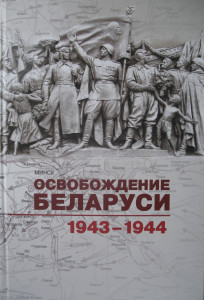 Liberation of Belarus 1943–1944 (2014). Ed. V. V. Abaturov, editorial board I. I. Basik, A. A. Kovalenya (co-chairs) et al. Minsk: Belaruskaya Navuka, 942 pp.
Review prepared by Dzmitry Liutsik.
The reviewed book appeared in 2014, on the 70th anniversary of the liberation of Belarus. The print run was 800 copies. The text was prepared by a team of authors under the direction of Aleksei Litvin and the Institute of History of the National Academy of Sciences of the Republic of Belarus on the Belarusian side, and Valery Abaturov and the Research Institute of Military History of the Military Academy of the General Staff of the Russian Federation on the Russian side.
The appearance of such a substantial work devoted to the military operations of 1943–44 on the territory of Belarus is certainly welcome. The quantity of archival materials is especially impressive: as many as 614 pages are devoted to them. Given the absence in Belarusian historiography of a work of this scale, the publication of Liberation of Belarus 1943–1944 can undoubtedly be regarded as a significant event.
The annotation to this edition notes that the book was prepared jointly by Belarusian and Russian historians and contains a description of the most important events on the territory of Belarus in 1943–44: the crimes of the occupation regime, the forms and methods of underground and partisan struggle, the preparation and conduct of military operations, and the successes and failures of Soviet troops. In addition, the book contains a large number of archival materials from the archives of Belarus and the Russian Federation, many of which are published for the first time. The book is intended to be of interest to veterans of the Great Patriotic War, researchers, teachers, and everyone interested in the history of the war.
After reading the book, however, I felt considerable disappointment. Unfortunately, the team of authors was unable to fulfil, responsibly and at a high level, the task of presenting the military events of 1943–44 objectively and comprehensively. Unfortunately, the authors also failed to free themselves from Soviet approaches and clichés in describing military operations on the territory of Belarus. In addition, one must note the almost complete disregard of documents and literature from the German side, despite the fact that the format and scale of the edition presented to us directly implied their inclusion.
The bibliography was also disappointing. Most of the publications belong to the Soviet period, including books from the 1960s and 1970s. The presence of one source was particularly surprising: I. V. Stalin’s On the Great Patriotic War of the Soviet Union, published in 1953, for which there is simply no need in the text. Why was it included? At the same time, modern works by Russian historians, including rather detailed and objective studies, are virtually absent. Overall, one gets the impression that the authors’ main aim was to publish archival materials, while the history of the liberation of Belarus is present only as an appendix to them.
The book consists of an introduction, four chapters, and six appendices. Unfortunately, there is no information about the author of the introduction to the volume; no author is indicated. Analysing the text, one should note that the aim of the “Introduction” was to give a brief description of the beginning of the Great Patriotic War and the liberation of Belarus in 1943–44. Very briefly, in fewer than five pages, the authors did accomplish this task.
It should be noted at once that the first chapter, “The Situation in the Occupied Territory of Belarus in 1943–1944,” is the only one in the book that uses German sources and literature, and only in the part dealing with the German occupation regime. In describing the underground and partisan struggle, the authors used not a single German source, which is rather strange and difficult to explain. The rest of the first chapter is written on the basis of materials from the National Archives of the Republic of Belarus and Soviet literature.
Most of the information was taken from the book The Nationwide Struggle in Belarus… (Vsenarodnaya borba…, 1983–85). The authors completely ignored the questions of the existence of a collaborationist movement on the territory of Belarus, as well as the participation of detachments of the Polish Home Army in the partisan struggle, and indeed its very presence in Belarus. Only the forced use of labour from among Belarusians in the interests of the German occupation and military authorities is briefly mentioned.
The section “Combat Operations of Soviet Troops on the Territory of Belarus in Autumn 1943 – Spring 1944” describes the operations of the Western and Kalinin Fronts during the period in question. In writing the chapter, the authors used only one German document: the “Combat Journal of the 3rd Panzer Army,” translated into Russian and published long ago, in 1947, in Moscow. The remaining German documents remained inaccessible to the team of historians from the two countries. Of German literature, only the work of Kurt von Tippelskirch was used (Tippelskirch, 1956).
Of modern and interesting works on this topic, the authors used only two articles: by Vladimir Fesenko (Fesenko, 1991) and Makhmud Gareev (Gareev, 1994). In addition, materials from the Central Archive of the Ministry of Defence of the Russian Federation (hereafter TsAMO) were used.
Unfortunately, the authors did not turn to the very substantial work by the Russian historian Aleksei Isaev, Operation Bagration: Stalin’s Blitzkrieg in Belarus (Isaev, 2014), which is devoted to the same events. The detail of Isaev’s analysis and the large number of sources and works he used to compare the Soviet and German sides are impressive. It is a pity that such an approach and such depth of research remain beyond the reach of Belarusian military historiography.
Nevertheless, the edition under review does have its advantages. The operation to capture Nevel is described in considerable detail, although the first attempts by the 3rd Shock Army to take Vitebsk in September–October 1943 are not described at all. The description of military operations contains limited criticism of the Soviet leadership, for example of General Vasily Sokolovsky, commander of the Western Front, and of the orders of the Supreme High Command Headquarters.
A very significant shortcoming is the absence of data on German forces, losses, and armaments, although the size of the chapter would have allowed this to be done. As a result, we perceive the information one-sidedly, without imagining the actions and thinking of the command opposing the Soviet troops.
As in the previous chapter, German sources are absent in the third chapter as well. Of the extensive German literature, only the very general memoirs of Generals Kurt von Tippelskirch and Werner Haupt, translated into Russian, are used. References to TsAMO are given only in limited quantity. A significant portion of the literature belongs to the Soviet period.
The text contains a number of inaccuracies and errors that result from an insufficient study of the subject. The figures given to characterise the forces of Army Group Centre are inaccurate: the numbers of armoured vehicles, aircraft, and so on are overstated. There is no description of the German counterattack by the 5th Panzer Division and the 505th Heavy Tank Battalion to the north-east of Minsk.
Incidentally, the 5th Panzer Division is for some reason called in the text the “5th SS Panzer Division,” which is certainly incorrect. Interestingly, later on (p. 156) it is noted that the 5th SS Panzer Division “Wiking” arrived in Army Group Centre, in the area of Belsk-Podlaski, only in July. This is now the territory of Poland. Nor is there any description of the counterattack by the German 4th Panzer Division in the direction of Babruisk. Nothing is said about the breakthrough from the city by the remnants of the 20th Panzer Division.
The difficulties encountered in the offensive of General Rotmistrov’s Soviet 5th Guards Tank Army were not analysed in any way. Yet during Operation Bagration the Headquarters even initiated an investigation to establish the reasons for the very slow pace of its advance. The list of such comments could be continued further.
One can only regret that the authors do not provide Soviet losses either in aircraft or in armoured vehicles, although these data are contained in TsAMO. This, of course, greatly reduces the value of the study. The reader cannot imagine what the battles in Belarus cost the Soviet Army.
The description of the Białystok front operation, including the liberation of Grodno and Białystok and the fighting in the area of these cities, is based practically on a single work by Yevgeny Eliseev (Eliseev, 1971). This book was undoubtedly very good for its time, but by now it has become significantly outdated. Once again, chapter 3 contains no objective data on German forces and gives neither the personnel strength nor the losses of both sides.
Despite this, it is precisely the description of the fighting of General Boldin’s 50th Army in the Grodno–Białystok area that, at least to some extent, shows us two opposing sides: the Soviet and the German. But the credit for this belongs not to the authors, but to Yevgeny Eliseev, who described the fighting of 1944 in great detail and quite objectively more than forty years ago. Overall, the third chapter is written without serious analysis, superficially, and not entirely accurately. The final short chapter is devoted to the restoration of the republic’s economy immediately after liberation.
The main part of the book consists of appendices made up of archival documents from TsAMO fonds and collections. Some of them are very interesting. One example is the “Report of the State Defence Committee Commission on the Inspection of the Work of the Headquarters of the Western Front” of 11 April 1944, which very critically analyses the reasons for the failures of the Western Front’s offensives in the spring of 1944, beginning with General Sokolovsky himself and the commanders of the various branches of the armed forces.
Unfortunately, documents at divisional level are completely absent. Most of the documents are directives of the Headquarters, resolutions of the State Defence Committee, orders of front commanders, and operational summaries of the General Staff of the Red Army from September 1943 to 29 July 1944. Documents such as operational summaries are very general in character and do not contain descriptions of battles, characteristics of military formations, and so on. Their value is therefore not very great. Moreover, for the period from 13 April to 23 June 1944, the summaries are for some reason absent.
Overall, I would like to note that the book is deeply disappointing. One must state that a thorough and in-depth study of Operation Bagration still awaits its author. For now, one has either to make do with books of this level or to search for information independently.
Literature mentioned in the review
Vsenarodnaya borba v Belorussii protiv nemetsko-fashistskikh zakhvatchikov v gody Velikoi Otechestvennoi voiny (1983–85). In 3 vols. Minsk.
Gareev, M. A. On the failure of Soviet offensive operations in the Great Patriotic War (Novaya i noveishaya istoriya, 1994, no. 1).
Eliseev, E. P. (1971). Na belostokskom napravlenii. Moscow: Nauka.
Isaev, A. (2014). Operation Bagration: Stalin’s Blitzkrieg in Belarus. Moscow: Eksmo.
Tippelskirch, K. von (1956). History of the Second World War. Moscow.
Fesenko, V. I. (1991). The Orsha Front Offensive Operation. Moscow.